
SEO Strategy Guide
Everything you need to know about choosing, using, and maximising the results of the right keyword intelligence platform for your site. For a deeper walkthrough, see our SEO Tips to Start 2025 Off Right.
An advanced keyword research tool is a specialized SEO software platform that goes far beyond basic search volume lookups — it combines competitor gap analysis, search intent classification, semantic clustering, and predictive trend data to give marketers a complete picture of every keyword opportunity available to them. If you have ever published a well-written page only to watch it stagnate on page three, the problem is almost certainly rooted in keyword selection, and that is precisely the problem an advanced keyword research tool is designed to solve. For a deeper walkthrough, see our AEO Services for Local Businesses: The Complete Guide.
Quick Answer
An advanced keyword research tool helps SEO professionals identify high-value search terms by analysing intent, competition, and trend data simultaneously. It prioritises keywords most likely to drive qualified organic traffic, not just raw volume. The best tools integrate competitor intelligence and SERP feature data to surface opportunities a basic tool would miss entirely.

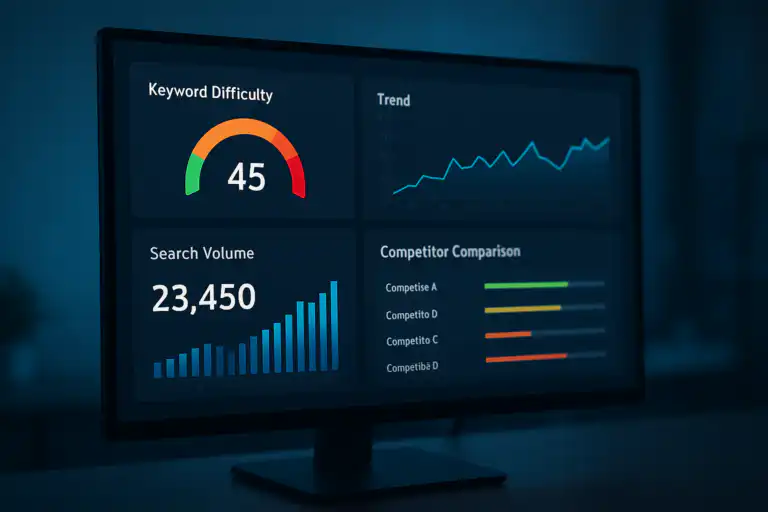
A well-designed advanced keyword research tool surfaces intent signals, difficulty scores, and trend data in a single unified view.
What Is an Advanced Keyword Research Tool?
An advanced keyword research tool is a platform that layers multiple data dimensions on top of the standard search volume metric. Where a basic tool tells you that a keyword receives 5,000 monthly searches, an advanced tool tells you who is searching, why they are searching, which competitors currently own those rankings, how volatile the SERP has been over the past twelve months, and whether a featured snippet or People Also Ask box is likely to intercept the click before it ever reaches an organic result.
According to Wikipedia’s overview of search engine optimisation, keyword research has been a foundational SEO practice since the earliest days of the discipline — but the sophistication of the tooling available today bears almost no resemblance to the simple keyword match tools of the early 2000s. Modern platforms process billions of SERP data points, apply machine learning to intent classification, and deliver actionable recommendations rather than raw lists of terms.
How Does an Advanced Keyword Research Tool Differ From a Basic One?
The distinction is not merely cosmetic. A basic keyword tool is a lookup table. An advanced keyword research tool is an intelligence system. Here is how the two categories separate across the metrics that actually matter:
What Metrics Should I Look For in an Advanced Keyword Research Tool?
Not all metrics are created equal. When evaluating any advanced keyword research tool, prioritise platforms that surface the following data points clearly and accurately:
1
Keyword Difficulty Score (KD)
A reliable difficulty score estimates how hard it will be to rank in the top ten for a given term, factoring in the domain authority, content quality, and backlink profiles of the current top-ranking pages — not just a generic competition number. For a deeper walkthrough, see our SEO Is Evolving — Meet AEO, the Future of AI Search.
2
Search Intent Classification
Every keyword carries an underlying intent. Matching your content format and angle to that intent is now a ranking prerequisite. Look for tools that categorise intent at scale across your entire keyword list, not just one term at a time.
3
Click-Through Rate (CTR) Potential
High search volume means nothing if SERP features absorb all the clicks. A good advanced tool will flag keywords where zero-click results dominate, helping you avoid investing content effort in terms that will not deliver traffic even if you rank first. For a deeper walkthrough, see our 1-Click SEO with AI (Artificial Intelligence).
4
Trend Data and Seasonality
A keyword averaging 2,000 searches per month might spike to 18,000 in November and drop to 400 in January. Understanding the trend shape allows you to time content publication for maximum impact at the peak of demand.
5
Semantic Keyword Clusters
Rather than targeting keywords in isolation, advanced tools group semantically related terms into topic clusters. This allows you to build content that satisfies multiple related queries simultaneously, improving topical authority and reducing keyword cannibalisation.

Understanding search intent is one of the most valuable capabilities an advanced keyword research tool can provide. For a deeper walkthrough, see our How Does Advanced Algorithm Optimization Impact Search Rankings?.
Can a Free Keyword Tool Provide Advanced Research Capabilities?
The short answer is: more than most people realise. While enterprise-grade platforms charge hundreds of dollars per month, a number of free tools now surface genuinely useful advanced data. The free keyword checker at Rank Authority is a strong example — it provides search volume estimates, keyword difficulty scores, and intent signals without requiring a subscription, making it an accessible entry point for teams operating on lean budgets or those who want to validate a keyword hypothesis before committing to a full research sprint.
The practical ceiling of free tools is that they typically limit the number of queries you can run per day and do not offer bulk processing, API access, or the deep competitor gap analysis that paid platforms provide. For a content creator publishing two or three articles per week, a free tool may be entirely sufficient. For an enterprise SEO team managing thousands of pages across multiple domains, a paid advanced keyword research tool becomes a genuine necessity.
How to Build a Keyword Research Workflow That Actually Scales
Having access to an advanced keyword research tool is only half the equation. The other half is a repeatable process that converts raw keyword data into a content calendar. Here is a workflow that works across industries and site sizes:
Step 01
Seed Keyword Brainstorm
Start with ten to fifteen broad terms that describe your product, service, or content niche. These seeds are not your target keywords — they are the input that your advanced tool will use to generate hundreds of related opportunities.
Step 02
Filter by Intent and Difficulty
Apply filters to isolate keywords that match your content goals. A new site should prioritise low-difficulty informational terms. An established e-commerce site should chase transactional terms with moderate difficulty and high CPC, which signals commercial value.
Step 03
Run Competitor Gap Analysis
Identify keywords your direct competitors rank for that you do not. These gaps represent the fastest path to incremental traffic because demand is already proven and you know exactly what content format is working in that SERP. For a deeper walkthrough, see our What Is the 1-Click AI AutoPilot Technology?.
Step 04
Cluster and Map to Pages
Group semantically related keywords into clusters and assign each cluster to a single page. This prevents cannibalisation and ensures every piece of content you create has a clearly defined keyword territory to own.
Step 05
Validate With Real Data
After publishing, monitor Google Search Console impressions and click data for your target keywords. Use this feedback loop to refine your difficulty estimates and intent assumptions over time, continuously improving the accuracy of your keyword selection process.
What the Data Says: AI and Keyword Research in 2025
The integration of artificial intelligence into keyword research is no longer a future trend — it is the current standard. Research published by Rank Authority, drawn from a dataset of over 200,000 keyword and SERP combinations, reveals significant patterns in how intent classification and difficulty scoring interact with actual ranking outcomes. The full AI key findings from the 200,000-dataset study are worth reviewing in detail if you want to understand how machine learning is reshaping what an advanced keyword research tool can realistically predict. For a deeper walkthrough, see our How Does Advanced Algorithmic Optimization Work?.
Among the most actionable findings: keywords with clear transactional intent and a difficulty score below 40 showed a disproportionately high rate of first-page ranking achievement within 90 days of content publication, even on sites with modest domain authority. This suggests that intent-matching is now more predictive of ranking success than raw domain strength alone — a finding that fundamentally changes how you should be using your advanced keyword research tool. For a deeper walkthrough, see our 2025 SEO Innovation: Key Strategies for Success.

Semantic clustering allows an advanced keyword research tool to map entire topic territories, not just individual search terms.
Frequently Asked Questions
How important is search intent in keyword research?
Search intent is critical. Targeting a keyword without matching the underlying intent — whether informational, transactional, or navigational — results in high bounce rates and poor rankings regardless of how well the page is optimised for other factors. An advanced keyword research tool that classifies intent at scale is therefore one of the most valuable assets in any SEO workflow. For a deeper walkthrough, see our 2017 SEO Ranking Factors Moz: Complete Guide.
How many keywords should I target per page?
Target one primary keyword cluster per page, which may include three to eight semantically related terms. Attempting to rank a single page for dozens of unrelated keywords dilutes topical focus and confuses both readers and search engines about what the page is fundamentally about. For a deeper walkthrough, see our What Are the Advantages of Using RankAuthority.com?.
Is keyword density still a ranking factor?
Keyword density as a mechanical metric is largely obsolete. Modern search algorithms evaluate topical depth, entity coverage, and semantic relevance rather than counting how many times a phrase appears. Write for comprehensiveness and clarity, and appropriate keyword frequency will follow naturally.
How often should I refresh my keyword research?
For most sites, a full keyword audit every six months is appropriate, with monthly monitoring of your top-priority terms. High-velocity industries such as finance, health, and technology may require more frequent reviews as search demand patterns shift with news cycles and product launches.
Conclusion
An advanced keyword research tool is not an optional upgrade for serious SEO practitioners — it is the foundation on which every other content and optimisation decision rests. From intent classification and competitor gap analysis to semantic clustering and trend forecasting, the right tool transforms keyword research from a guesswork exercise into a data-driven system with predictable outcomes.
Whether you are starting with the free keyword checker at Rank Authority or investing in an enterprise platform, the principles remain the same: prioritise intent, respect difficulty, think in clusters, and always validate your assumptions with real performance data. For a deeper walkthrough, see our Higher Rank Authority: 15 SEO Tips.
The sites that consistently outrank their competitors are not the ones with the biggest budgets — they are the ones with the most disciplined keyword intelligence process.

