

SEO search keywords are the exact words and phrases real people type into Google and other search engines when they’re looking for information, products, or services — and choosing the right ones is the single most important decision you make when building a content strategy. Without targeting the right keywords, even the best-written content can sit on page ten and never get seen.
In practice, keyword research shapes almost everything on your site: your blog topics, your page titles, your internal linking structure, and even how you measure success months later. Therefore, understanding how to find, evaluate, and deploy SEO search keywords is a foundational skill every site owner, blogger, and marketer needs — not a one-time task you check off a list.
This guide goes further than a simple definition. Below, you’ll find a complete, step-by-step system for researching keywords, matching search intent, avoiding common ranking traps, and building a keyword strategy that compounds in value instead of going stale after a few months.

Effective SEO search keywords research combines data tools with a clear understanding of your audience’s intent. See our Keyword research guide.
What Are SEO Search Keywords and Why Do They Matter?
SEO search keywords are the terms that connect a user’s question to your content. When someone types “how to fix a leaky faucet” into Google, that phrase is the keyword — and every page competing for that spot has deliberately targeted it. According to Wikipedia’s overview of search engine optimization, keyword relevance remains one of the core ranking signals search engines use to evaluate content.
Additionally, keywords reveal exactly what your audience wants. They tell you which problems people are trying to solve, which products they’re comparing, and which questions still need answers. As a result, a well-researched keyword list is essentially a map of your audience’s mind — and arguably more valuable than any single piece of content you’ll ever publish.
Google’s own SEO Starter Guide echoes this point: content built around what people are actually searching for consistently outperforms content built around what a business merely wants to say. For a deeper walkthrough, see our SEO Services for Small Businesses: 2026 Buyer’s Guide to Sustainable Growth.
Short-Tail vs. Long-Tail Keywords: Choosing the Right Mix
Not all keywords are created equal. Short-tail keywords — like “shoes” or “marketing” — attract enormous search volume but come with fierce competition. Long-tail keywords, in contrast, are more specific phrases such as “affordable running shoes for wide feet” that attract smaller but highly targeted audiences.
For most websites, long-tail keywords offer the fastest path to ranking. Because they’re more specific, they face less competition, and they tend to attract visitors who are closer to making a decision. Therefore, building a strategy around a deliberate mix of both types — a handful of ambitious short-tail terms and dozens of achievable long-tail ones — is the smartest approach. Our complete guide to keyword research success walks through exactly how to balance that mix.
Types of SEO Keywords: Head, Body, LSI, Branded, and Local Terms
Beyond the short-tail and long-tail split, it helps to understand the full keyword vocabulary used in SEO:
- Head keywords — one or two words, very high volume, very high competition (e.g., “insurance”).
- Body keywords — two to three words, moderate volume and difficulty (e.g., “car insurance quotes”).
- LSI (semantically related) keywords — terms conceptually tied to your main topic, such as “premium,” “deductible,” or “coverage” for an insurance article.
- Branded keywords — searches that include a specific company or product name.
- Local keywords — phrases tied to a city, neighborhood, or “near me” intent, which matter enormously for service businesses. If you’re writing for local audiences, see our guide on turning local-intent keywords into headings that actually convert.
Understanding these categories matters because each one plays a different role in your content plan. Specifically, head keywords build pillar pages, body and long-tail keywords build supporting articles, and local keywords build location pages that capture nearby buyers.
How to Research SEO Keywords Step by Step
Below is the exact process we recommend for finding and prioritizing keywords, whether you’re starting from zero or refreshing an existing site. For a deeper, tool-by-tool walkthrough, our keyword SEO guide to researching and ranking expands on each step below.
- Define your core topics. Start by listing the five to ten main themes your business or website covers. These become your seed keywords — broad terms you’ll expand into specific keyword ideas using research tools.
- Run those seed topics through a keyword research tool. Google Keyword Planner is free and pulls monthly search volume directly from Google’s own data. Tools like Ahrefs and Semrush go further, offering keyword difficulty scores, competitor gap analysis, and click-through rate estimates.
- Evaluate search intent for every candidate keyword. Look at the top five results on Google for that term. Are they blog posts, product pages, or comparison guides? That pattern tells you exactly what format your content needs in order to compete.
- Prioritize your list by realistic opportunity. For newer sites, focus on keywords with a difficulty score below 30. For established domains, moderate-difficulty terms in the 30 to 60 range become realistic targets, and Google Search Console can reveal keywords you already rank for but haven’t fully optimized yet.
- Place your chosen keywords strategically. Use them in the title, meta description, first paragraph, at least one subheading, and naturally throughout the body — never so often that the sentence reads unnaturally, since over-optimization can actively harm rankings.
- Map keywords to content and track results monthly. Record each target keyword alongside the page it belongs to, then revisit Google Search Console every few weeks to track movement and spot new opportunities as they appear.
Quick Answer: What makes a keyword worth targeting?
A keyword is worth targeting when it has meaningful search volume, a difficulty score your site can realistically compete with, and a search intent that aligns with the content you can genuinely provide. All three factors must align — volume alone is never enough.
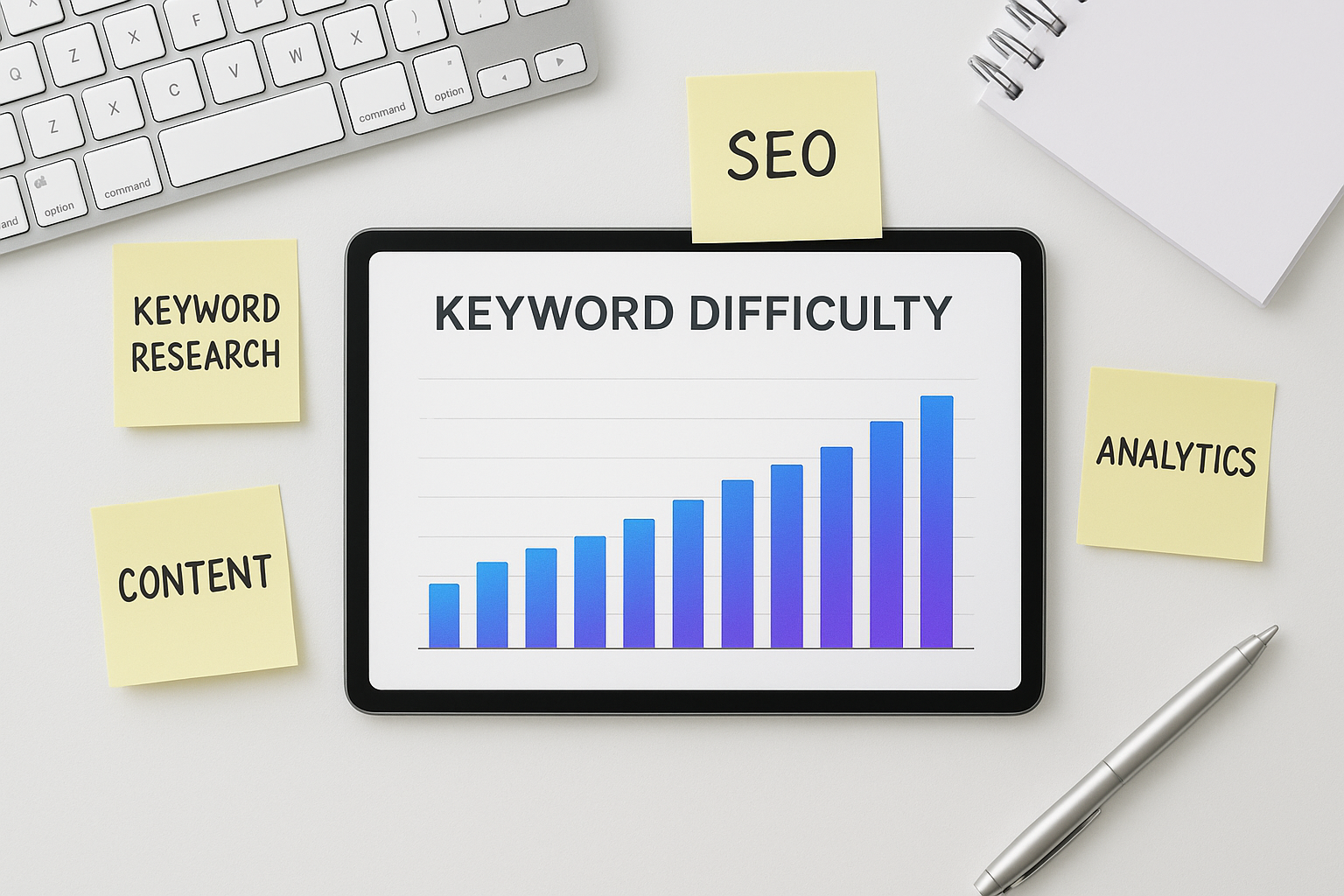
Prioritizing keywords by difficulty score helps you target achievable rankings and build momentum over time.
Understanding Search Intent Behind Every Query
Search intent is the “why” behind every query. Google categorizes intent into four main types: informational (the user wants to learn), navigational (the user wants a specific site), transactional (the user wants to buy), and commercial investigation (the user is comparing options before buying).
Matching your content format to the correct intent is, in many cases, more important than keyword placement itself. For example, if a keyword has transactional intent but you publish an informational blog post, you’re unlikely to rank — because Google recognizes the mismatch between your content and what users actually want. For a deeper walkthrough of mapping intent to content format, see how to research keywords for better SEO rankings.
Avoiding Keyword Cannibalization
Keyword cannibalization occurs when multiple pages on your site compete for the same search keyword. As a result, Google splits ranking signals between those pages, weakening both. To avoid this, assign each target keyword to exactly one page and consolidate overlapping content through redirects or merges.
A simple keyword map — a spreadsheet listing each page alongside its primary keyword — prevents this problem before it starts. In addition, auditing your site every few months helps you catch cannibalization issues before they quietly drain your rankings.
Keyword Density, Keyword Stuffing, and the Truth About Optimization
Keyword density — the percentage of times a term appears relative to total word count — used to be treated like a magic formula. However, modern search engines rely on natural language understanding, not simple word counting. There is no “ideal” density percentage that guarantees rankings, and chasing one usually backfires.
Keyword stuffing — repeating a phrase unnaturally throughout a page — is a textbook example of over-optimization. Not only does it read poorly, it can trigger spam filters. Google’s own spam policies explicitly flag excessive, unnatural keyword repetition as a manipulative practice. Instead, write for the reader first, then confirm your target phrase appears in the title, intro, a heading, and naturally throughout the body.
Specifically, a well-optimized page usually includes the primary keyword two to six times across a 1,500-word article, plus several synonyms and related phrases sprinkled naturally throughout. That variety — not raw repetition — is what demonstrates topical depth to search engines today.
Where to Place Your Target Keywords for Maximum Impact
Placement matters as much as selection. At minimum, your primary keyword should appear in each of these locations:
- The page title / SEO title, ideally near the beginning.
- The meta description, written as a natural, compelling summary.
- The URL slug, kept short and free of unnecessary words.
- The first paragraph, preferably within the first sentence or two.
- At least one subheading, with synonyms used in others.
- One image alt attribute, described naturally rather than stuffed.
Above all, every placement should read naturally to a human first. Search engines reward content that genuinely satisfies the searcher, and placement checklists exist to support that goal — not replace it.
Common Mistakes to Avoid When Targeting SEO Keywords
One of the most frequent errors is chasing high-volume keywords without considering competition. A site with 20 pages has almost no chance of ranking for a term that established sites with thousands of pages dominate. Instead, focus on realistic wins first and build authority over time.
Another common mistake is ignoring secondary keywords. While your primary keyword drives the page’s focus, semantically related terms — LSI keywords — signal to Google that your content covers a topic thoroughly. For instance, an article about keyword research might naturally include terms like “search volume,” “SERP analysis,” and “content gap.”
Finally, many site owners set a keyword strategy once and never revisit it. However, search trends evolve constantly. A keyword that was low-competition six months ago may now be saturated, while new opportunities emerge regularly. Therefore, scheduling quarterly keyword audits is a best practice that pays dividends over time. Tools and guidance at Rank Authority can help you stay current with these shifts.

Every search engine results page is a competition — and the right keywords determine whether your content appears at the top.
Building a Keyword-Driven Content Plan That Compounds
Once you have a prioritized keyword list, the next step is mapping each keyword to a specific content piece. Group related keywords into clusters — for example, all keywords related to “email marketing” might feed into a pillar page and several supporting blog posts. This cluster model strengthens topical authority and helps search engines understand the depth of your expertise.
Consequently, each new article should reinforce the ones around it through internal links, rather than existing in isolation. Over time, this turns a scattered blog into a genuine topical authority that Google trusts more with every new, well-linked page you publish.
The Future of Keyword Research: AI Search, Voice, and Semantic SEO
Voice search and AI-generated search summaries are changing how people phrase queries — favoring longer, conversational questions over short fragments. In particular, tools like Google Trends can reveal how phrasing shifts over time, helping you spot rising conversational variants of your core keywords before competitors do.
As a result, future-proofing your keyword strategy means writing complete answers to full questions, not just targeting fragments. Structuring content with clear headings and direct answers — much like the FAQ section below — helps your content surface in both traditional results and AI-generated overviews.
In conclusion, mastering SEO search keywords is not a one-time task — it’s an ongoing discipline that rewards consistency and curiosity. By researching with purpose, matching intent, avoiding over-optimization and cannibalization, and revisiting your strategy every quarter, you build a content engine that compounds in value over time and delivers sustained organic growth, rather than a short-lived traffic spike.
Frequently Asked Questions About SEO Search Keywords
What are SEO search keywords?
SEO search keywords are the specific words and phrases people type into search engines when looking for information, products, or services. Targeting the right keywords helps search engines match your pages to relevant queries, increasing organic visibility.
How do I find the best keywords for my website?
Start by brainstorming topics your audience cares about, then use tools like Google Keyword Planner, Ahrefs, or Semrush to discover search volume and competition data. See our SEO automation guide for workflow tips that scale keyword discovery.
What is keyword search intent?
Search intent is the underlying goal a user has when typing a query — whether they want to learn something, buy something, or navigate to a specific site. Matching your content to the correct intent is critical for ranking and reducing bounce rates.
What is the difference between short-tail and long-tail keywords?
Short-tail keywords are broad, high-volume terms that are very competitive. Long-tail keywords are more specific phrases with lower volume but higher conversion potential and less competition. Most content strategies benefit from targeting both types strategically.
How many keywords should I target per page?
Focus on one primary keyword per page, supported by two to five semantically related secondary keywords. Targeting too many unrelated keywords dilutes relevance and confuses search engines about the page’s main topic.
What is keyword difficulty and why does it matter?
Keyword difficulty is a score that estimates how hard it is to rank on the first page of Google for a given keyword. Higher difficulty means more established competitors are targeting that term, so newer sites should prioritize lower-difficulty opportunities first.
Where should I place keywords in my content?
Include your primary keyword in the page title, meta description, URL, first paragraph, at least one subheading, and naturally throughout the body. Avoid keyword stuffing, as Google penalizes over-optimization that harms readability.
How often should I update my keyword strategy?
Review your keyword strategy at least every three to six months. Search trends shift, new competitors emerge, and your site’s authority grows — all of which open new ranking opportunities you should actively capture.
Can I rank for keywords without backlinks?
Yes, especially for low-competition long-tail keywords where content quality and relevance can outweigh link authority. However, for competitive terms, a strong backlink profile significantly improves your chances of ranking on page one.
What tools are best for keyword research?
Popular options include Google Keyword Planner for free search volume data, Ahrefs and Semrush for comprehensive competitive analysis, Google Trends for spotting rising queries, and Google Search Console for discovering keywords your site already ranks for.
What is keyword cannibalization and how do I avoid it?
Keyword cannibalization happens when multiple pages on your site compete for the same keyword, splitting ranking signals and weakening both. Avoid it by assigning each keyword to a single dedicated page and consolidating overlapping content through redirects or merges.
How does search volume affect keyword selection?
Search volume tells you how many times a keyword is searched per month. High-volume keywords bring more potential traffic but are usually harder to rank for, while lower-volume keywords can still drive meaningful results if they align precisely with your audience’s intent.
What is keyword density and can it hurt my rankings?
Keyword density is the percentage of times a term appears relative to the total word count on a page. There’s no magic target percentage, but repeating a phrase unnaturally — keyword stuffing — can trigger spam filters and hurt readability, so prioritize natural writing over a specific ratio.
Will voice search and AI search change how I target keywords?
Yes. Voice search and AI-generated summaries favor longer, conversational phrasing over short keyword fragments, so writing complete answers to full questions — rather than just inserting a keyword — improves your chances of appearing in both traditional and AI-driven results.

