
SEO Strategy & Link Building. SEO Backlinks Analysis is the systematic process of examining every inbound link to evaluate quality, diagnose toxic links, and prioritize recoveries and outreach.
SEO Backlinks Analysis: The Complete Guide to Auditing, Comparing, and Growing Your Link Profile
SEO backlinks analysis is the systematic process of examining every inbound link pointing to your website — evaluating link quality, diagnosing harmful links, benchmarking against competitors, and uncovering opportunities that strengthen your search rankings. Without a rigorous analysis, your entire link-building strategy is built on guesswork. Use our Backlink Profile Checker.
Backlinks remain one of the top three ranking signals in Google’s algorithm, alongside content quality and RankBrain. But the landscape has shifted dramatically: in 2024, a single high-authority, topically relevant link can move the needle more than a thousand low-quality ones. Understanding how to read, interpret, and act on your backlink data is the skill that separates sustainable organic growth from short-lived ranking spikes.
This guide covers everything you need — from the exact metrics that matter, to a step-by-step audit process, to a head-to-head comparison of the best tools, to advanced strategies for turning analysis into real ranking gains. For a fast, tool-led check, try our backlink profile checker.
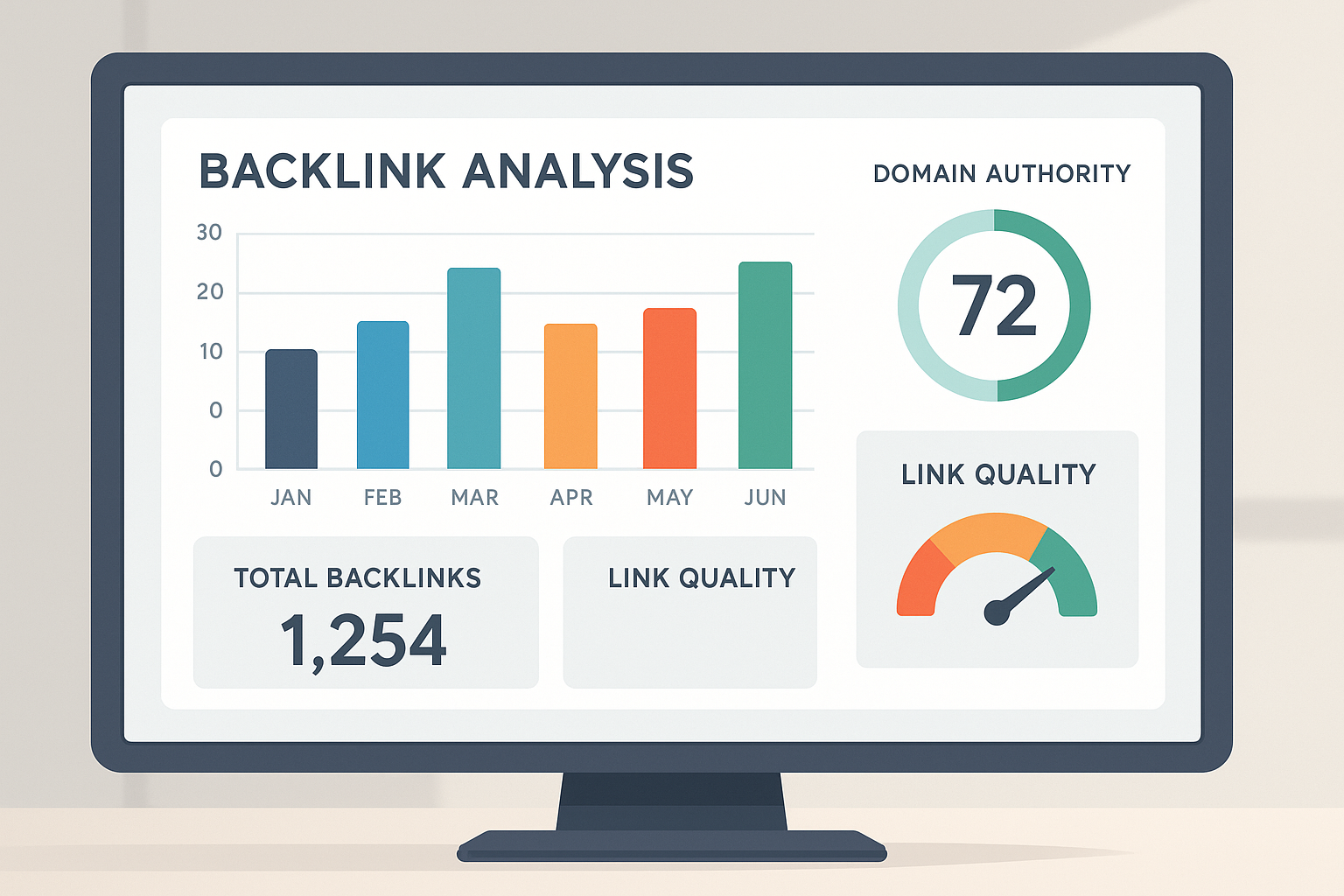
A well-structured SEO backlinks analysis dashboard reveals the full health of your link profile at a glance. For a deeper walkthrough, see our SEO Content Optimization for AI Answers: Full Guide.
What Is SEO Backlinks Analysis — and Why Does It Matter?
At its core, SEO backlinks analysis measures the quantity, quality, diversity, and competitive context of every link pointing to your domain. These dimensions collectively determine how Google perceives your site’s authority and trustworthiness — which directly translates into where you rank.
For a deeper walkthrough, see our SEO Keyword Analysis: A Complete Step-by-Step Guide.
According to Google’s foundational PageRank algorithm, links act as votes of confidence between websites. The more authoritative and topically relevant the linking site, the more value — or “link equity” — that link passes to your page. One editorial link from a respected publication in your niche can outperform hundreds of directory submissions combined.
But analysis is not just about counting votes. A thorough backlink audit examines:
- Referring domain diversity — how many unique sites link to you
- Anchor text distribution — the mix of branded, generic, and keyword-rich link text
- Link types — dofollow vs. nofollow vs. sponsored vs. UGC
- Toxic links — spammy or manipulative links that could trigger penalties
- Link velocity — the pace at which links are being acquired
- Competitive gap — which high-value domains link to competitors but not to you
- Geographic and linguistic diversity — especially important for international SEO For a deeper walkthrough, see our 8 Steps to SEO for STARTUPs.
The 10 Core Metrics Every Backlink Audit Must Cover
Before touching any tool, know which numbers actually move rankings. Below are the ten metrics that belong in every professional backlink audit.
Domain Rating / Domain Authority
A 1–100 predictive score of a linking domain’s ranking strength. Higher scores pass more link equity to your site. (DR = Ahrefs; DA = Moz)
Referring Domains
The number of unique websites linking to you. Diversity matters — 100 links from 10 domains is far weaker than 100 links from 80 distinct domains.
Anchor Text Distribution
The ratio of branded, generic, partial-match, and exact-match anchors. Over-optimized exact-match anchors are a known penalty trigger.
Link Velocity
The rate of new link acquisition over time. Sudden artificial spikes signal manipulation; slow, steady growth signals organic authority.
Toxic / Spam Score
Tool-generated flags for links from penalized, manipulative, or irrelevant domains. Ahrefs and Semrush both provide toxicity indicators.
Dofollow vs. Nofollow Ratio
Dofollow links pass PageRank; nofollow links do not. A healthy profile includes both, but an overwhelmingly nofollow profile limits ranking power.
Topical Relevance
Links from sites in your niche carry more semantic weight than off-topic links of equal authority. Google’s Helpful Content system amplifies this signal. For a deeper walkthrough, see our SEO Content Optimization for AI Answers: Full Guide.
Linked Page Distribution
Which pages on your site attract the most backlinks? A profile concentrated entirely on the homepage suggests thin content elsewhere.
Lost and Broken Links
Links you’ve lost due to page deletions or domain changes represent recoverable link equity — often through simple outreach or 301 redirects.
Competitive Link Gap
Referring domains that link to your top competitors but not to you. This is your highest-value outreach target list, ready-made.
How to Perform a Complete SEO Backlinks Analysis: 8-Step Process
A disciplined, repeatable process ensures you never miss critical issues or overlook high-value opportunities. Follow these eight steps in order to complete a professional-grade backlink audit. See our website backlinks analysis for additional examples and templates.
Step 1: Export Your Complete Backlink Profile
Open Ahrefs, Semrush, or Moz and export your full backlink list — all links, not just the filtered highlights. Also pull your link data from Google Search Console under Links > External Links, since GSC shows only what Google has actively crawled and indexed. Cross-referencing both sources gives you the most complete picture possible. Use a spreadsheet to merge the exports, remove exact duplicates, and prepare a working dataset. For a quick check, try the Backlink Profile Checker to locate common issues fast.
Step 2: Score Each Referring Domain by Authority and Relevance
Filter referring domains by DR or DA score, then manually review the top and bottom ends of the list. For each domain, ask two questions: (1) Is this site in my niche or a closely related one? (2) Does this site appear to have real editorial content and organic traffic? A DR 45 link from a directly relevant industry blog is almost always more valuable than a DR 80 link from an unrelated mass-publishing site. Flag each domain as High Value, Neutral, or Investigate Further.
Step 3: Audit Your Anchor Text Distribution
Export your anchor text report and categorize every anchor as: Branded (your company or domain name), Exact-Match (the precise keyword you’re targeting), Partial-Match (contains your keyword plus other words), Generic (“click here,” “learn more,” “this article”), or Naked URL (the raw URL as the anchor). A natural, healthy profile is dominated by branded and generic anchors, with exact-match representing no more than 1–3% of your total. If exact-match anchors exceed 10–15%, this is a significant over-optimization risk that needs correcting through diversified link acquisition.
Step 4: Identify and Triage Toxic Links
Use Semrush’s Backlink Audit tool or Ahrefs’ spam score filters to isolate potentially harmful links. Toxic links typically share these characteristics: very low DR (under 10), no organic traffic according to third-party estimates, hosted on domains associated with link farms or private blog networks (PBNs), irrelevant to your niche in any logical way, or pages with hundreds of outbound links on a single page. Create a separate toxic links tab in your spreadsheet. Before disavowing, attempt direct outreach to request removal — document every attempt. Only submit a disavow file to Google when you have strong evidence a link is causing active harm and removal requests have been ignored.
Step 5: Recover Lost and Broken Links
In Ahrefs, navigate to Site Explorer > Backlinks and filter by “Lost.” Sort by the DR of the lost referring domain — high-DR lost links represent recoverable authority. Common causes include: your page was deleted or moved without a redirect, the linking page was updated and the link was removed, or the referring domain went offline. For deleted-page links, implement a 301 redirect from the old URL to the most relevant current page. For links that were editorially removed, reach out and politely ask if the resource can be re-linked. Recovering even 5–10 high-authority lost links can produce measurable ranking improvements.
Step 6: Run a Full Competitor Backlink Analysis
Enter your top three to five organic search competitors into your backlink tool and run a Link Intersect or Gap Analysis. This report shows domains that link to competitors but not to you — sorted by the number of competitors they link to. A domain linking to three of your competitors and not to you is your highest-priority outreach target. Also study the content types that earn your competitors the most links: if they’re getting links from industry roundups, resource pages, data studies, or interview posts, those are the content formats you should be producing and promoting. For an expanded methodology, see the Analysis Backlink Checker guide.
Step 7: Analyze Internal Link Equity Distribution
Backlink analysis should never happen in isolation from your internal link structure. After identifying which pages attract the most external links, map how internal links flow from those pages to your key conversion or ranking pages. A page with 50 high-quality external links but no internal links pointing to supporting content is wasting distributable link equity. Use a site crawler like Screaming Frog to visualize your internal link graph and ensure link equity flows strategically toward your highest-priority pages. See our backlink rank checker to find and track linking pages quickly.
Step 8: Build a Prioritized Outreach and Link Acquisition Plan
Compile all findings into a prioritized action list with three categories: (1) Fix — toxic links to remove or disavow, lost links to recover, anchor text issues to address; (2) Build — competitor link gap domains to target with outreach; (3) Create — content formats and topics that attract links in your niche. Rank outreach targets by DR, topical relevance, and estimated effort. Assign each action an owner, a deadline, and a success metric. This plan is a living document — review and update it quarterly.

Comparing competitor backlink profiles is one of the fastest ways to uncover untapped link-building opportunities.
The Best Tools for SEO Backlinks Analysis: A Detailed Comparison
No single tool captures the entire web; see our how to check backlinks guide. The most effective SEO professionals use two or more platforms in combination to cross-verify data and fill each tool’s blind spots. Here’s what each major platform does best — and where it falls short. For a deeper walkthrough, see our What Is SEO Juice and How Does It Boost Rankings?.
Ahrefs
Best for: Largest and most frequently updated backlink index; competitor analysis; content gap research For a deeper walkthrough, see our SEO Content Optimization for AI Answers: Full Guide. For an alternative comparison and 2025-focused tool roundup, see our backlink checker guide.
Standout features: Site Explorer gives you a full view of any domain’s backlink profile. The “Best by Links” report identifies which content earns the most links in any niche. Link Intersect shows competitor-exclusive domains instantly. Ahrefs also crawls the web independently, meaning its index often includes links that other tools miss.
Limitations: No built-in disavow management; pricing starts high for solo operators.
Semrush
Best for: Toxic link detection; all-in-one SEO workflow; disavow file management For a deeper walkthrough, see our Rank Authority vs. SEO Juice:The Definitive Comparison.
Standout features: Backlink Audit tool automates toxicity scoring and integrates directly with Google Search Console and the Disavow Tool. The Bulk Analysis feature lets you check hundreds of domains simultaneously. Authority Score (0–100) combines domain-level and page-level signals into a single metric.
Limitations: Index can lag behind Ahrefs for freshly discovered links; interface complexity has a learning curve.
Moz Link Explorer
Best for: Domain Authority benchmarking; link profile snapshot; accessible pricing For a deeper walkthrough, see our SEO AI Domain Authority Checker: The Complete Guide.
Standout features: DA (Domain Authority) remains the most widely cited metric in outreach and digital PR. Spam Score identifies potentially harmful domains. Link Tracking Lists let you monitor new acquisitions over time.
Limitations: Smaller index than Ahrefs or Semrush; updates less frequently; less granular anchor text analysis.
Google Search Console
Best for: Confirming which links Google has actually discovered; free baseline data
Standout features: The only tool that shows Google’s own crawled link data — entirely free. External Links report identifies your most-linked pages, top linking sites, and anchor text. Indispensable for verifying that Google is actually seeing links you’ve built.
Limitations: No authority scoring; no competitor data; no toxicity detection; limited export depth; no historical trending for individual links.
Majestic SEO
Best for: Deep link topology analysis; Trust Flow and Citation Flow metrics
Standout features: Trust Flow measures link quality by proximity to trusted seed sites. Citation Flow measures volume. The TF:CF ratio is a quick signal for manipulative link profiles — a very high CF and very low TF indicates bulk, low-quality links. Topical Trust Flow categorizes your link profile by subject area.
Limitations: Less intuitive interface; weaker for competitor content gap analysis. For a deeper walkthrough, see our SEO Content Optimization for AI Answers: Full Guide.
Google Search Console + Screaming Frog (Free Combination)
Best for: Teams or individuals with limited budgets who still need actionable data
Combining GSC’s external link data with Screaming Frog’s internal link crawl gives you a surprisingly complete picture of both your external link profile and internal equity distribution — entirely free. It lacks competitor analysis capability but covers the foundational audit thoroughly.
How to Read Your Anchor Text Report (With Examples)
Anchor text analysis is one of the most misunderstood parts of an SEO backlinks analysis. Here’s exactly what a healthy vs. over-optimized profile looks like in practice.
| Anchor Type | Example | Healthy % | Risk Signal |
|---|---|---|---|
| Branded | “YourBrand” or “YourBrand.com” | 40–60% | Under 20% (weak brand authority) |
| Generic | “click here,” “read more,” “this page” | 20–35% | Under 5% (unnaturally optimized) |
| Naked URL | “yourdomain.com/page” | 10–20% | Low risk on its own |
| Partial-Match | “best SEO analysis tools for beginners” | 5–15% | Moderate risk if high concentration |
| Exact-Match | “seo backlinks analysis” | 1–3% maximum | Over 10% = high penalty risk |
If your exact-match anchor percentage is elevated, the fix is not to remove existing links — it’s to build more branded and generic anchors going forward until the ratio normalizes naturally.
Dofollow vs. Nofollow vs. Sponsored vs. UGC: What Each Link Type Means
Google’s link attribute system has evolved significantly since 2019. Understanding the four active link types is essential for any accurate backlink analysis.
- Dofollow (default): No attribute tag. Google follows the link and passes PageRank to the destination. These are the links that directly influence rankings and should be the primary focus of your acquisition efforts.
- Nofollow (rel=”nofollow”): Google treats these as hints rather than hard directives since September 2019. They may still pass some ranking credit in Google’s discretion. Valuable for referral traffic even when link equity transfer is uncertain.
- Sponsored (rel=”sponsored”): Required for paid placements, affiliate links, and paid link insertions. Failure to use this attribute on paid links violates Google’s Webmaster Guidelines and can result in a manual penalty.
- UGC (rel=”ugc”): Applied to user-generated content — comments, forum posts, community submissions. Signals low editorial control. Links with this attribute carry minimal ranking weight.
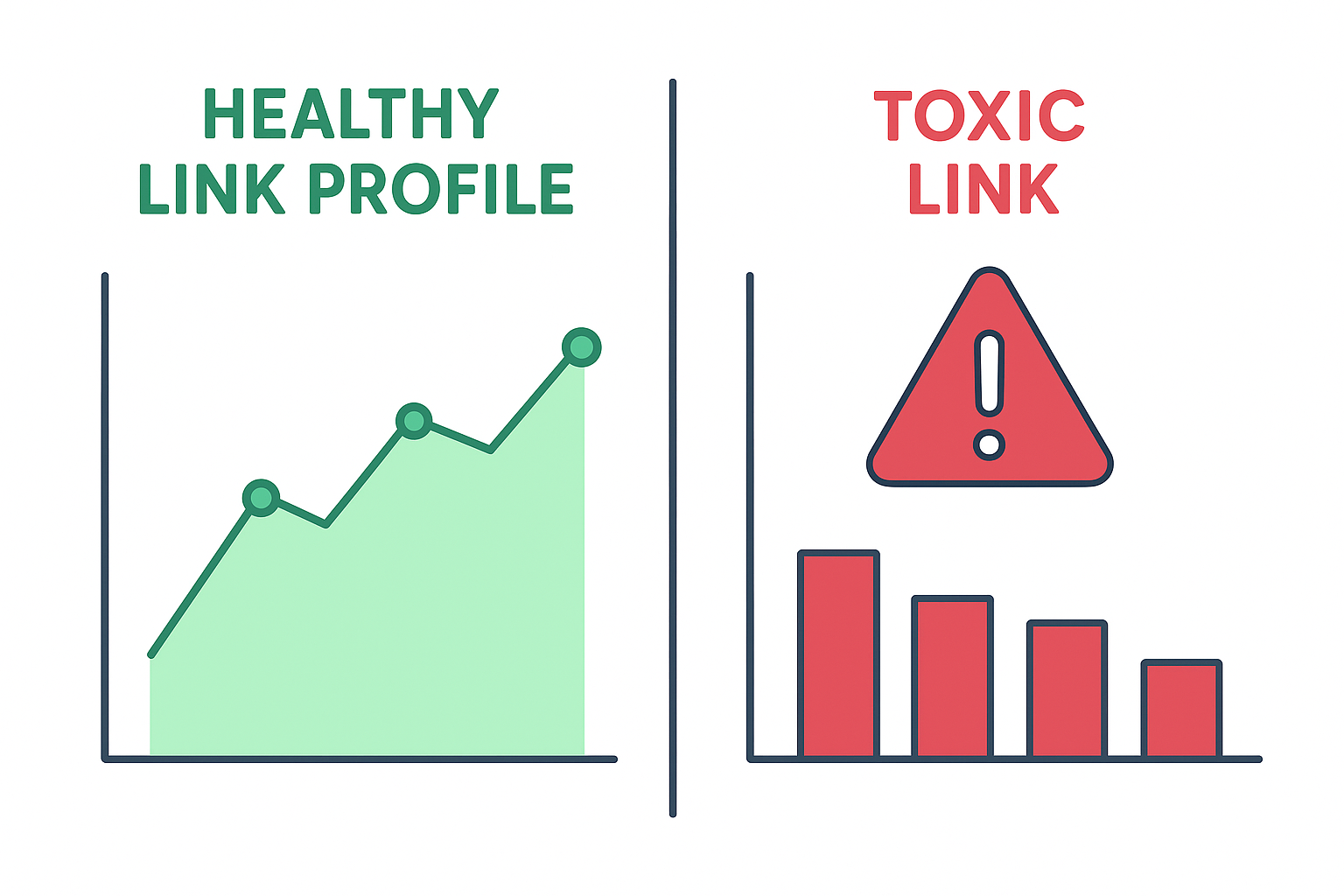
Distinguishing healthy links from toxic ones is a critical skill in any SEO backlinks analysis process.
Toxic Links: How to Identify, Remove, and Disavow Them Correctly
One of the most consequential — and most mishandled — aspects of SEO backlinks analysis is toxic link management. Over-disavowing can cost you legitimate link equity; under-disavowing can leave algorithmic or manual penalties unaddressed.
What Makes a Link Toxic?
- Domain has DR/DA under 10 AND near-zero organic traffic
- Site is part of a known link farm or PBN (Private Blog Network)
- Page containing the link has hundreds of outbound links — clearly a “link dump” page
- Domain has received a confirmed Google manual action in the past
- Anchor text is extremely spammy (pharmaceutical keywords, gambling terms, adult content) on a site unrelated to those topics
- Multiple links from the same domain with the exact same keyword-rich anchor text pointing to your money pages
The Correct Disavow Process
- Identify toxic links using Semrush Backlink Audit or Ahrefs’ spam score filters
- Attempt manual removal: contact the webmaster of each linking site and request the link be removed. Log every attempt with date and response status
- Wait 2–4 weeks for responses before moving to the next step
- For unresponsive or unreachable webmasters, compile a disavow file listing domains (not individual URLs, unless specific pages are the issue)
- Submit the disavow file via Google Search Console’s Disavow Tool
- Revisit the disavow file quarterly — do not let it grow unchecked, as incorrectly disavowed links can suppress legitimate link equity
Important: Google’s John Mueller has confirmed that the algorithm is sophisticated enough to ignore most low-quality links without a disavow. Only disavow when you have a confirmed manual action, a sudden ranking drop correlated with a spike in spammy links, or links that are clearly from manipulative sources you or a previous agency built intentionally.
Competitor Backlink Analysis: How to Find and Win Their Best Links
Competitor backlink analysis is the single highest-ROI component of any SEO backlinks analysis workflow. It transforms a diagnostic exercise into a direct action plan. See our improve website backlinks guide for tactical next steps.
The Link Intersect Method
In Ahrefs, navigate to More Tools > Link Intersect. Enter three to five competitor domains in the top fields and your own domain in the “but doesn’t link to” field. The resulting list shows every domain that links to at least one competitor but has never linked to you — sorted by DR. Work from the top down. Domains that link to multiple competitors simultaneously are the richest targets, because they are clearly covering your topic area editorially and have an established pattern of linking out. You can also run our analysis backlink checker to automate link-gap extraction and prioritization.
What Content Types Attract the Most Competitor Links?
In Ahrefs Site Explorer for each competitor, review “Best by Links” to see which specific pages attract the most referring domains. Common high-link-earning content formats include:
- Original data studies and industry surveys — journalists and bloggers cite statistics constantly
- Comprehensive guides and glossary pages — referenced as definitions and learning resources
- Free tools and calculators — earn passive links as long as the tool is useful
- Curated resource lists and industry reports — high editorial linkability when authoritative
- Opinion pieces and expert commentary — especially when timed with news cycles or policy changes
Broken Link Building at Scale
Within your competitor analysis, look for referring domains where the link is now broken (the competitor’s page was deleted or moved). Use Ahrefs’ Broken Backlinks report on competitor domains to surface these. If the linked content is similar to something you already have — or could easily create — reach out to the referring domain, notify them of the broken link, and offer your page as a replacement. Broken link building has some of the highest acceptance rates in outreach because you’re doing the webmaster a favor while gaining a link.
Common Mistakes That Undermine Your Backlink Profile
Even experienced SEO professionals make costly errors during — and after — their backlink audits. Here are the most damaging mistakes and how to avoid them.
Ignoring link velocity patterns
Acquiring hundreds of links in a short burst — especially through paid link schemes or low-quality guest post networks — triggers Google’s spam detection. Aim for steady, organic-looking growth that mirrors natural editorial behavior. Track your velocity monthly using Ahrefs’ “New Backlinks” chart.
Over-disavowing legitimate links
Panicked, overly aggressive disavow submissions are a common and costly mistake. Many links that trigger toxicity alerts in tools are actually ignored by Google’s algorithm without any action required. Disavowing them can strip away real ranking power. Only disavow links with strong evidence of active harm.
Treating backlink analysis as a one-time task
Link profiles change continuously — new links are acquired, old ones are lost, referring domains change their own authority. A link audit conducted once and then forgotten is almost as useless as no audit at all. Set a recurring quarterly review on your SEO calendar. For a deeper walkthrough, see our SEO Free Check: How to Audit Your Site at No Cost.
Neglecting internal link equity distribution
Pages that attract significant external links should be connected to your highest-priority pages via strong internal links, so the equity flows through your site. Ignoring this means you’re leaving distributable link power sitting unused on your most-linked pages.
Chasing quantity over quality
Site owners who celebrate reaching “1,000 backlinks” while ignoring that 800 come from low-DA directories are optimizing for a vanity metric. Ten editorially earned links from topically relevant DR 50+ domains will outperform a thousand directory submissions every time.
Relying on a single tool
Every backlink tool has index gaps. Ahrefs may miss links that Semrush has indexed and vice versa. Running your analysis through only one platform means you’re making decisions on incomplete data. Always cross-verify with at least Google Search Console alongside your primary tool.
Turning Analysis Into Action: Link Building Strategies That Work
Analysis without action produces zero ranking benefit. Every finding from your backlink audit should feed directly into one of the following link-building approaches.
Digital PR and Original Research
Creating data-driven studies, original industry surveys, or proprietary research consistently earns high-authority editorial links that competitors cannot replicate by simply copying your content. Journalists and bloggers need citable data — when you produce it, they link to you as the source. One well-executed data study can earn dozens of DR 60–80+ links. For templates and outreach advice, see backlink checker.
Resource Page Link Building
If your competitor analysis reveals that linking domains maintain resource pages or “best tools” roundups in your niche, create content specifically designed for those placements. Use Google advanced search operators like inurl:resources [your niche] or intitle:"useful links" [your topic] to find relevant resource pages at scale. See our checklist in Backlinks SEO Check for outreach-ready content formats.
HARO and Expert Source Outreach
Help a Reporter Out (HARO) and similar journalist query platforms (Connectively, Qwoted, SourceBottle) connect you with journalists writing stories in your niche who need expert quotes. A single well-timed HARO response can earn a link from a major publication. Set up keyword-specific alerts for queries relevant to your industry.
Strategic Guest Posting
Guest posting on high-authority, topically relevant publications remains effective when done correctly — meaning the content is genuinely editorial, the site has real organic traffic, and the link is contextually placed rather than in a bio or footer. Use it sparingly and only on sites with real audiences. Mass guest post schemes targeting any-DA-will-do sites are a link velocity and quality risk.
Reclaiming Unlinked Brand Mentions
Use tools like Ahrefs Content Explorer or Google Alerts to find pages that mention your brand name without linking to you. This is a warm outreach scenario — the author already knows who you are. A polite request to turn the mention into a link converts at a much higher rate than cold outreach and requires minimal content effort on your part. Resources like Rank Authority provide proven frameworks for translating audit insights into measurable link growth. See our practical checklist in Find and Fix Link Profile for outreach templates and tracking tips.
How Often Should You Run an SEO Backlinks Analysis?
Frequency depends on your site’s scale, competitive intensity, and whether you’re actively building links. Here’s a practical framework:
- Monthly: Check for new toxic link spikes, review link velocity, monitor for lost high-value links. Use tool alerts (Semrush Backlink Audit notifications) to automate initial detection.
- Quarterly: Run a full comprehensive audit — anchor text review, competitor gap analysis, internal equity mapping, outreach pipeline refresh. This is your primary strategic review cycle.
- Immediately: After any significant ranking drop (10+ positions on target keywords), after a Google algorithm update, after a site migration or URL restructure, or after receiving a Google manual action notification.
- Before and after campaigns: Benchmark your profile before a major outreach or digital PR campaign, then measure the impact 60–90 days later to calculate link-building ROI.
Putting It All Together
A disciplined approach to SEO backlinks analysis gives you a measurable competitive advantage in organic search. By regularly auditing your link profile, recovering lost equity, resolving anchor text imbalances, diagnosing toxic links accurately, studying competitor link gaps, and converting findings into a structured outreach plan, you build an authority foundation that compounds with every passing month.
The sites that consistently outrank their competitors are not simply the ones with the most backlinks — they are the ones that understand the quality, context, topical alignment, and strategic value of every single link in their profile. Make SEO backlinks analysis a scheduled, recurring practice — not a reactive one-time task — and the ranking gains will follow. Last updated: 2026-08-14. Author: Rank Authority SEO Team.
Frequently Asked Questions About SEO Backlinks Analysis
What is SEO backlinks analysis?
SEO backlinks analysis is the systematic process of evaluating all inbound links pointing to a website to assess their quality, relevance, authority, and impact on search rankings. It helps identify high-value link sources, toxic links to disavow, lost links to recover, and new link-building opportunities through competitor gap analysis.
Why are backlinks important for SEO?
Backlinks are votes of confidence from other websites, signaling to Google that your content is trustworthy and authoritative. They remain one of the top three ranking signals in Google’s algorithm. High-quality backlinks from reputable, topically relevant domains pass link equity (PageRank) that directly lifts your pages in search results. Learn how to perform a backlink audit.
How often should I run a backlink audit?
Run a comprehensive SEO backlinks analysis quarterly for routine strategy. Conduct monthly spot-checks for new toxic links and lost high-value links. Perform an immediate audit after any significant ranking drop, Google algorithm update, site migration, or manual action notification.
What tools are best for SEO backlinks analysis?
The most widely used tools are Ahrefs (largest index, best competitor analysis), Semrush (best for toxic link detection and disavow management), Moz Link Explorer (reliable DA benchmarking), Google Search Console (free, shows Google’s actual crawled links), and Majestic (Trust Flow and Citation Flow metrics). Using two or more in combination gives the most complete picture.
What is a toxic backlink and how do I identify one?
A toxic backlink is a low-quality or manipulative inbound link from a penalized, spammy, or irrelevant website. Common indicators include DR/DA under 10, near-zero organic traffic, association with link farms or PBNs, hundreds of outbound links on a single page, and spammy keyword-rich anchor text. Use Semrush Backlink Audit or Ahrefs’ spam score filters to identify them systematically.
How do I remove or disavow harmful backlinks?
First, contact each linking webmaster directly and request removal — document every attempt with dates and responses. If outreach fails after 2–4 weeks, compile the unresponsive domains into a disavow file and submit it via Google Search Console’s Disavow Tool. Only disavow domains (not individual URLs) unless a specific page is the sole problem. Avoid over-disavowing — Google ignores most low-quality links automatically.
What is anchor text and why does it matter in SEO backlinks analysis?
Anchor text is the clickable text of a hyperlink. In SEO backlinks analysis, reviewing anchor text distribution reveals whether your profile is over-optimized with exact-match keywords — a known Google penalty trigger. A healthy profile has 40–60% branded anchors, 20–35% generic anchors, and no more than 1–3% exact-match keyword anchors pointing to any single page.
What is the difference between dofollow and nofollow backlinks?
Dofollow backlinks pass PageRank (link equity) to the destination page and directly influence search rankings. Nofollow backlinks (rel=”nofollow”) were historically ignored but since September 2019, Google treats them as hints rather than directives, meaning they may pass some ranking credit at Google’s discretion. A healthy profile contains both types, but dofollow links from topically relevant domains carry the most ranking weight.
How does competitor backlink analysis improve my SEO strategy?
Competitor backlink analysis using tools like Ahrefs’ Link Intersect reveals high-authority domains linking to competitors but not to you — your highest-priority outreach targets. It also shows which content formats earn the most links in your niche, guiding your content creation strategy. Domains that link to three or more competitors simultaneously are especially valuable to pursue.
What metrics should I focus on during a backlink audit?
The ten core metrics are: Domain Rating/Domain Authority, referring domain count and diversity, anchor text distribution, link velocity, toxic/spam score, dofollow vs. nofollow ratio, topical relevance of linking sites, linked page distribution across your site, lost and broken links, and competitive link gap. Together these paint a complete picture of your link profile health and opportunities.
Can too many backlinks hurt my website?
The total number of backlinks is far less important than their quality. A large volume of low-quality, manipulative, or irrelevant links can trigger Google’s spam algorithms and result in ranking penalties. However, having many high-quality links from authoritative, topically relevant sources is always beneficial. Focus on quality, diversity, and natural link velocity rather than chasing raw link counts.
What is link velocity and why does it matter?
Link velocity is the rate at which a website gains new backlinks over time. A sudden, unnatural spike in links — especially if they are low-quality — signals potential manipulation to Google’s spam detection systems. A steady, consistent growth pattern that mirrors organic editorial behavior is the safest and most sustainable approach to link acquisition.
What is broken link building and how does it work?
Broken link building is a technique where you find pages on authoritative sites that link to now-deleted or moved content similar to yours. You then contact the webmaster, alert them to the broken link, and offer your page as a replacement. Because you’re helping them fix a problem, this tactic has high outreach acceptance rates and consistently earns links from high-DR domains.

