Local Business Growth
“The businesses that win tomorrow are the ones that become the answer — not just a result.”
AEO services for local businesses is the practice of optimizing your online presence so that AI-powered search tools, voice assistants, and answer engines — such as Google’s AI Overviews, ChatGPT search, Siri, and Alexa — surface your business as a direct, authoritative answer to a customer’s question. If you run a local business and you haven’t yet explored AEO, you’re likely invisible in the fastest-growing search channel available today.
Quick Answer
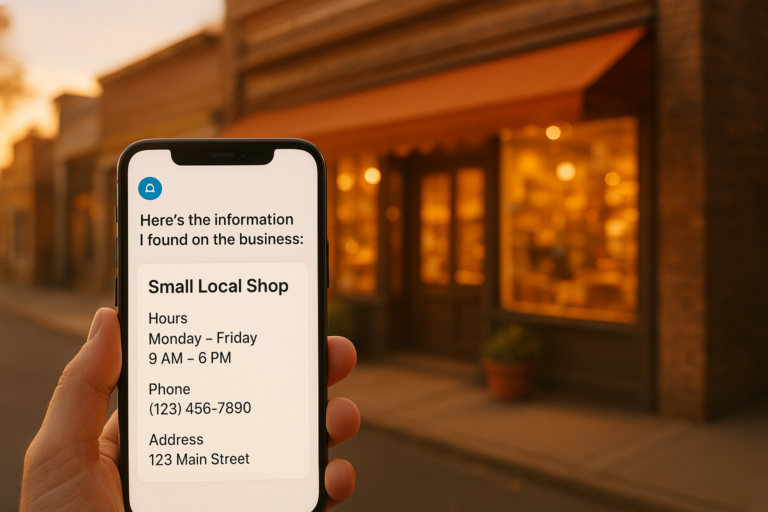
AEO services for local businesses help small and mid-sized companies appear as the spoken or displayed answer when nearby customers ask AI tools questions like “best plumber near me” or “what time does the pharmacy close?” They combine structured data, conversational content, and local authority signals to win zero-click visibility.

AEO services for local businesses help your shop become the answer customers hear and see first.
What Are AEO Services for Local Businesses?
Answer Engine Optimization — commonly abbreviated as AEO — is the discipline of structuring your content, metadata, and authority signals specifically to satisfy the algorithms that power AI-driven answer engines. Unlike traditional search engine optimization (SEO), which aims to rank a page in a list of blue links, AEO targets the zero-position: the spoken response from a voice assistant, the featured snippet box, or the AI-generated summary that appears before any organic results.
For local businesses — think restaurants, law firms, dentists, plumbers, boutique retailers, and fitness studios — this distinction is enormously consequential. When someone asks their phone “Who is the best Italian restaurant in downtown Austin?” the answer engine doesn’t return ten links. It returns one answer. AEO services determine whether that answer is you.
According to research tracked by Wikipedia’s overview of voice search, voice-based queries have grown exponentially with the proliferation of smart speakers and mobile AI assistants, and a significant proportion of those queries have strong local intent. That makes AEO not a future consideration for local businesses — it’s an urgent present-day priority.
Why Local Businesses Are Uniquely Positioned to Win with AEO
There is a compelling competitive reality: most local businesses have not yet invested meaningfully in AEO. That means the playing field is wide open. Large national brands dominate traditional SEO through massive content budgets and domain authority. But answer engines prioritize relevance, proximity, and specificity — three qualities that local businesses naturally possess.
Traditional SEO
- Competes for ranked list positions
- Requires high domain authority
- Click-dependent traffic model
- Content volume is a major factor
AEO Strategy
- Targets the single direct answer
- Rewards local specificity
- Zero-click visibility model
- Structured clarity wins over volume
Core Components of Effective AEO Services
1. Structured Data and Schema Markup
Schema markup is the backbone of any AEO strategy. By adding structured data to your website — specifically LocalBusiness, FAQPage, HowTo, and Review schema — you speak directly to answer engines in their native language. This tells AI systems your business name, address, phone number, hours, services, and areas of expertise with machine-readable certainty.
2. Conversational Content Architecture
Answer engines are trained on natural language. Your content must mirror how real customers ask questions — not just how they type keywords. This means creating dedicated FAQ sections, question-and-answer formatted service pages, and blog content that directly addresses phrases like “How much does a roof repair cost in [city]?” or “Does [business name] accept walk-in appointments?” Each question answered is a potential answer engine trigger.
3. Google Business Profile Optimization
Your Google Business Profile (GBP) is a primary data source for AI-powered local answers. A fully optimized GBP — with accurate categories, detailed service descriptions, regularly updated posts, and a strong review portfolio — dramatically increases the probability of your business being surfaced in voice and AI answer results. Treat your GBP as a living document, not a one-time setup.
4. Citation Consistency and NAP Accuracy
Answer engines cross-reference your business information across dozens of directories — Yelp, TripAdvisor, Apple Maps, Bing Places, and industry-specific listings. Inconsistent Name, Address, and Phone (NAP) data creates ambiguity that AI systems resolve by choosing a competitor with cleaner data. AEO services audit and correct these inconsistencies systematically.
5. Real-Time Monitoring and Issue Alerts
AEO is not a set-and-forget strategy. Algorithm updates, new competitor content, and changes to your own website can disrupt your answer engine visibility overnight. Proactive monitoring tools that flag technical issues in real time are essential. Rank Authority’s real-time SEO issue alerts provide exactly this kind of continuous oversight, ensuring that your AEO signals remain clean and competitive at all times.

Structured data planning is a foundational element of any effective AEO strategy.
How AEO Intersects with GEO and AI Search
AEO doesn’t exist in isolation. It sits within a broader ecosystem that now includes Generative Engine Optimization (GEO) — the practice of ensuring your content is cited and referenced by large language model-based search tools like Perplexity, ChatGPT, and Google’s AI Mode. For local businesses, understanding how AEO, GEO, and traditional SEO interact is critical for building a durable visibility strategy.
The team at Rank Authority has published a detailed breakdown of AEO, GEO, and AI search that is highly recommended reading for any local business owner trying to understand how these disciplines connect and where to invest first.
Key Insight
GEO focuses on being cited by AI-generated content. AEO focuses on being the direct answer delivered to a user. For local businesses, AEO typically delivers faster, more measurable ROI because local queries are highly specific and less contested at the AI answer layer than broad informational queries.
Frequently Asked Questions About AEO for Local Businesses

Understanding your AEO performance metrics helps local businesses make smarter optimization decisions.
Building Your AEO Action Plan: Where to Start
Getting started with AEO doesn’t require an enterprise budget. The following prioritized roadmap is designed specifically for local businesses working with realistic resources:
- Audit your current structured data — Use Google’s Rich Results Test to identify missing or broken schema on your key pages.
- Implement LocalBusiness schema — Ensure every location page carries complete, accurate structured data including hours, services, and geographic coordinates.
- Build a comprehensive FAQ section — Research the exact questions your customers ask using tools like AnswerThePublic or Google’s “People Also Ask” boxes.
- Optimize your Google Business Profile — Fill every available field, add photos regularly, respond to all reviews, and post weekly updates.
- Audit and unify your citations — Correct NAP inconsistencies across all major directories using a citation management tool.
- Set up continuous monitoring — Implement real-time alerts so technical issues never silently erode your AEO visibility.
The Bottom Line
The era of competing for a position on page one is giving way to competing to be the answer. AEO services for local businesses are the strategic response to this shift — and the businesses that act now will build a durable, compounding advantage over those that wait. Start with your schema, invest in conversational content, and treat your local data as the precision asset it truly is.
The landscape of local search is evolving faster than most business owners realize. AEO services for local businesses represent the clearest, most actionable path to sustained visibility in an AI-first search environment. Whether you’re a solo practitioner or a multi-location operation, the fundamentals outlined here — structured data, conversational content, citation hygiene, and continuous monitoring — form a foundation that no algorithm update can take away.