
AI Blog Builder for SEO: The Complete Guide to Ranking Faster with Smarter Content
An AI blog builder for SEO is a platform that plans, writes, optimizes, and publishes blog content so your pages rank sooner and accumulate compounding organic traffic. This guide explains exactly how these tools work, how to evaluate them against real criteria, how to build a production-ready workflow in days, and how to measure the outcomes that matter. You will leave with a practical, repeatable system — not theory — built around search intent, topical authority, and sustainable growth. This guide was produced by Rank Authority's editorial team; an author bio with qualifications and a link to full credentials is included on the article page for E‑E‑A‑T transparency. For a deeper walkthrough, see our AI Citation Score Checker: The Complete 2025 Guide.

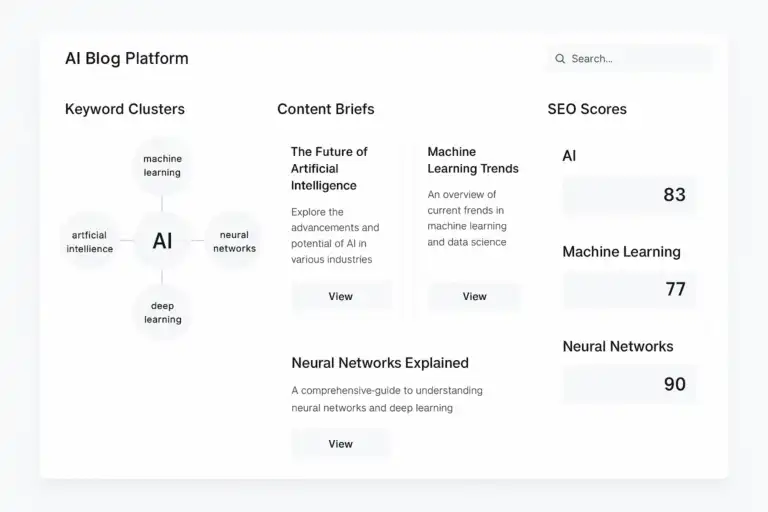
A streamlined dashboard helps your AI blog builder for SEO plan, write, and optimize posts across every stage of the content pipeline.
⚡ Quick Wins You Can Implement Today
- Cluster first: Group keywords by intent before writing a single word so every post builds topical authority from day one.
- Brief fast: Lock H2 structure, FAQ targets, schema type, and internal link destinations before drafting begins.
- Publish consistently: Ship iterative posts on a set cadence and refine based on weekly impression and CTR data.
- Measure holistically: Track impressions, clicks, average position, assisted conversions, and time-on-page together.
- Refresh on a cycle: Update underperforming posts with new data, examples, and expanded FAQs every 60–90 days.
What Is an AI Blog Builder for SEO?
An AI blog builder for SEO is a unified platform that automates the entire content production pipeline — from keyword research and topic clustering through brief creation (see our AI content writing guide), drafting, on-page optimization, publishing, and post-publish monitoring. Unlike a standalone AI writing tool that simply generates text on demand, a true SEO blog builder enforces structure, search intent alignment, technical completeness, and iterative improvement at every stage.
The critical distinction is workflow control. A general-purpose AI writer answers a prompt. An AI Blog Builder for SEO manages a repeatable system that produces search-optimized content at scale, consistently, across every post your team publishes.
Direct answer: An AI blog builder for SEO automates research-to-publish steps so each article precisely aligns with search intent and technical best practices — producing faster initial rankings and compounding authority over time.
“Plan the cluster, not the post. Topical authority is the product of dozens of interconnected articles, not a single well-optimized page. The builder makes that interconnection systematic.”
The Three Core Problems It Solves
- Speed at scale: Manual workflows take 10–20 hours per article when you include research, brief creation, writing, editing, and on-page setup. AI builders compress that to 1–3 hours without sacrificing quality.
- Consistency across a team: When multiple writers or editors touch a blog, quality variance becomes the enemy of authority. A builder enforces structural consistency through templates and briefs.
- Coverage gaps: Most editorial calendars are reactive — built around ideas, not search demand. AI builders surface every keyword cluster your site should own and flag what you are missing.
Why an AI Blog Builder Outperforms Manual SEO Workflows
The core argument for AI-assisted SEO blogging is not that AI writes better prose — it is that AI enforces a better process. Search engines reward consistent, well-structured, topically comprehensive content. Manual teams, no matter how talented, introduce variance. An AI blog builder eliminates that variance systematically.
Speed and Volume Advantages
A manual SEO content operation publishing 4 posts per month takes roughly 8–10 months to build a content cluster dense enough to drive measurable topical authority. An AI blog builder compresses that timeline to 6–8 weeks by parallelizing research, brief creation, and drafting. The compounding effect of publishing 15–20 well-clustered articles in a single month dwarfs what 15–20 isolated articles published over a year would produce; see our AI SEO tools guide for tool recommendations.
Structural and Technical Completeness
Every post leaving a well-configured AI blog builder for SEO arrives with correct meta titles, meta descriptions, structured heading hierarchies, FAQ schema, Article schema, compressed images with descriptive alt text, and pre-mapped internal links. These elements are frequently skipped or inconsistently applied in manual workflows, costing rankings even when the prose quality is high.
Topical Authority at Depth
Modern search algorithms evaluate a site’s depth of coverage on a topic, not just its performance on a single keyword. AI builders that cluster semantically related terms around hub topics allow you to claim authority across an entire subject area — not just a single high-volume phrase. This is the structural shift that separates brands that build traffic over time from those that stagnate despite high-quality individual posts.
✅ With AI Blog Builder
- Research to publish in 1–3 hours
- Consistent brief and heading structure
- Schema added automatically at publish
- Internal links planned before writing
- Cluster coverage tracked and alerted
- Refresh cycle triggered by data
❌ Manual Workflow
- 10–20 hours per article
- Structure varies by writer
- Schema added inconsistently or never
- Internal links added reactively
- Coverage gaps discovered late
- Refreshes happen ad hoc if at all

The full pipeline: seed keywords → cluster design → brief creation → AI drafting → on-page optimization → publish → monitor → refresh.
How an AI Blog Builder for SEO Works: The Full Pipeline
Understanding the mechanics behind an AI blog builder for SEO helps you configure one correctly and get predictable results. Here is how each stage of the pipeline operates and what it produces; refer to our AI-driven SEO tools overview for how those components interact.
-
Define Goals, Audience, and Seed Keywords
Start with business context, not keyword volume. Define who you are writing for, what problems they have, and what commercial or informational intent you want to capture. Feed seed terms into the research layer — the AI will expand them into full keyword sets organized by intent.
-
Cluster Topics by Semantic Relationship
The AI groups related keywords by parent theme, creating hub-and-spoke architectures. A hub covers a broad topic (e.g., “AI blog builder for SEO”) and each spoke covers a specific subtopic (e.g., “AI blog brief templates,” “how to build a keyword cluster,” “SEO schema for blog posts”). This map becomes your editorial calendar.
-
Generate Structured Content Briefs
For each post, the builder creates a brief that locks in the target keyword, primary and secondary H2s, FAQ questions, entities to mention, schema type, and internal link targets — before a single word of the draft is written. This brief is the single most important output of the system because it controls quality upstream.
- Draft Content with Examples, Data, and POV The AI SEO content creator generates a full draft following the brief’s structure. Strong builders allow you to inject brand voice guidelines, expertise signals, and specific data points at this stage. Human editors review and add genuinely unique insights, original examples, or proprietary data that the AI cannot generate — this is the editorial layer that separates great content from generic output.
-
Optimize On-Page Elements Systematically
The builder runs the draft through on-page checks: meta title length and keyword placement, meta description engagement, heading hierarchy, keyword density and variation, image alt text, readability score, and estimated word count against SERP norms for that keyword. Issues surface as flagged items, not buried in a spreadsheet.
-
Add Structured Data and Schema Markup
Schema is implemented automatically based on content type — Article and BlogPosting for editorial content, FAQPage for posts with Q&A sections, HowTo for step-by-step guides. Structured data signals increase the probability of earning rich SERP features (FAQ dropdowns, how-to carousels) without any manual JSON-LD editing.
-
Publish with Full Interlinking
The builder schedules and publishes directly to your CMS (WordPress, Webflow, Contentful, or via API), inserting pre-planned internal links with varied anchor text. Hub pages link to all spokes; spokes link back to the hub and between related spoke articles. This link graph is planned at the cluster level, not retrofitted after the fact.
-
Monitor Performance Signals and Trigger Refreshes
After publish, the builder connects to Search Console and analytics to track impressions, clicks, average position, and CTR at the page level. Alerts fire when positions drop more than a defined threshold or when a competitor captures a featured snippet on a keyword you rank for. The refresh cycle is data-driven, not calendar-driven.
AI Blog Builder for SEO: Complete Pre-Launch Checklist
Use this checklist at every post before it goes live. Each item corresponds to a specific ranking signal — skip one and you leave traffic on the table.
Research and Intent
- ✅ Primary keyword and 3–5 semantic variants confirmed against live SERP data
- ✅ Search intent classified (informational / navigational / transactional / commercial) and content type matched
- ✅ SERP features present on target keyword identified (featured snippet, PAA, FAQ, how-to)
- ✅ Competitor top-3 outlines reviewed for coverage gaps
Structure and On-Page
- ✅ H1 contains the primary keyword near the start and is unique across the site
- ✅ H2 structure maps to sub-intents, not just topic summaries
- ✅ Meta title under 60 characters with keyword in the first 30
- ✅ Meta description under 160 characters with a clear benefit and soft CTA
- ✅ Short direct-answer block in the first 100 words (targets featured snippet)
- ✅ FAQ section with 3–6 questions using PAA-aligned phrasing
- ✅ Anchor text varied across internal links (keyword, partial match, and natural phrasing)
Technical and Schema
- ✅ Article or BlogPosting schema added with headline, datePublished, dateModified, and author
- ✅ FAQPage schema added if post contains a Q&A section
- ✅ Images compressed to under 150KB, with descriptive alt text containing the keyword where natural
- ✅ Canonical tag pointing to the correct URL
- ✅ Page added to the sitemap and submitted to Search Console
Content Quality
- ✅ At least one original insight, data point, or proprietary example added by a human editor
- ✅ Reading grade level appropriate for the audience (Flesch-Kincaid 50–70 for most SEO content)
- ✅ No keyword stuffing — primary term appears at natural density (1–2%), synonyms carry the rest
- ✅ External links go to authoritative, non-competing sources only
Step-by-Step: Build a Production-Ready AI Blog Workflow
This workflow is designed for teams starting from scratch or rebuilding a stalled blog program using AI-driven SEO tools. Follow these steps in order — the sequence matters because each stage depends on the output of the previous one.
-
Step 1 — Select Your Minimum Viable Stack
Choose one keyword research source (Ahrefs, Semrush, or Google Search Console for existing sites), one AI drafting and brief tool, and your existing CMS. Resist the temptation to add complexity before you have proven the core loop. A simple, connected stack that ships daily beats a sophisticated stack that ships monthly.
-
Step 2 — Design 3–5 Core Topic Clusters
Each cluster has one hub article targeting a broad, high-volume keyword and 6–10 spoke articles targeting specific long-tail variations. For a new site, start with one cluster and publish it completely before opening a second. Concentrated authority signals outperform scattered publishing in the first 90 days.
-
Step 3 — Create Reusable Brief Templates
Build a brief template that every post follows without exception: target keyword, secondary keywords, H1 draft, H2 list, FAQ targets, schema type, internal link targets (hub and lateral spokes), CTA placement, and word count range. Store this in your project management tool so every team member uses the same starting point.
-
Step 4 — Set a Non-Negotiable Publication Cadence
Publish 2–5 posts per week per active cluster. Consistency matters more than volume in the early stages — search crawlers reward sites that demonstrate regular, high-quality output. Use a content calendar that assigns specific keywords to specific dates so the team never waits for direction.
-
Step 5 — Implement Aggressive Interlinking from Day One
Internal links are not an afterthought. Every spoke links back to its hub with an exact-match or partial-match anchor. Every hub links forward to all its spokes. Related spokes within the same cluster link laterally to each other. When you publish a new spoke, update the hub and at least two existing spokes with links to the new post. This is what makes a cluster feel like a cluster to search engines.
-
Step 6 — Connect Analytics and Track the Right Signals
Connect Google Search Console and your analytics platform to the builder or a reporting dashboard. Track at the page level: impressions, clicks, average position, CTR, and time-on-page. Track at the cluster level: total impressions across all posts in the cluster, number of posts in the top 20, and total organic sessions. Cluster-level metrics tell you when an authority threshold is being crossed.
-
Step 7 — Run Quarterly Refresh Cycles
Every 60–90 days, audit posts that rank in positions 5–20 for their target keyword — these are the easiest wins. Update outdated statistics, add new FAQ entries based on emerging PAA questions, strengthen the intro, and expand any sections where competitors have since outpaced your coverage. Refreshed content often jumps 3–8 positions without requiring new backlinks.
How to Choose the Best AI Blog Builder for SEO: A Practical Evaluation Framework
Not every AI blog builder for SEO is equivalent. The category ranges from simple AI writing assistants with an SEO mode to full-stack platforms that manage research, production, publishing, and monitoring. This framework helps you evaluate any tool against the criteria that actually move rankings — see the AI SEO Content Creator guide for practical examples.
Tier 1: Non-Negotiable Requirements
- Keyword clustering and intent classification: The tool must group semantically related keywords and label them by intent type. Raw volume lists are insufficient — you need relational maps.
- Brief generation with H2, FAQ, and entity outputs: Briefs should specify heading structure, FAQ questions, NLP entities to include, and internal link targets — not just a keyword and a word count.
- Automated schema insertion: Article, BlogPosting, FAQPage, and HowTo schema should be generated and inserted without manual JSON-LD editing.
- CMS integration: Direct publishing to WordPress, Webflow, Contentful, or equivalent. Copy-paste workflows introduce errors and slow cadence.
Tier 2: Strong Differentiators
- Automated internal link suggestions: The builder should recommend where to place links across the cluster as new posts are published, not require manual curation.
- Competitor gap analysis: Surface keywords and subtopics your competitors rank for that you do not yet cover.
- SERP feature targeting: Flag posts where a featured snippet or FAQ result is achievable and suggest structural changes to capture it.
- Performance monitoring and refresh alerts: Proactive alerts when a page drops in position or when a refresh opportunity is detected — not a dashboard you have to check manually.
Tier 3: Nice-to-Have Features
- Brand voice and tone controls: Presets that inject style guidelines at the drafting stage reduce editorial revision time.
- Multi-language support: Important if you operate in more than one market.
- Content scoring and readability analysis: Useful for training junior editors, though not a substitute for human judgment on quality.
- ROI reporting: Attribution of organic traffic value at the cluster and page level for reporting to stakeholders.
For deeper analysis of tool stacks and ROI modeling frameworks, RankAuthority’s guide to AI SEO strategies, tools, and ROI provides a comprehensive resource for teams in evaluation mode.

Side-by-side comparison: manual blog workflow vs. an AI blog builder for SEO — time, consistency, and structural quality all shift in favor of the automated pipeline.
Pros and Cons of AI Blog Builders for SEO
Every serious AI blog builder for SEO involves trade-offs. Understanding them before you commit to a platform helps you mitigate the downsides and capitalize on the strengths from day one.
| Advantage | Trade-off to Manage |
|---|---|
| Research and drafting in hours, not days | Generic tone if briefs lack specificity or human editorial review is skipped |
| Consistent on-page optimization across every post | Over-reliance on templates can suppress voice differentiation |
| Cluster-level topical authority at scale | Upfront investment in designing clusters correctly — poor clusters produce poor content |
| Systematic internal linking across hubs and spokes | Teams need training to trust and maintain automated link suggestions |
| Data-driven refresh cycles catch decay before it hurts | Monitoring requires a connected analytics stack and someone responsible for acting on alerts |
| Schema and structured data generated automatically | Schema errors in bulk can be harder to catch than one-off manual implementations |
Key insight: The trade-offs above are manageable with process. The advantages are structural — they operate even on a bad day. That asymmetry is why teams that adopt AI blog builders for SEO tend to outpace manual operations over an 18–24 month horizon regardless of initial content quality differences.
Essential On-Page SEO Elements Every Builder Must Cover
On-page fundamentals remain the most controllable ranking factor — and the most frequently skipped under deadline pressure. A strong AI blog builder for SEO makes these impossible to miss by surfacing them as required fields, not optional checkboxes.
Title Tags and Meta Descriptions
Title tags should place the primary keyword within the first 30 characters and stay under 60 characters total to avoid truncation in SERPs. Meta descriptions should lead with a benefit or question that matches search intent and include a soft call to action. They do not directly influence ranking, but they control CTR — which does.
Heading Hierarchy and Sub-Intent Mapping
Each H2 should address a distinct sub-intent or supporting question, not a generic topic label. H3s break those sub-intents into specific points. Correct heading hierarchy helps both readers navigate content and search engines understand the topical structure of the page. A builder that auto-generates headings from the brief eliminates structural guesswork.
Structured Data and Schema
Article schema and BlogPosting schema signal content type and authorship to search engines. FAQPage schema enables expanded FAQ results in SERPs — these increase visible real estate without requiring a higher ranking position. HowTo schema qualifies step-by-step guides for how-to rich results in Google and Google Discover. These markups are cumulative: more schema types on the same page increase the total surface area available for rich results.
Images and Media
Every image should be compressed (under 150KB for standard post images), served in WebP format where possible, and accompanied by descriptive alt text that includes the target keyword at least once where contextually natural. Captions below images are indexed and contribute to keyword coverage — use them. Original diagrams, charts, or screenshots earn backlinks at rates that stock images never will.
Internal Links and Anchor Text Strategy
Internal links pass PageRank, establish topical relationships, and guide crawlers. Use exact-match anchors sparingly (1–2 per page maximum), partial-match anchors for the majority, and natural descriptive phrases for the rest. Never link to the same destination URL twice on a single page with different anchor text — this creates conflicting signals about the destination page’s topic.
Readability and Engagement Signals
Short paragraphs (3–4 sentences maximum), active voice, clear transitions, and scannable formatting (bullets, numbered lists, bold key terms) reduce bounce rate and increase time-on-page — both of which influence how search engines assess content quality over time. A builder that enforces readability standards protects your engagement signals at scale.
For foundational terminology and a deeper understanding of the ranking factors these elements address, the Wikipedia overview of search engine optimization provides a reliable reference for teams new to the discipline.
Keyword Clusters and Topical Authority: The Architecture Behind AI Blog SEO
Understanding why clusters work explains why AI blog builders for SEO are architecturally superior to one-off publishing strategies. Topical authority is the aggregate signal that tells a search engine your site comprehensively covers a subject area — and it cannot be built one post at a time, no matter how good each individual post is. For tooling and real-world examples see the AI SEO Software guide.
How Clusters Build Authority
When you publish a hub article and 8 supporting spoke articles that all interlink within the same cluster, you create a document graph that search engines can traverse. Each spoke reinforces the hub’s authority. The hub distributes link equity back to the spokes. Together, the cluster signals that your site has breadth (multiple angles covered) and depth (each angle covered thoroughly) on a topic — the combination that modern ranking algorithms reward most strongly. For site-wide performance tactics, also see AI website optimization.
Hub-and-Spoke Design Principles
- One hub per broad topic: The hub targets a high-volume, moderate-competition keyword that represents the topic’s parent intent (e.g., “AI blog builder for SEO”).
- 6–10 spokes per hub: Each spoke targets a long-tail variation or sub-question with informational or commercial intent (e.g., “how to create an AI SEO blog brief,” “best AI blogging tools for small teams”).
- Lateral spoke links: Where two spoke articles share semantic overlap, link between them — this increases crawl depth and reinforces topical relationships.
- Cluster completeness before expansion: Fully populate one cluster (hub + all spokes) before opening a second cluster. Partial clusters signal thin coverage, not deep expertise.
Measuring Cluster-Level Authority
Track these metrics at the cluster level, not just the post level:
- Cluster impressions: Total impressions across all posts in the cluster per month — a rising trend indicates growing authority.
- Posts in top 20: The number of cluster articles ranking on page 1 or 2 is a more meaningful authority signal than average position alone.
- Internal PageRank flow: Use a crawl tool to verify that link equity is flowing correctly from hub to spokes and back.
Monitoring, Alerts, and Intelligent Content Refresh
Publishing is not the end of the workflow — it is the beginning of the measurement phase (see AI-powered SEO guide). Great AI blog builders for SEO treat post-publish monitoring as a first-class feature, not an afterthought.
What to Monitor and Why
- Rank shifts (drops of 3+ positions): Investigate title tag relevance, intro content, and whether a competitor has published something newer. Act within 48 hours of a significant drop.
- CTR below 2% on impressions over 500: The post is visible but not compelling in the SERP. Test title tag variations with numbers, questions, or power words. Rewrite the meta description to front-load the primary benefit.
- Featured snippet losses: When you hold a featured snippet and lose it, the culprit is almost always a competitor who added a cleaner direct-answer block. Add a concise one-paragraph answer directly below the H2 that matches the snippet query.
- New PAA questions appearing: People Also Ask questions evolve with search behavior. New PAA entries on your target keywords represent FAQ opportunities you can add to existing posts without a full rewrite.
- Content freshness signals: Stats, product references, pricing data, and regulatory information go stale. Posts that mention specific years, versions, or prices need quarterly review flags.
The Refresh Priority Matrix
Not all posts deserve equal refresh investment. Prioritize by this sequence:
- Posts ranking 5–15 with high impressions: These are closest to page-one dominance and respond fastest to refresh efforts.
- Hub articles: Hub health affects all spoke rankings — hub refreshes have cluster-wide impact.
- Posts with high impressions but low CTR: Traffic exists — it just is not clicking through. Title and meta work here.
- Posts ranking below 20: These need structural revision, not just cosmetic updates, and should be treated as partial rewrites.
RankAuthority’s real-time SEO issue alerts help teams catch rank drops, CTR issues, and content decay signals early so refreshes happen before traffic loss compounds.
AI Blog Builder for SEO vs. Generic AI Writing Tools: What Actually Differs
This distinction matters when evaluating tools and justifying budget. Many teams adopt a generic AI writing assistant and expect SEO results — only to find that the tool handles none of the structural, technical, or strategic work that rankings actually depend on.
| Capability | AI Blog Builder for SEO | Generic AI Writer |
|---|---|---|
| Keyword clustering and intent mapping | ✅ Built in | ❌ Not included |
| Structured brief with H2s, FAQs, entities | ✅ Built in | ❌ Manual |
| Automated schema markup | ✅ Built in | ❌ Not included |
| Internal link planning and insertion | ✅ Built in | ❌ Manual |
| CMS publishing integration | ✅ Built in | ❌ Copy-paste |
| Post-publish monitoring and refresh alerts | ✅ Built in | ❌ Not included |
| AI text generation | ✅ Built in | ✅ Core feature |
The AI writing capability is the smallest part of what an AI blog builder for SEO provides. Teams that use generic writers and handle the rest manually are paying in time what they save in tool cost — a trade that rarely favors them at scale.
Common Mistakes to Avoid When Using an AI Blog Builder for SEO
AI blog builders for SEO are powerful precisely because they enforce process — but that same power means misconfiguration compounds quickly. Avoid these mistakes to protect your investment and your rankings.
Publishing Without Human Review
AI-generated drafts are starting points, not finished articles. Every post needs at least one editorial pass to add an original insight, verify factual claims, and ensure the tone matches your brand. Publishing AI-only content at high volume with no human layer is the fastest way to accumulate thin content penalties and brand credibility damage simultaneously.
Building Clusters Before Understanding Intent
A cluster built around keyword volume rather than search intent produces posts that fight each other for the same SERP position. Map intent (informational, commercial, transactional) before assigning keywords to hub or spoke positions. Conflicting intents within a cluster create internal cannibalization that no amount of interlinking can fix.
Ignoring the Refresh Cycle
Teams that treat publishing as the end state see their rankings decay within 6–12 months as competitors refresh and as search intent evolves. A structured refresh cycle is not optional — it is the mechanism by which compounding authority is maintained. Schedule quarterly reviews as a fixed operational task, not a reactive response to traffic drops.
Neglecting the Hub Article
Many teams invest in their spoke articles and let the hub article become outdated. The hub is the authority anchor for the entire cluster — if it is thin, outdated, or poorly optimized, it suppresses the ranking performance of every spoke it is connected to. Treat hub articles as living documents that receive major updates every 6 months.
Using the Same Anchor Text for Every Internal Link
Repeating the exact same anchor text across dozens of internal links triggers over-optimization signals. Vary your anchors: use exact match once per page, partial match for most links, and descriptive natural language for the remainder. This applies to AI-generated internal links as much as manually written ones.
Measuring ROI from Your AI Blog Builder for SEO
Justifying an AI blog builder investment requires connecting content outputs to business outcomes — not just ranking improvements. Here is a framework for measuring ROI at each stage of the funnel.
Visibility Metrics (Top of Funnel)
- Total impressions: Rising monthly impressions indicate growing SERP presence across your cluster.
- Keywords ranking in top 20: A leading indicator of pages approaching page-one positions.
- Rich result appearances: Featured snippets, FAQ results, and how-to appearances expand SERP real estate beyond blue links.
Traffic Metrics (Middle of Funnel)
- Organic sessions: Total visits from search, segmented by cluster and by individual post.
- CTR by keyword: Identifies titles and descriptions that underperform despite strong rankings.
- New vs. returning visitors: A growing returning visitor share indicates content that builds an audience, not just search traffic.
Business Outcome Metrics (Bottom of Funnel)
- Assisted conversions: Blog content rarely converts on the first touch — track it as an assist in multi-touch attribution models.
- Organic revenue: For e-commerce, attribute revenue to sessions that entered via blog posts and subsequently converted. For a deeper walkthrough, see our AI Blog Posts for Local Businesses: Complete Guide.
- Cost per organic acquisition: Compare the total cost of the AI builder and editorial team against the number of conversions attributable to organic blog traffic. This is the number that justifies or challenges continued investment.
Benchmark: A well-configured AI blog builder for SEO publishing 3–4 posts per week across one focused cluster (see our AI SEO content creator) typically begins showing measurable impressions growth within 6–8 weeks and meaningful organic traffic growth within 3–4 months. ROI from content compounds — the same post that drives 100 sessions per month in month 3 often drives 500+ sessions per month by month 12 without additional investment.
Frequently Asked Questions About AI Blog Builders for SEO
What is an AI blog builder for SEO?
An AI blog builder for SEO is a platform that automates the complete content production pipeline — from keyword research and topic clustering through brief creation, AI-assisted drafting, on-page optimization, schema markup, CMS publishing, and post-publish performance monitoring. Unlike a generic AI writing tool, it enforces search intent alignment and technical completeness at every stage of the workflow.
How does an AI blog builder differ from a standalone AI writing tool?
A standalone AI writer generates text from a prompt. An AI blog builder for SEO manages the entire workflow: it clusters keywords by intent, creates structured briefs before writing begins, enforces on-page optimization requirements, inserts schema markup automatically, manages internal linking across a cluster, publishes directly to your CMS, and monitors performance after publication. The writing is one small step inside a much larger system.
Can I maintain my brand voice while using an AI blog builder?
Yes. Strong AI blog builders for SEO allow you to configure tone presets, brand vocabulary, style guidelines, and forbidden phrases at the system level. These settings apply to every draft generated. Human editorial review at the approval gate ensures voice consistency — the builder handles structure and speed while editors add personality and proprietary perspective.
How long does it take to see SEO results from an AI blog builder?
For a new site publishing 3–4 posts per week focused on a single cluster, meaningful impression growth typically appears in 6–8 weeks. Page-one rankings on long-tail keywords within the cluster often appear at 8–12 weeks. Significant organic traffic growth from competitive mid-tail keywords generally takes 3–6 months. Results depend on domain age, existing authority, competition level, and publishing consistency.
Does AI content rank well on Google?
Google’s current stance is that it evaluates content quality, not production method. AI-generated content that is accurate, helpful, well-structured, and demonstrates expertise, authoritativeness, and trustworthiness (E-E-A-T) ranks well. AI content that is generic, factually unreliable, or published without human editorial oversight performs poorly — not because it is AI-generated, but because it is low quality. The human editorial layer in an AI blog builder workflow is what produces content that ranks.
What is a topic cluster in SEO?
A topic cluster is a group of interlinked web pages covering a broad subject area from multiple angles. It consists of a hub page (targeting a high-volume parent keyword) and multiple spoke pages (targeting specific long-tail variations). All pages interlink within the cluster. This architecture signals topical authority to search engines — that your site comprehensively covers a subject, not just a single query — and is the primary structural method AI blog builders use to build rankings at scale.
How often should I refresh blog content produced by an AI builder?
Run a formal refresh cycle every 60–90 days on posts ranking in positions 5–20. Hub articles should receive major updates every 6 months regardless of position. Any post that references specific statistics, product versions, pricing, or dated events should be reviewed immediately when that information changes. Data-driven builders flag refresh opportunities automatically based on rank shifts and CTR data.
Key Takeaways
- An AI blog builder for SEO manages the entire content pipeline — from keyword clustering to post-publish monitoring — not just text generation.
- Topic clusters and briefs are the architectural foundation of topical authority — they must be designed before drafting begins.
- On-page fundamentals — meta tags, schema, internal links, alt text, heading hierarchy — compound more than any single tactic when enforced consistently at scale.
- Human editorial review is the layer that separates rankable AI-assisted content from generic AI output — never remove it from the workflow.
- Monitoring and refresh cycles protect rankings and drive compounding gains — publishing without ongoing measurement is a depreciating asset strategy.
- ROI compounds over time — the post that drives 100 sessions in month 3 typically drives 500+ in month 12 with no additional investment beyond a quarterly refresh.
Conclusion: Launch Your AI Blog Builder for SEO Today
You now have the complete picture: what an AI blog builder for SEO is, why it outperforms manual workflows structurally, how to configure the full research-to-refresh pipeline, how to evaluate tools against the criteria that actually matter, and how to measure the ROI that justifies continued investment. Add an author byline and a "Last updated" date near the top to surface expertise and freshness for readers and search engines. Add an author bio (name, role, 2–3 credentials) and a clear "Last updated" date on this page to strengthen E‑E‑A‑T.
The next step is simple: pick one cluster, publish it completely, and measure results for 90 days. You will have enough data to optimize your workflow, justify expansion, and build the compounding content engine that your competitors are already scaling toward.
Start with one hub. Ship 8 spokes. Interlink aggressively. Measure everything. Refresh on data. That is the system — and it works every time it is followed consistently.
Ready to build a search-first content engine?
Explore deeper strategy frameworks, tool evaluations, and ROI modeling at AI content strategy tools

