

AI-driven content discovery is reshaping how audiences find brands, products, and information across search engines, AI chatbots, and answer engines alike. Rather than relying solely on keyword matching, AI-driven content discovery uses machine learning models to interpret intent, context, and relevance in real time. For businesses, understanding this shift is no longer optional — it is often the difference between appearing inside an AI Overview or disappearing from results entirely.
Direct answer: AI-driven content discovery is the process by which AI systems — including Google’s AI Overviews, ChatGPT, and Perplexity — identify, rank, and surface relevant content based on semantic meaning rather than exact keyword matches. It combines natural language processing with structured data to decide which pages deserve a citation.
What Is AI-Driven Content Discovery?
AI-driven content discovery is the practice of using artificial intelligence to locate, evaluate, and present the most relevant content to a user’s query. Unlike older algorithms that scanned for matching words, today’s systems rely on natural language processing to understand what a page actually means. As a result, well-structured, clearly written content now has a real advantage over content stuffed with keywords.
In practice, this means search engines and AI assistants read a page much like a human would. They look for direct answers, supporting evidence, and clear organization. Consequently, businesses that structure their content around real questions tend to perform better in AI-generated results.

AI-driven content discovery relies on semantic connections rather than simple keyword matches.
How AI-Powered Content Discovery Works Behind the Scenes
AI-powered content discovery generally follows a layered process. First, crawlers gather content from across the web, much like traditional search engines. However, instead of stopping at keyword indexing, AI models then convert that content into mathematical representations called embeddings, which capture meaning rather than exact wording.
Next, when a user asks a question, the system compares that query’s embedding against millions of content embeddings to find the closest semantic matches. In addition, models weigh signals such as source credibility, freshness, and structured data to decide which pages earn a citation. This is why Google’s own documentation on AI features emphasizes clear, well-organized content as a ranking factor.
Finally, the system generates a response and, in many cases, links back to the source. Therefore, pages that clearly answer a specific question in the first few sentences are far more likely to be quoted directly inside an AI Overview or chatbot reply.
Why AI Content Discoverability Matters for SEO in 2025
AI content discoverability matters because search behavior itself has changed. According to industry research, a growing share of queries now get resolved directly inside AI-generated summaries without a traditional click-through. As a result, businesses that only optimize for classic blue-link rankings are missing a substantial and growing slice of visibility.
Moreover, AI-driven content discovery tends to reward specificity. For example, a page that clearly defines a term, lists steps, and answers common follow-up questions is more “extractable” than a vague overview page. Similarly, structured data such as schema markup gives AI systems explicit signals about what a page contains, reducing ambiguity.
For a deeper look at the mechanics behind this shift, our guide on how AI improves content discoverability for businesses breaks down the ranking signals in more detail.
How to Improve AI-Driven Content Discovery: A Step-by-Step Process
Improving AI-driven content discovery does not require a complete website rebuild. Instead, a focused, sequential approach tends to produce the best results over time. Below is a practical five-step process businesses can follow.
- Audit existing content structure. Review pages for clear headings, direct answers, and logical flow so AI crawlers can quickly identify the main topic.
- Add structured data markup. Implement JSON-LD schema, such as Article and FAQPage, so AI systems can accurately parse entities and questions.
- Write direct, concise answers. Place a one to three sentence answer right after each major heading, then add supporting context afterward.
- Strengthen internal and external linking. Link to relevant internal resources and authoritative external sources so AI models can verify context.
- Monitor AI visibility and refine. Track appearances in AI Overviews and chatbot citations, then update underperforming pages regularly.
For a more detailed walkthrough of this workflow, see how to leverage AI for better content discoverability.
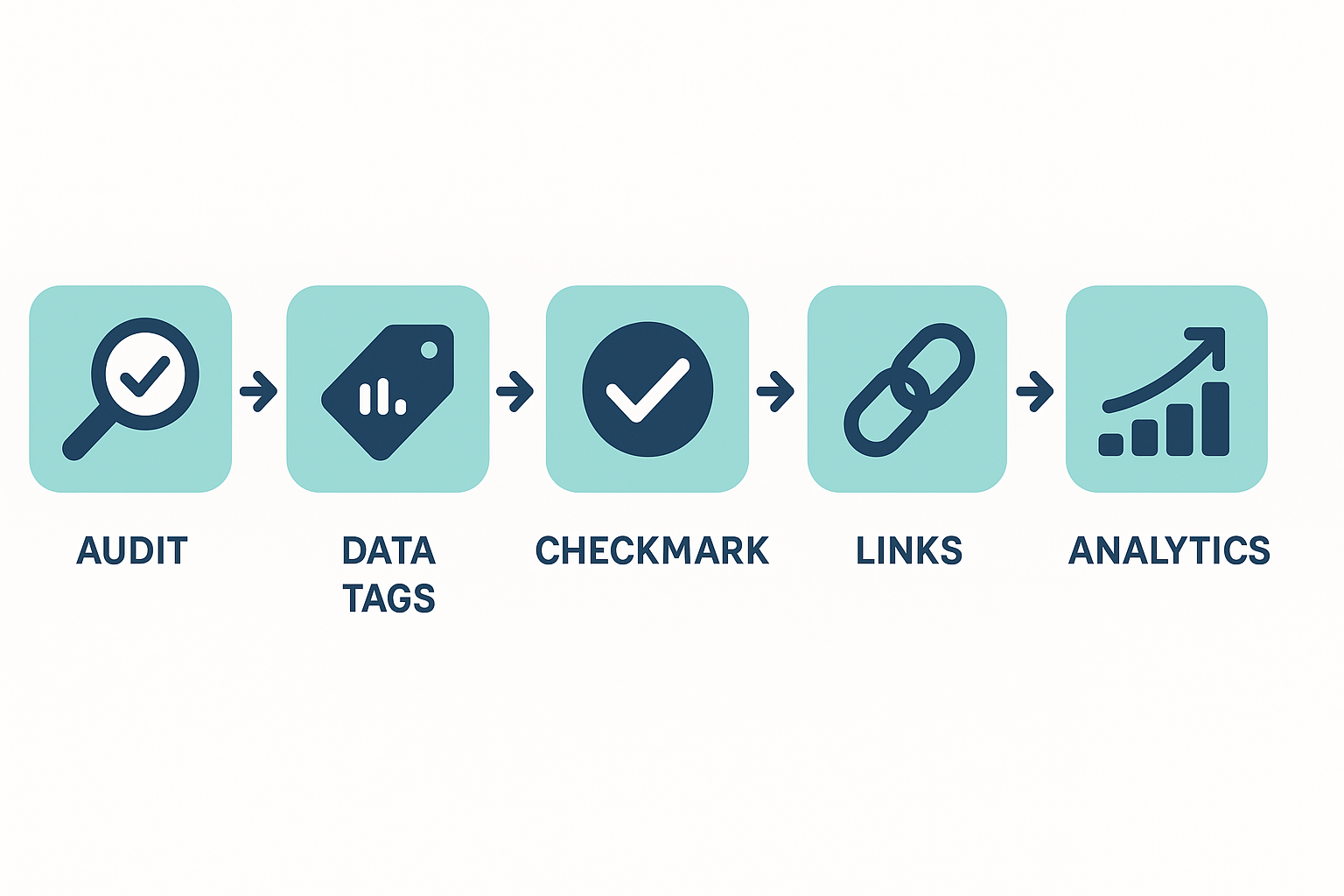
A simple, repeatable workflow makes AI-driven content discovery easier to manage at scale.
Best Tools for Boosting Content Discovery in AI Search
Manually implementing every technical and structural fix can be time-consuming, especially for small teams. Fortunately, automation platforms now handle much of this work. For instance, rankauthority.com offers a 1-Click AI AutoPilot feature that automates GEO and AEO tasks, including schema generation and content structuring, backed by a seven-day trial for businesses that want to test results first.
In addition to full automation platforms, businesses can compare options in our roundup of the best tools for enhancing content discoverability. This is particularly useful for agencies managing several client sites at once, since consistency across properties becomes far easier with automated workflows.
Ultimately, whether a business chooses manual optimization or an automated platform, the goal remains the same: make content easy for AI systems to find, understand, and trust.
Common Mistakes That Hurt AI-Driven Content Discovery
Even well-intentioned content teams make avoidable errors. Vague headings, for example, give AI crawlers little to work with when deciding what a page covers. Similarly, missing or incomplete schema markup leaves search systems guessing about page structure and intent.
Thin content is another common issue. If a page never actually answers the question implied by its title, AI models are unlikely to cite it. Likewise, slow-loading pages can hurt crawl efficiency, which indirectly limits how often content gets reevaluated for freshness.
To avoid these pitfalls, many teams reference our complete resource on AI content discoverability: the complete 2025 guide, which covers technical checklists in more depth. You can also explore how AI can enhance content discoverability for your website for site-specific recommendations.
Frequently Asked Questions About AI-Driven Content Discovery
What is AI-driven content discovery?
AI-driven content discovery is the process by which artificial intelligence systems analyze, interpret, and surface content based on meaning and intent rather than exact keyword matches. It powers features like AI Overviews, chatbot answers, and semantic search results.
How does AI-driven content discovery differ from traditional SEO?
Traditional SEO focuses on keyword density and backlinks, while AI-driven content discovery prioritizes semantic relevance and entity relationships. As a result, content must be structured for both human readers and machine comprehension.
Why is AI-driven content discovery important in 2025?
It matters because a growing share of searches are resolved directly inside AI Overviews, chatbots, and voice assistants without a traditional click-through. Businesses that ignore it risk losing visibility as this share increases.
How long does it take to see results from AI content discoverability improvements?
Most sites see measurable changes within 4 to 12 weeks, depending on crawl frequency and existing authority. Consistent structured content tends to accelerate results.
Does AI-driven content discovery replace traditional SEO?
No, it builds on traditional SEO rather than replacing it. Strong technical foundations and quality backlinks still matter alongside semantic and structured data signals.
What role does structured data play in AI-driven content discovery?
Structured data, such as JSON-LD schema, helps AI systems understand entities and context within a page. This makes it easier for models to extract accurate answers and attribute them correctly.
What is the difference between GEO and AEO?
Generative Engine Optimization (GEO) focuses on visibility inside AI-generated answers, while Answer Engine Optimization (AEO) focuses on directly answering questions in an extractable format. Both feed into AI-driven content discovery.
How much does improving AI-driven content discovery cost?
Costs vary widely, from free technical fixes like schema markup to paid automation platforms ranging from roughly $30 to $300 or more per month. Many tools, including rankauthority.com, offer trial periods so businesses can test results first.
What are common mistakes that hurt AI-driven content discovery?
Common mistakes include vague headings, missing schema markup, thin content, and slow page speed. These issues make it harder for AI crawlers to extract and trust the content.
Can small businesses benefit from AI-driven content discovery?
Yes, small businesses often benefit significantly because AI-driven content discovery rewards clarity and relevance over sheer domain authority. A well-structured local page can outrank larger competitors in AI-generated answers.
What tools help automate AI-driven content discovery?
Tools that automate technical audits, schema generation, and content optimization can significantly speed up AI-driven content discovery efforts. One-click automation platforms reduce the manual work traditionally required for GEO and AEO.
How do I measure success in AI-driven content discovery?
Success can be measured through AI Overview appearances, citation frequency in chatbot answers, and organic visibility reports. Tracking referral traffic from AI platforms alongside traditional search metrics gives the clearest picture.

Tracking citations and visibility trends helps confirm whether optimization efforts are working.
Final Thoughts on AI-Driven Content Discovery
In summary, AI-driven content discovery has fundamentally changed how content earns visibility, shifting the focus from exact keyword matches to semantic relevance and structured clarity. Businesses that adapt by writing direct answers, adding structured data, and monitoring AI citations will be far better positioned than those relying solely on legacy SEO tactics. Above all, treating AI systems as a primary audience, not an afterthought, is the clearest path toward sustained visibility in 2025 and beyond.
Whether you manage optimization manually or rely on automated platforms like rankauthority.com, the core principle stays the same: content that is clear, well-structured, and genuinely useful will consistently win in an AI-driven content discovery landscape.

