

estimated read time 15 minutes — AI-driven marketing automation is fundamentally changing how businesses attract, convert, and retain customers by combining artificial intelligence with automated workflows that once demanded entire teams of specialists. Instead of manually adjusting bids, subject lines, or audience segments, marketers now let intelligent systems analyze data, personalize content, and optimize spend continuously and in real time. For small business owners, in-house teams, and agencies managing several client accounts, this shift means faster results with dramatically less manual effort.
However, understanding how these systems actually work matters just as much as adopting them. In particular, businesses that treat AI-driven marketing automation as a strategic partner, rather than a plug-and-play fix, consistently see the strongest gains in visibility, efficiency, and revenue. This guide goes further than a typical overview: it breaks down what AI-driven marketing automation is, exactly how the technology works behind the scenes, the data challenges most teams overlook, real-world examples across channels, a step-by-step setup process, statistics worth knowing, and how to choose a platform that fits your goals and budget.
Quick answer: AI-driven marketing automation is the use of artificial intelligence to handle repetitive marketing tasks — segmentation, content personalization, ad optimization, and reporting — automatically and continuously, based on real-time data instead of fixed rules.
What Is AI-Driven Marketing Automation?
AI-driven marketing automation is a system that combines machine learning with marketing software to execute, test, and refine campaigns without constant human input. Unlike traditional automation, which follows static if-then rules, AI-based tools learn from outcomes and adjust strategy on their own.
For example, a system might notice that emails sent Tuesday mornings convert better for one segment, then automatically shift future sends to match. According to Wikipedia’s overview of marketing automation, this evolution builds on decades of rule-based tools now enhanced by predictive analytics and artificial intelligence, a field focused on systems that can learn and make decisions. As a result, campaigns become more adaptive while marketers spend less time on manual optimization.
Core Components of an AI-Driven Marketing Automation System
Specifically, most platforms are built from four connected layers that work together continuously:
- Data layer: pulls customer, campaign, and behavioral data from every channel into one place.
- Prediction layer: a machine learning model scores what content, offer, or timing will perform best.
- Execution layer: automatically sends, adjusts, or publishes the decided action without waiting on a person.
- Feedback loop: feeds results back into the model so future predictions keep improving.
How AI-Driven Marketing Automation Works
AI-driven marketing automation generally follows a data-decision-execution loop. First, it collects customer and campaign data from multiple channels. Then, a machine learning model analyzes patterns to predict what content, timing, or offer will perform best for each individual.
Consequently, the system executes that decision automatically, whether it’s sending a personalized email, adjusting an ad bid, or updating a landing page. In addition, it continues monitoring results and feeding new data back into the model, so performance improves with every cycle rather than staying flat. Businesses exploring this technology can review a complete guide to AI technology in digital marketing for a deeper technical breakdown.
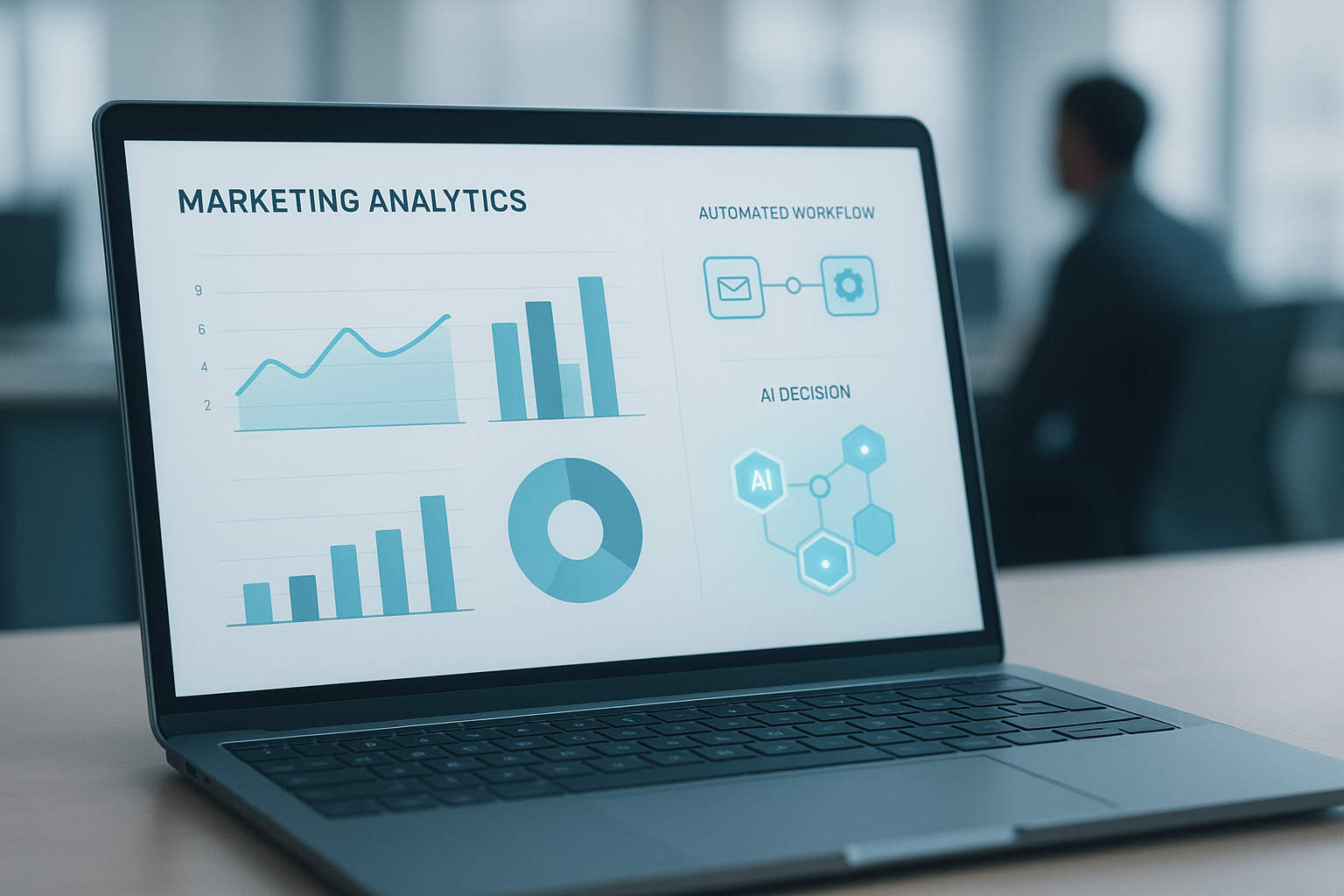
A typical AI-driven marketing automation dashboard combines real-time analytics with automated decision triggers.
Solving Data Fragmentation: The Hidden Requirement Behind AI-Driven Marketing Automation
Above all, an AI model is only as good as the data it learns from. Many businesses adopt AI-driven marketing automation tools while their customer data still sits scattered across ad platforms, a CRM, an email service, and a separate analytics dashboard. Consequently, predictions built on incomplete or conflicting data tend to underperform, no matter how advanced the algorithm is.
Therefore, unifying data before layering AI on top is a foundational step that many overviews skip entirely. A connected data layer lets the automation see the full customer journey — from first ad click to final purchase — rather than isolated fragments. For a closer look at building this foundation, see this complete 2025 guide to automated digital marketing insights.
Why Clean, Unified Data Matters More Than the Algorithm
In particular, three data habits separate businesses that see strong results from those that don’t: removing duplicate or outdated contact records before automation begins, standardizing naming conventions across channels so the model reads campaigns consistently, and auditing tracking setups quarterly so decisions stay based on accurate signals rather than broken pixels.
Key Benefits of Automated AI Marketing Tools
Above all, automated AI marketing tools save time by handling tasks that previously required constant manual review. Beyond efficiency, though, several other advantages stand out:
- Faster campaign testing and optimization across email, ads, and search content.
- Consistent personalization at a scale no human team could manage manually.
- Improved discoverability across traditional search engines and AI-powered answer engines.
- Lower operating costs since fewer specialists are needed for repetitive optimization tasks.
- More accurate cross-channel attribution, since the system connects touchpoints a human team might miss.
- Real-time reporting that flags underperforming spend before budgets are wasted.
For teams looking to apply this in practice, resources like how AI tools can enhance a marketing strategy offer practical starting points.
AI-Driven Marketing Automation vs. Traditional Marketing Automation
Traditional marketing automation runs on rules a person defines in advance, such as “send this email if a form is submitted.” In contrast, AI-driven marketing automation continuously tests and adjusts those rules based on what actually works, without needing a person to rewrite them. Learn how to automate your SEO process with a structured rollout and pilot tests.
Therefore, traditional tools tend to plateau in performance once initial rules are set. AI-driven systems, however, keep improving as they gather more data, which is why many marketers now pair the two approaches together rather than relying on one alone:
- Decision-making: fixed rules versus continuous, data-based adjustment.
- Performance curve: plateaus over time versus compounding improvement.
- Maintenance: requires manual rule updates versus self-adjusting logic.
- Best fit: simple, predictable workflows versus complex, high-volume decisions.
Real-World Examples of AI-Driven Marketing Automation in Action
Naturally, the concept becomes clearer through concrete examples. Below are five common ways businesses put AI-driven marketing automation to work today.
Predictive Lead Scoring and Segmentation
Instead of ranking leads manually, the system scores each contact based on likelihood to convert, then automatically routes high-value leads to sales while nurturing the rest with tailored content.
Dynamic Creative Optimization for Ads
Similarly, ad platforms test multiple headline, image, and copy combinations simultaneously, then automatically shift spend toward whichever variant performs best for each audience segment. To see how this fits a broader growth plan, review these automated digital marketing solutions for 2025 growth.
Conversational AI and Chatbot Automation
In addition, chatbots powered by AI qualify visitors, answer common questions, and schedule calls around the clock, capturing leads that would otherwise be lost outside business hours.
Programmatic Media Buying
Meanwhile, programmatic platforms bid on ad inventory in real time, adjusting spend based on predicted conversion probability rather than fixed budgets set weeks in advance.
AI Content Optimization for Search and Answer Engines
Finally, AI-driven marketing automation increasingly extends to content itself, flagging topic gaps and optimizing pages for both traditional search rankings and AI-powered answer engines that summarize results directly.
AI-Driven Marketing Automation Statistics and ROI Signals to Know
Industry research from McKinsey & Company indicates AI-powered marketing tools can lift campaign efficiency and ROI by meaningful margins when applied consistently. As a result, businesses that track the right metrics tend to justify further investment faster than those relying on gut feel alone.
Specifically, the KPIs worth tracking include customer acquisition cost, customer lifetime value, conversion rate lift compared to a pre-automation baseline, and hours of manual work saved per week. For a deeper look at where this technology is heading, see this AI-enhanced digital marketing growth guide for 2025.
How to Set Up Intelligent Marketing Automation: A Step-by-Step Process
Getting started with intelligent marketing automation does not require a technical background. Instead, following a structured process helps avoid wasted spend and unclear results.
- Define one clear goal. Choose a single measurable objective, such as improving email open rates or increasing organic search visibility, before automating anything else.
- Audit existing data quality. Review current customer, content, and campaign data to confirm accuracy, since AI systems learn directly from this information.
- Unify data across channels. Connect your CRM, ad accounts, email platform, and analytics tools into one view so the automation reads the full customer journey correctly.
- Select a platform matched to your goal. Pick a tool built for that specific task, whether it’s email personalization, ad bidding, or search and answer engine optimization.
- Run a limited pilot test. Apply the automation to one segment or campaign first so results can be compared against the existing manual process.
- Review results and expand gradually. Analyze pilot performance, adjust settings as needed, and extend automation to additional channels once results hold steady.
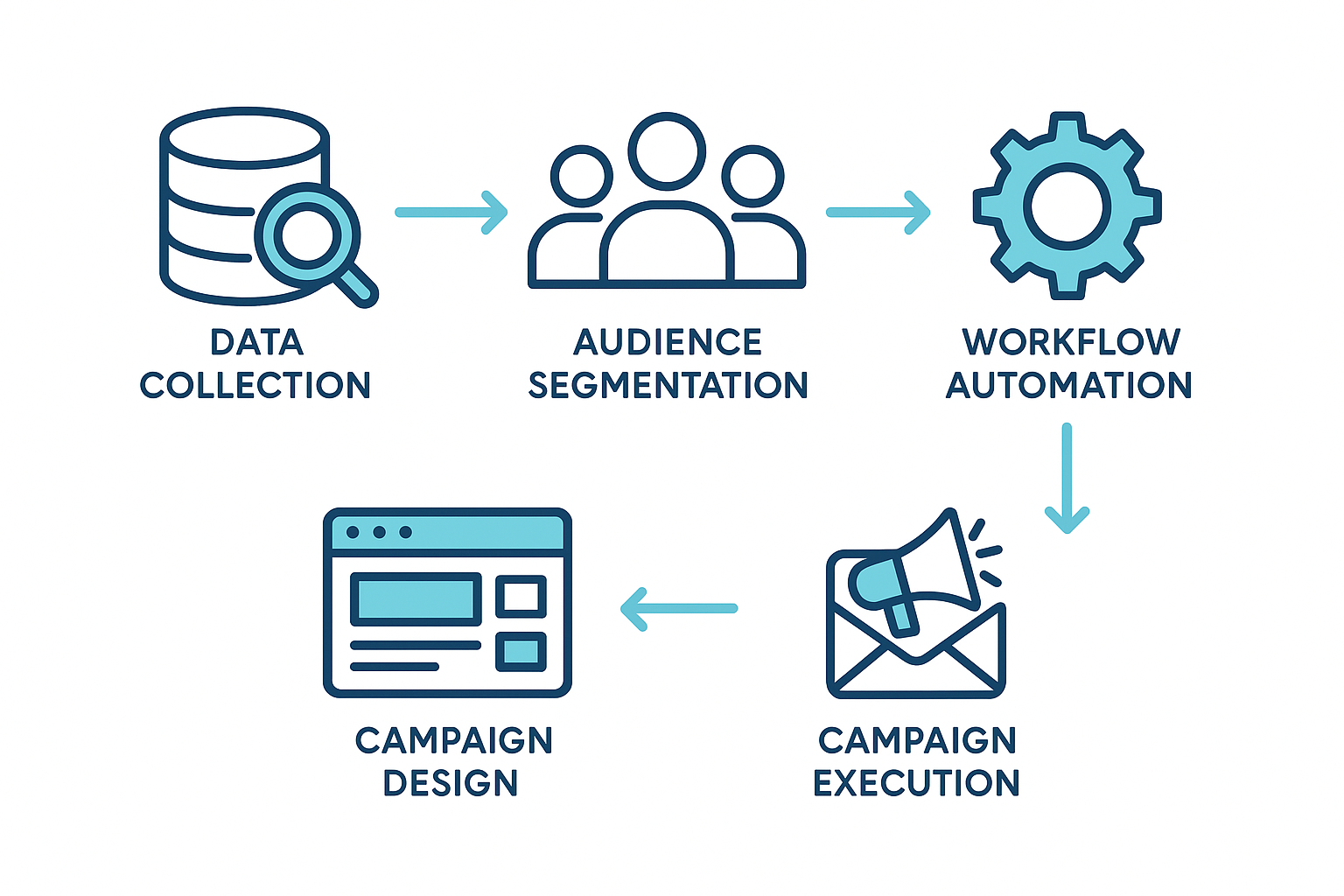
Implementing intelligent marketing automation works best as a gradual, tested rollout rather than an all-at-once switch.
Choosing the Right AI Marketing Automation Platform
Not every platform fits every business, so it helps to match the tool to your specific need rather than choosing based on features alone. Small businesses and agencies managing multiple client sites, for example, typically benefit from platforms that simplify technical setup rather than adding to it. (See how to streamline content marketing with automation tools.)
RankAuthority’s 1-Click AI AutoPilot, for instance, automates the technical and strategic work behind Generative Engine Optimization (GEO) and Answer Engine Optimization (AEO), which helps content stay visible as AI search tools reshape how people find information. Businesses can compare options further through top marketing automation tools for 2025 or explore rankauthority.com directly, including its seven-day trial period.

Choosing the right AI-driven marketing automation platform depends on business size, goals, and technical comfort. For a deeper platform comparison, see our marketing automation platform guide.
Common Mistakes to Avoid With AI-Driven Marketing Automation
One frequent mistake is automating a weak strategy instead of fixing it first. Since automation scales whatever process it’s given, poor targeting or messaging gets amplified just as quickly as strong strategy does.
Similarly, businesses sometimes skip the pilot-testing stage and roll out automation across every channel at once. In contrast, testing on a single segment first makes it far easier to spot and fix issues before they affect the whole campaign. Another overlooked mistake is ignoring data fragmentation, since even a strong algorithm produces weak results when it’s fed inconsistent or siloed information. For more context on integrating this into an existing plan, see smarter AI marketing campaigns for 2025 and effective digital marketing tools for 2026.
Data Privacy, Security, and Compliance in AI-Driven Marketing Automation
Because AI-driven marketing automation depends on customer data, privacy and security cannot be an afterthought. Reputable platforms encrypt stored data, limit access by role, and document how customer information moves through each automated workflow.
Furthermore, frameworks like the NIST AI Risk Management Framework give businesses a practical checklist for evaluating whether an AI vendor handles data responsibly. Above all, compliance requirements vary by industry and region, so reviewing a vendor’s data policies before onboarding remains a necessary step regardless of how advanced its automation looks on the surface.
The Future of AI-Driven Marketing Automation: Trends for 2025 and Beyond
Looking ahead, agentic AI systems that chain multiple tasks together without human approval at every step are becoming more common. In addition, generative AI is expanding beyond copywriting into full campaign asset creation, from ad variants to landing pages built on the fly.
Perhaps most notably, as more searches happen through AI-powered answer engines rather than traditional results pages, AI-driven marketing automation is expanding into content visibility itself, not just campaign execution. Businesses that adapt early to this shift, rather than after it becomes mainstream, are positioned to capture disproportionate visibility gains.
Frequently Asked Questions About AI-Driven Marketing Automation
What is AI-driven marketing automation?
AI-driven marketing automation is the use of artificial intelligence to run, test, and optimize marketing tasks like segmentation, content, and ad bidding automatically. It differs from basic automation because it learns from performance data and adjusts strategy without manual rule updates.
How does AI-driven marketing automation differ from regular marketing automation?
Regular automation follows fixed if-then rules set by a human, while AI-driven marketing automation uses machine learning to predict outcomes and change tactics on its own. As a result, AI-based systems tend to improve over time instead of staying static.
How much does AI-driven marketing automation cost?
Pricing varies widely, from free entry-level tools to enterprise platforms costing several thousand dollars monthly. Many providers, including RankAuthority, offer a risk-free trial period so businesses can test results before committing to a paid plan.
How long does it take to see results?
Most businesses notice measurable improvements in engagement or efficiency within four to eight weeks. However, deeper gains in search visibility and ranking authority often build gradually over three to six months.
Can small businesses benefit from AI-driven marketing automation?
Yes, small businesses often benefit the most because AI-driven marketing automation removes the need for large in-house teams. It allows a single owner or small marketing team to manage tasks that once required specialists.
What tools use AI-driven marketing automation?
Common examples include email platforms with predictive send-time optimization, chatbots, dynamic ad bidding systems, and GEO or AEO platforms like RankAuthority’s 1-Click AI AutoPilot. These tools automate decisions that used to require manual analysis.
Does AI-driven marketing automation replace human marketers?
No, it does not replace marketers; instead, it removes repetitive tasks so people can focus on strategy and creative work. Human oversight is still needed to set goals, review brand voice, and interpret nuanced results.
What skills are needed to manage it?
Basic data literacy, an understanding of campaign goals, and comfort reviewing performance dashboards are usually enough. Most modern platforms are built to minimize the technical learning curve for non-specialists.
How does it improve SEO and content visibility?
AI-driven marketing automation analyzes search patterns, content gaps, and ranking signals to suggest or apply optimizations automatically. This helps content stay visible across both traditional search engines and newer AI-powered answer engines.
Is it secure and compliant with privacy laws?
Reputable platforms follow data protection standards and regional privacy regulations when processing customer information. Businesses should still review each vendor’s data policies, since compliance requirements vary by industry and location, according to FTC guidance on AI use in business.
What’s the best way to start?
Start with one clear goal, such as improving email engagement or search visibility, rather than automating everything at once. Testing a single workflow first makes it easier to measure results and expand gradually.
How does AI-driven marketing automation affect ROI?
Industry research from McKinsey indicates AI-powered marketing tools can lift campaign efficiency and ROI by meaningful margins when applied consistently. Results depend on data quality and how closely the automation is aligned with business goals.
How does AI-driven marketing automation handle data from multiple channels?
It typically connects to a unified data layer that pulls information from ad platforms, CRMs, and email tools into one view. Without this unification step, predictions and personalization become far less accurate.
Is AI-driven marketing automation suitable for agencies managing multiple clients?
Yes, agencies often gain the most leverage since AI-driven marketing automation lets one team manage optimization across many accounts simultaneously. Platforms with simple technical setup are especially valuable in this context.
Final Thoughts
In summary, AI-driven marketing automation gives businesses of any size a practical way to compete in an increasingly AI-shaped search landscape without needing a full in-house technical team. From data-driven personalization to automated search optimization, the technology handles the repetitive work while people focus on strategy.
Ultimately, success depends less on picking the flashiest tool and more on starting with a clear goal, unifying your data, testing carefully, and scaling what works. Whether managing one website or several client accounts, adopting AI-driven marketing automation thoughtfully now can set the foundation for stronger visibility well into the future.

