

Complete 2025 Expert Guide · AI SEO Analytics
AI-Driven SEO Analytics: The Complete 2025 Guide to Rankings, Tools, and ROI
Search rankings are no longer won by whoever works hardest — they are won by whoever has the smartest data. This definitive guide explains what ai-driven seo analytics is, how it works in practice, which tools lead the field, how to measure real ROI, and exactly how to implement it step by step — so you can outpace competitors still relying on manual workflows.
Quick Answer
AI-driven SEO analytics is the use of artificial intelligence — including machine learning, natural language processing, and predictive modeling — to automatically collect, interpret, and act on search optimization data at scale. It replaces slow manual reporting with real-time anomaly detection, predictive ranking forecasts, semantic keyword clustering, and prioritized action recommendations — compressing weeks of analyst work into hours and enabling measurable, faster ranking gains.
What Is AI-Driven SEO Analytics?
AI-driven SEO analytics is the discipline of applying artificial intelligence technologies — machine learning models, natural language processing engines, predictive algorithms, and automated data pipelines — to the enormous and constantly shifting volume of data that governs search engine rankings. Where traditional analytics tools present raw numbers, AI layers actionable meaning on top of those numbers: surfacing which changes will move rankings, which competitors are accelerating, and which content gaps represent the fastest path to sustainable traffic growth.
The fundamental shift AI brings to SEO is one of speed, scale, and pattern recognition. Human analysts working with spreadsheets and manual rank trackers operate on weekly or monthly cycles. AI systems operate continuously — ingesting crawl data, search console signals, SERP fluctuations, backlink changes, and competitor activity simultaneously, then surfacing insights before competitors even notice a trend.
According to search engine optimization principles documented on Wikipedia, SEO has always been a data-intensive discipline involving technical factors, content relevance, and authority signals. AI elevates the precision and velocity with which that data becomes strategy — transforming SEO from a reactive discipline into a proactive, predictive one.
The practical result: organizations that adopt AI-driven SEO analytics consistently outpace those relying on manual workflows — not because they have more people, but because every decision is grounded in a richer, faster-updating data model that compounds in sophistication over time.
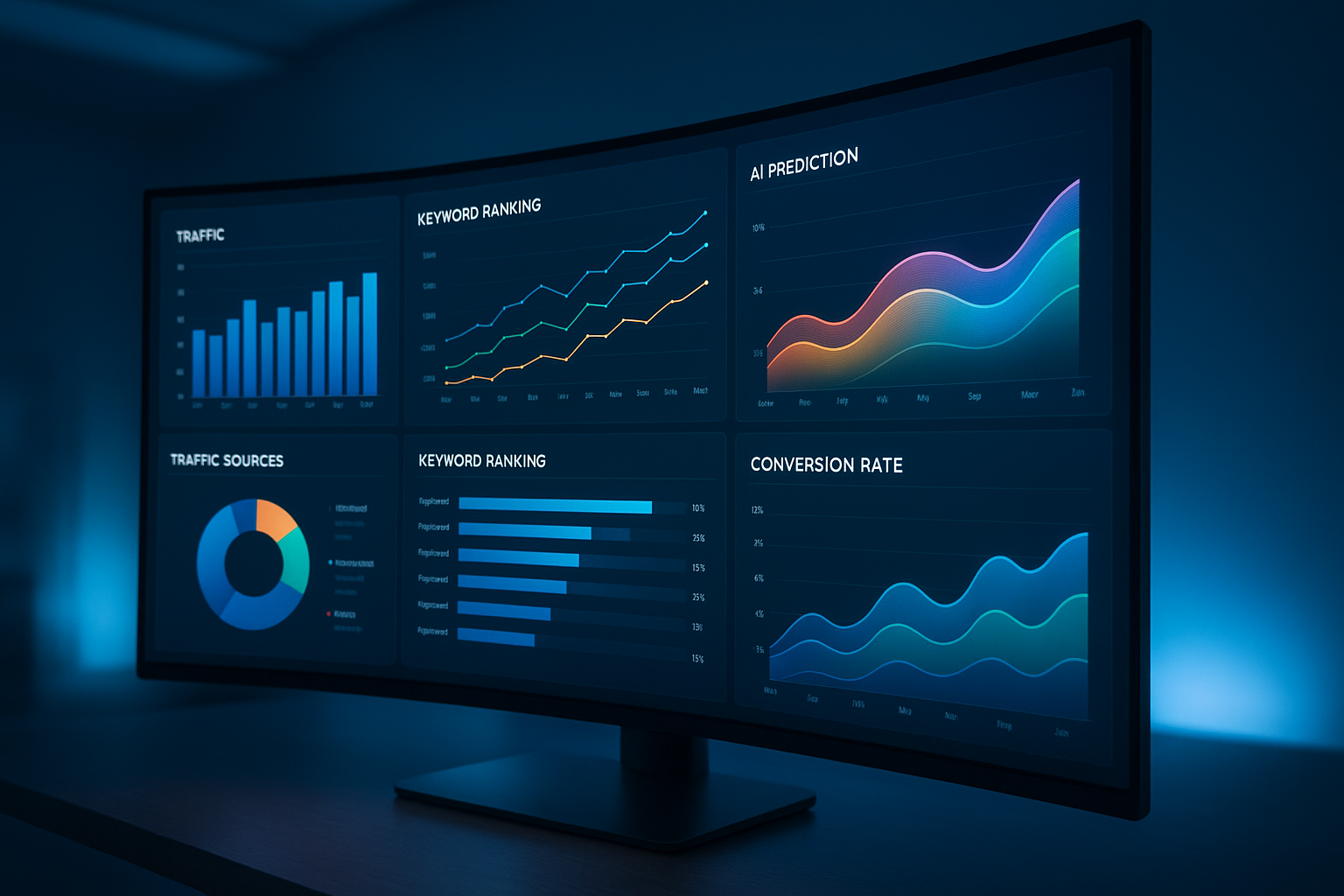
A modern ai-driven seo analytics interface surfaces ranking trends, content gaps, and predictive forecasts in a single unified view.
How AI Transforms Traditional SEO Data
Traditional SEO analytics relied on static snapshots: weekly rank tracking reports, monthly traffic summaries, and manually compiled spreadsheets. The lag between data collection and insight was measured in days or weeks. By the time an analyst identified a ranking drop, diagnosed its root cause, and recommended a fix, competitors had already capitalized on the opportunity.
AI-driven systems operate on a fundamentally different timeline and with a categorically different level of analytical depth. The table below illustrates the contrast across the most critical dimensions of SEO data work:
| Dimension | Traditional SEO Analytics | AI-Driven SEO Analytics |
|---|---|---|
| Data update frequency | Weekly or monthly | Continuous / real-time |
| Keyword categorization | Manual, days of work | NLP clustering in minutes |
| Ranking change alerts | Discovered in next report | Anomaly detection within hours |
| Content optimization | Manual competitor review | NLP scoring vs. top 20 SERPs |
| Competitor monitoring | Periodic spot checks | Continuous automated benchmarking |
| Traffic forecasting | Gut feel or simple extrapolation | ML-powered predictive models |
| Opportunity prioritization | Analyst judgment | Impact-ranked by projected ROI |
In practical terms, AI-driven SEO analytics systems deliver five capabilities that traditional tools simply cannot replicate at scale:
-
⚡
Real-time monitoring. AI crawlers and rank trackers update continuously, detecting algorithm fluctuations and SERP changes within hours — not days — giving teams time to respond before rankings erode. -
🧠
Predictive ranking intelligence. Machine learning models trained on historical SERP data can forecast which pages are likely to gain or lose positions — before the shift happens — enabling proactive optimization rather than reactive damage control. -
🔍
Semantic intent clustering at scale. NLP models group thousands of keywords by underlying search intent — informational, navigational, commercial, transactional — collapsing weeks of manual categorization into minutes and revealing content gaps invisible to manual analysis. -
📊
Impact-ranked prioritization. Rather than a flat list of recommendations, AI ranks every opportunity by projected ranking impact and traffic value — ensuring teams always work on what moves the needle most, not just what is easiest to fix. -
🔗
Continuous competitor benchmarking. AI automatically benchmarks your site against top-ranking competitors on every tracked keyword, alerting teams instantly when rivals publish significant new content, earn authoritative backlinks, or shift their content strategy.
Core Components of an AI-Driven SEO Analytics Stack
A mature AI-driven SEO analytics implementation is not a single tool — it is a layered stack of specialized capabilities working in concert. Here are the six functional layers every serious SEO program needs, along with what each layer actually does and how it contributes to the whole:
Layer 01
Intelligent Crawling and Technical Auditing
AI-powered crawlers do far more than list broken links. They model how Googlebot navigates your site, identify crawl budget waste, detect JavaScript rendering issues that hide content from indexing, and score technical health across hundreds of thousands of pages simultaneously.
Critically, modern AI auditing tools can prioritize technical fixes by estimated traffic impact — so engineers are not spending weeks fixing errors that affect two pages when a single Core Web Vitals issue is suppressing rankings site-wide. Enterprise platforms like Botify and Lumar (formerly DeepCrawl) specialize in this layer, while tools like Screaming Frog pair well with AI analysis extensions.
Layer 02
Predictive Keyword Intelligence
Beyond volume and difficulty scores, AI keyword tools model seasonal demand shifts, emerging query trends, SERP feature likelihood (featured snippets, People Also Ask boxes, knowledge panels), and topic velocity — how quickly interest in a keyword cluster is rising or falling.
This lets content teams invest in topics before they peak — a decisive competitive advantage in fast-moving industries. It also enables negative prioritization: identifying keyword clusters where intent misalignment means ranking would deliver traffic that never converts.
Layer 03
NLP-Based Content Performance Scoring
NLP-powered content scoring tools analyze your pages against top-ranking competitors for semantic completeness, entity coverage, topical authority, and readability. Rather than counting keyword occurrences, these systems assess whether your content comprehensively addresses the full topic scope that top-ranking pages collectively cover.
Platforms like Surfer SEO, Clearscope, and MarketMuse produce real-time content briefs that tell writers exactly which concepts, entities, and questions to address — removing guesswork from the content creation process entirely and replacing it with statistically-backed direction.
Layer 04
Automated Rank Tracking and Anomaly Detection
AI rank trackers do not simply report positions — they detect statistically significant anomalies and correlate ranking changes with external events: confirmed algorithm updates, competitor content launches, new backlink acquisition, or technical regressions introduced through site deployments.
This transforms rank data from a lagging indicator into a real-time diagnostic instrument. When a page drops 8 positions overnight, an AI system can determine within hours whether the cause is algorithmic, competitive, technical, or a backlink loss — dramatically reducing the time to remediation.
Layer 05
AI-Powered Link Intelligence
Backlink analysis has historically been one of the most time-consuming aspects of SEO. AI-powered link intelligence tools assess backlink profiles at scale — evaluating not just domain authority but topical relevance, anchor text diversity, link velocity patterns, and spam risk scoring across thousands of linking domains simultaneously.
More importantly, AI link tools identify link gap opportunities: specific domains that link to multiple competitors but not to you — surfacing an outreach list ranked by authority and relevance without manual research.
Layer 06
ROI Attribution and Revenue Forecasting
The final and most strategically valuable layer connects SEO activity directly to revenue. AI attribution models map organic sessions to conversions across multi-touch customer journeys, calculate the monetary value of ranking improvements, and generate traffic forecasts that give leadership defensible numbers for budget allocation decisions.
For a comprehensive framework on connecting analytics to revenue outcomes, Rank Authority’s 2026 AI SEO playbook for strategy and ROI provides an excellent reference for organizations building this capability.

Integrating AI analytics into daily SEO workflows reduces manual reporting time and accelerates data-to-decision cycles significantly.
Best AI-Driven SEO Analytics Tools in 2025
The AI SEO tools landscape has matured dramatically. Below is a structured breakdown of the leading platforms by functional category — along with their standout AI-specific capabilities and ideal use cases:
All-in-One AI SEO Platforms
Semrush
AI keyword clustering, topic research, writing assistant, and position tracking with intent classification. Best for teams that want breadth across keyword, content, and competitive intelligence in one platform. Strong for both SMBs and enterprise teams.
Ahrefs
Predictive backlink analysis, traffic value modeling, content gap identification, and SERP feature tracking. Particularly strong for link intelligence and keyword difficulty modeling at scale. The Site Audit feature is among the most technically comprehensive available.
Moz Pro
Domain Authority modeling, SERP analysis, and keyword explorer with opportunity scoring. Well-suited for teams that prioritize clean data visualization and straightforward prioritization recommendations without heavy setup.
AI Content Intelligence Platforms
Surfer SEO
NLP-based content scoring that analyzes your page against the top 20 SERP results in real time, scoring for semantic completeness, entity density, and structural alignment. The content editor provides live guidance during writing — not just after the fact.
Clearscope
Semantic relevance optimization platform favored by enterprise content teams for its clarity of output and integration with Google Docs. Grades content on topical coverage using IBM Watson NLP and real SERP analysis.
MarketMuse
Topic modeling platform that maps your entire content library against topic authority scores, identifying where your site has depth and where competitors hold authority gaps. Strongest for large content operations with hundreds of existing pages to optimize.
Enterprise AI SEO Analytics Platforms
BrightEdge
Full-funnel AI forecasting, revenue attribution, and share-of-voice tracking at enterprise scale. The DataCube technology provides cross-channel keyword intelligence across billions of data points. Widely used by Fortune 500 SEO teams.
Conductor
Enterprise content intelligence and SEO analytics platform with deep workflow integration, multi-site management, and AI-powered content recommendations tied directly to revenue metrics. Strong for global and multi-brand organizations.
Botify
Enterprise-grade technical SEO and log file analysis platform with AI-powered crawl optimization. Particularly powerful for large e-commerce and publishing sites with millions of pages where crawl budget management is a critical ranking lever.
How AI-Driven SEO Analytics Improves Search Rankings
AI-driven SEO analytics improves rankings through a compounding feedback loop that manual processes simply cannot replicate. The mechanism operates across five interconnected vectors:
1. Faster Response to Algorithm Changes
Google’s core algorithm updates, BERT improvements, and helpful content system adjustments affect rankings continuously. AI analytics systems detect anomalous ranking movements across your entire keyword portfolio within hours of an update rolling out — while teams relying on weekly reports are still oblivious a week later. Faster detection means faster diagnosis, faster remediation, and faster recovery of lost rankings.
2. Content That Matches Search Intent More Precisely
NLP analysis of the top-ranking pages for any keyword reveals exactly which semantic concepts, entities, and questions that query population expects to find answered. Content built against this model satisfies intent more completely than content written from instinct — and Google’s ranking systems are explicitly designed to reward intent satisfaction. AI-scored content consistently outperforms non-scored content for ranking speed and depth.
3. Strategic Prioritization of High-Leverage Work
Every SEO team has a finite capacity for content creation, technical fixes, and link acquisition. AI analytics tools rank every open opportunity by projected ranking impact and traffic value — ensuring the team’s capacity is always invested in the work with the highest return. This alone can double or triple the effective output of a fixed-size team by eliminating low-value work.
4. Proactive Competitive Response
AI competitive monitoring alerts you when a rival publishes new content targeting a keyword you rank for, earns a significant link that shifts their authority, or improves their content score on a shared target. This allows your team to respond with strategic counter-moves — updated content, targeted link building, or SERP feature optimization — before the competitor’s changes fully propagate in rankings.
5. The Compounding Advantage
Each AI-informed optimization feeds back into the model, progressively refining future recommendations based on what actually moves rankings for your specific domain, niche, and competitive landscape. A site running AI analytics for twelve months benefits from a dramatically smarter recommendation engine than one that has been running for thirty days. The competitive advantage compounds continuously — making it structurally harder for manual competitors to close the gap over time.
For organizations ready to operationalize this capability, the detailed execution strategies at Rank Authority’s guide to AI search engine optimization strategies, tools, and ROI bridge the gap between analytics insight and day-to-day implementation. For a deeper walkthrough, see our AI-Driven Content Marketing: The Complete Guide.
Real-World Use Cases and Applications of AI SEO Analytics
Understanding what AI-driven SEO analytics does in theory is one thing — seeing how it plays out across specific industries and team sizes clarifies its real-world value. Here are five concrete application scenarios:
E-Commerce: Scaling Product Page Optimization
A large e-commerce retailer with 50,000 product pages cannot manually audit and optimize each one. AI crawlers identify which product pages have thin content, missing structured data, or duplicate title tags — and rank them by estimated traffic loss from each issue. NLP scoring tools then generate content briefs for the highest-priority pages, enabling a team of three to systematically improve thousands of pages in the time it previously took to fix dozens.
B2B SaaS: Topical Authority Building
A B2B software company wants to build topical authority around a product category. AI topic modeling maps the entire keyword universe — thousands of related queries — and identifies the fifteen content clusters that together cover the full topic comprehensively. Rather than publishing random blog posts, the content team executes a structured topical authority program that Google’s systems recognize as expertise — producing outsized ranking gains across the entire cluster, not just individual posts.
News and Media: Real-Time Trend Capture
Digital publishers live and die by their ability to capture search traffic on emerging topics before competitors publish. AI trend detection tools identify rising query patterns — often within hours of a news event — and alert editorial teams to high-opportunity topics with low current competition. This early-mover advantage frequently produces featured snippet and top-3 rankings that persist even after larger competitors publish.
Local Businesses: Competitive Gap Identification
Even small local businesses benefit from AI analytics. A multi-location service business can use AI competitor analysis to identify which locally-targeted keywords their top competitors rank for that they do not — revealing a specific, actionable content roadmap. AI tools also audit Google Business Profile completeness and local citation consistency at scale across all locations simultaneously.
Enterprise: Cross-Site Portfolio Management
Global enterprises managing dozens of regional or brand-specific websites face a coordination challenge that is impossible to address manually. AI-driven SEO analytics platforms provide unified dashboards across all properties, AI-powered content reuse recommendations (identifying content that performed in one market and should be adapted for another), and cross-site cannibalization detection — ensuring domains work together rather than competing against each other in search.
Measuring ROI from AI-Driven SEO Analytics
ROI measurement is where AI analytics programs either earn their budget or lose it. The good news: AI makes attribution far more precise than ever before. Here is the complete framework leading organizations use to demonstrate and defend the value of their AI SEO investment:
ROI Measurement Framework
Time Saved on Reporting and Analysis
Track analyst hours before and after AI implementation. Most teams report 30–60% reduction in manual data compilation time, freeing capacity for strategic, revenue-generating work. At an average analyst cost of $75/hour, this alone can justify mid-tier platform costs within the first quarter.
Ranking Velocity
Measure the average time from content publication to first-page ranking before and after AI-guided optimization. Faster ranking velocity means faster revenue impact. Benchmark this metric quarterly to track the compounding improvement in your recommendation model’s accuracy.
Organic Revenue Attribution
AI attribution models connect organic sessions to conversions across multi-touch journeys and assign defensible monetary value. This produces a cost-per-acquisition figure for organic search that can be compared directly against paid channel benchmarks — making the business case for organic investment quantitative rather than qualitative.
Competitive Share of Voice
Track your share of total impressions across your target keyword universe over time. AI tools make this calculation automatic and continuous — turning an otherwise labor-intensive market analysis into a dashboard metric that updates daily and trends over quarters.
Content Efficiency Ratio
Divide total organic traffic generated by the number of content pieces published in a given period. AI-optimized content consistently produces higher traffic per piece than non-optimized content — increasing this ratio is a direct measure of how effectively the AI recommendation layer is improving content ROI over time.
Common Challenges in AI SEO Analytics — and How to Overcome Them
AI-driven SEO analytics is powerful but not without friction points. Understanding these challenges before implementation prevents common failure modes:
Challenge 1: Data Silos Limit AI Effectiveness
The problem: AI analytics systems are only as good as the data they can access. Organizations with disconnected tools — rank tracker, GSC, CRM, analytics platform — in separate silos prevent the AI from seeing the full picture.
The solution: Prioritize platforms with native integrations or invest in a data warehouse layer (BigQuery, Snowflake) that aggregates all SEO-relevant data before feeding it to your AI analytics tools. Unified data produces exponentially richer AI insights.
Challenge 2: Over-Reliance on AI Recommendations
The problem: Teams that blindly implement every AI recommendation without applying editorial judgment sometimes produce content that is technically optimized but lacks the depth, perspective, and genuine expertise that builds lasting topical authority and earns backlinks.
The solution: Treat AI recommendations as a structured starting point, not a final answer. The best SEO content combines AI’s data precision with human expertise, unique insights, and original research. AI tells you what to cover; human expertise determines how to cover it better than anyone else.
Challenge 3: Tool Proliferation and Integration Complexity
The problem: Assembling the ideal six-layer AI SEO stack often means managing five to eight separate tools — each with its own login, data model, and recommendation output. Teams lose time context-switching and reconciling conflicting data across platforms.
The solution: For most teams, start with one all-in-one platform that covers keyword, content, and rank tracking. Add specialized layers (link intelligence, enterprise auditing) only when you have exhausted the core platform’s capabilities. Complexity should scale with team maturity, not be imposed at the start.
Challenge 4: Attribution Ambiguity in Multi-Channel Organizations
The problem: Isolating the contribution of AI-driven SEO improvements from paid, social, and email traffic in revenue attribution models is genuinely difficult — especially in organizations where channels heavily overlap in the customer journey.
The solution: Use incrementality testing — systematically varying AI implementation across comparable site sections or time periods — to isolate the organic contribution. Pair this with assisted conversion reporting in GA4 to understand SEO’s role across multi-touch journeys, not just last-click credit.
30-Day Implementation Roadmap: Start Getting Results Fast
The barrier to entry for AI-driven SEO analytics has dropped dramatically. Here is a practical, step-by-step 30-day onboarding roadmap that produces measurable early wins while building toward long-term compounding advantage:
-
1
Days 1–7: Full AI Audit and Baseline Establishment
Run a comprehensive AI site audit covering technical health, Core Web Vitals, crawlability, indexation status, and content quality scores. Document current ranking positions, organic traffic by page, and SERP feature ownership. Connect Google Search Console and GA4 to your AI platform. This baseline is the benchmark against which every future improvement is measured — without it, you cannot demonstrate ROI or identify the highest-leverage starting points.
-
2
Days 8–14: Keyword Intelligence and Intent Mapping
Import your full target keyword universe into an AI clustering tool. Use NLP clustering to group by semantic intent and identify topical gaps — areas where competitors rank and you have no content. Map intent clusters to existing pages and flag queries where a single new piece of content could capture multiple related searches. Prioritize by estimated traffic opportunity and current ranking position of best-performing competitors.
-
3
Days 15–21: Content Scoring, Prioritization, and Optimization
Score your top 25–30 pages against AI content benchmarks for the target keywords. Prioritize updates for pages currently ranking positions 8–20 — these represent the highest-leverage optimization opportunities because they are already in Google’s consideration set and require less total lift to reach page one. Implement AI-recommended content improvements, entity additions, and semantic coverage updates. For new content, generate NLP-based briefs before writing begins.
-
4
Days 22–30: Reporting Automation, Anomaly Alerts, and Cadence
Configure automated dashboards that aggregate rank tracking, traffic trends, content performance scores, and competitor changes into a single weekly view. Set up anomaly detection alerts for significant ranking drops across priority keyword clusters. Establish a weekly team review cadence where AI-generated insights drive the priority queue. Assign ownership for recurring AI recommendation categories (technical, content, links). From this point forward, the system compounds continuously — each cycle producing smarter recommendations than the last.

Machine learning models at the core of AI-driven SEO analytics process millions of data signals to surface the insights that matter most.
The Future of AI-Driven SEO Analytics
The capabilities available in AI SEO analytics today will look primitive by 2027. Four trends are reshaping the discipline in ways every SEO practitioner should understand and prepare for:
Generative AI Integration with Analytics Workflows
The next generation of AI SEO platforms will not just analyze and recommend — they will draft, publish, and optimize content autonomously within human-defined parameters. Platforms are already integrating large language models directly into their content scoring and editing workflows. Within two years, the line between AI analytics and AI content production will blur significantly — making the quality of the AI’s data model the primary differentiator between tools.
AI Overview Optimization as a Distinct Discipline
Google’s AI Overviews (formerly Search Generative Experience) represent a fundamental shift in how search results are displayed. AI-driven SEO analytics tools are rapidly developing capabilities specifically designed to optimize for AI Overview inclusion — analyzing which content characteristics predict citation in AI-generated summaries and generating structured content formats that AI systems prefer to quote. This is becoming a distinct ranking objective separate from traditional blue-link positioning.
Multimodal SEO Analytics
As Google’s systems become increasingly capable of indexing and ranking images, video, and audio content, AI SEO analytics platforms are expanding beyond text analysis. Emerging tools analyze image alt text optimization at scale, video transcript coverage, podcast content discoverability, and visual search optimization — creating a truly multimodal analytics framework for the next generation of search.
Autonomous SEO Agents
The most significant near-term development is the emergence of AI agents that execute SEO tasks autonomously — not just recommending what to do, but doing it. Early implementations already handle internal link optimization, meta title testing, image alt text generation, and structured data implementation without human involvement. As trust and capability in these systems grows, AI-driven SEO analytics will increasingly shift from “here is what you should do” to “here is what was done and what results were produced.”
Frequently Asked Questions About AI-Driven SEO Analytics
Conclusion
AI-driven SEO analytics is no longer an advanced option reserved for enterprise teams with nine-figure budgets and dedicated data engineering departments. It is the new baseline for any organization serious about competing in organic search — and the tools that make it accessible have never been more capable or affordable. The teams implementing it now are building a compounding data advantage that will be structurally difficult for manual-workflow competitors to overcome. Start with a thorough AI audit, layer in predictive keyword intelligence, score and optimize your most valuable content against NLP benchmarks, automate your reporting, and let data lead every decision from there. The gap between those who do and those who wait widens every quarter. Start now.

