
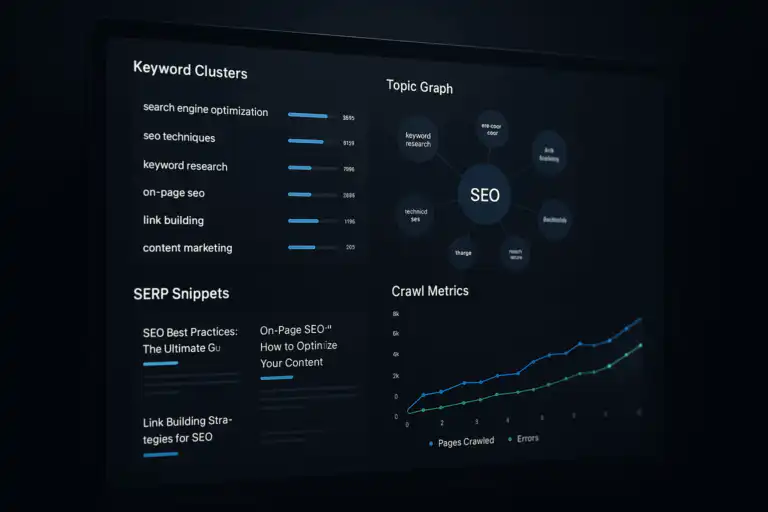
AI-driven SEO software is the single biggest shift in how modern teams research keywords, produce content, and fix technical issues at scale. Instead of juggling a dozen disconnected spreadsheets and crawlers, marketers now lean on machine learning and language models to spot opportunity faster, draft smarter briefs, and catch regressions before they cost rankings. This guide breaks down exactly how AI-driven SEO software works, what separates a genuinely useful platform from a gimmick, and how to build a repeatable workflow that turns automation into durable organic growth in 2026 and beyond.
 A hero visualization of AI-driven SEO software turning raw data into prioritized action.
What Is AI-Driven SEO Software?
AI-driven SEO software combines large-scale data collection with machine learning — a branch of artificial intelligence that improves its predictions from patterns in data — and natural language processing to understand what searchers actually want. In practice, this means the software clusters keywords by intent rather than raw text match, maps semantic entities across a topic, predicts realistic ranking difficulty, and can even draft or score content against top-performing pages. Consequently, it also flags technical faults, ranks fixes by projected impact, and suggests internal links that a human editor might overlook.
Unlike legacy keyword tools, which simply return search volume, an AI-powered SEO platform interprets why a page ranks and translates that reasoning into next steps. In short, it shortens the distance between strategy and execution while keeping a human firmly in the decision seat — a distinction that matters enormously once we get to governance later in this guide.
Why AI SEO Automation Matters More in 2026
Search results have changed dramatically. AI Overviews, zero-click answers, and shifting SERP layouts mean that ranking for a single exact-match keyword no longer guarantees traffic. As a result, teams need software that understands topical clusters, tracks visibility across multiple SERP features, and adapts content the moment intent shifts. In particular, this is where AI-driven SEO software earns its keep: it processes more signals, faster, than any manual process could sustain.
Furthermore, teams that want a broader comparison of automation options should compare the best AI software for automating SEO tasks before committing budget, since capability gaps between platforms are wider than marketing pages suggest.
Core Capabilities That Actually Matter
Data Ingestion and Entity-First Keyword Research
Great results begin with clean, rich inputs. Look for a platform that aggregates search volume, SERP features, click curves, and competitor pages in one place. Above all, strong models group queries by entity — a real-world person, place, product, or concept — rather than exact-match strings alone. This reveals topics that deserve a dedicated page, a supporting section, or an entirely new cluster, giving you a map of demand, intent, and authority gaps you can act on immediately.
Content Intelligence and On-Page Optimization
Modern systems analyze top-performing pages to surface the headings, entities, and questions users expect to see answered. They score drafts for topical depth and clarity, then propose titles, slugs, and meta descriptions aligned with search intent. When connected to your CMS, the software can push structured briefs, verify internal links automatically, and flag content regressions right after publish — long before rankings actually slip.
Technical SEO Diagnostics at Scale
Crawling remains essential, but raw crawl reports overwhelm most teams. AI helps by grouping issues by impact and effort instead of dumping a long list of warnings. For example, a canonicalization error across template pages becomes a single task with projected traffic gains, clear ownership, and a rollback plan — not fifty duplicate line items in a spreadsheet.
Automation With Guardrails
Automation should never remove editorial judgment. Therefore, seek features that let you set brand voice, tone, and sensitive-topic rules directly inside the platform. Human-in-the-loop review, version history, and source attribution all reduce risk. The best AI SEO automation tools expose their prompts and decision logic so your team can audit outcomes and improve them over time, rather than trusting a black box.
Does AI-Generated Content Actually Rank on Google?
This is the question every buyer of AI-driven SEO software eventually asks, and the honest answer is nuanced. Google has stated repeatedly that it rewards helpful, people-first content regardless of how it was produced — see its own guidance on creating helpful content. In contrast, thin, unedited, mass-produced AI text tends to underperform because it lacks the originality and firsthand experience that search quality raters look for.
Consequently, the safest approach is treating AI-driven SEO software as an accelerator for research, structure, and drafting — while a human editor still adds expert insight, real examples, and a final quality pass. Teams that follow this hybrid model consistently outperform those chasing full automation.
AI-Driven SEO Software in Action: A Practical Workflow
The most effective teams use a repeatable loop rather than a one-off project. Here is a streamlined process you can adapt to your own stack:
- Discover demand: Cluster keywords by entity and intent using your AI-driven SEO software, then filter by revenue alignment instead of raw volume alone. Mark quick wins and cornerstone topics separately so priorities stay clear.
- Design the information architecture: Draft hub-and-spoke structures that define canonical pages, supporting articles, and consistent internal link patterns before a single word of content is written.
- Create briefs: Generate content outlines with target entities, likely user questions, and CTA guidance, including examples, reading level targets, and formatting rules for writers to follow.
- Draft and refine: Use AI suggestions to speed up the first draft while editors enforce brand tone and verify every factual claim. Run on-page scoring afterward to catch missing angles.
- Ship with structure: Publish with consistent titles, meta descriptions, schema markup where relevant, and descriptive media alt text. Validate internal links and indexability before promoting the page.
- Monitor and iterate: Track leading indicators during weeks one through three, then evaluate business outcomes at the thirty to ninety day mark. Refresh content and links based on real performance signals.
 A clear, repeatable workflow helps AI-driven SEO software deliver predictable results instead of one-off wins.
If you want a fully mapped version of this loop with templates, our next-generation SEO automation tools guide walks through each stage in more depth, including tool-specific checklists.
How to Evaluate AI SEO Platforms Without the Hype
Shiny demos can distract from day-to-day needs. Use these criteria to choose a partner for your stack instead of a slide deck:
- Data quality and transparency: Ask how volumes, CTR curves, and SERP features are sourced and refreshed, and request methodology notes in writing.
- Model behavior: Can you inspect prompts, weights, or decision rules? Is there a change log, and can you revert a model update that hurts performance?
- Editorial control: Style guides, tone controls, blocked topics, and approval workflows prevent off-brand content from shipping unreviewed.
- Security and privacy: Clarify data retention windows, model training boundaries, PII handling, and access controls before signing a contract.
- Integrations: CMS plugins, analytics connectors, and ticketing integrations reduce manual copy-paste steps across your team.
- Roadmap and support: Look for responsive support, a clear release cadence, and a visible customer feedback loop that actually ships requested features.
For additional background reading and strategy frameworks, explore the resources available at Rank Authority. You will find guidance you can adapt to your own workflows and team structure. For a deeper walkthrough, see our AI-Driven SEO Optimization: The Complete Guide 2025.
AI-Driven SEO Software vs. Traditional SEO Tools
Traditional SEO tools primarily report data: rankings, backlinks, and crawl errors, leaving interpretation entirely to you. In contrast, an AI-powered SEO platform interprets that same data and recommends the next action, which shortens the gap between insight and execution. Similarly, where a legacy rank tracker shows you dropped three spots, AI-driven SEO software can explain why, model the likely cause, and suggest a fix ranked by projected impact.
That said, neither approach replaces strategic thinking. If you are weighing a fully automated, hands-off service against a hybrid model, our breakdown of an AI autopilot SEO service explains where full automation works well and where it still needs human oversight.
Metrics That Prove Real Impact
Choose metrics that connect effort to business outcomes. Leading indicators help you steer early, while lagging indicators validate the overall strategy.
Leading Indicators (Weeks 1–3)
- Indexation and coverage: New pages indexed and excluded pages reduced over time.
- Keyword universe growth: The number of ranking queries expanding across topic clusters.
- Topical depth score: An internal measure of entity coverage per page.
- Internal linking health: Orphan page rate and average inlinks to newly published content.
Outcome Metrics (30–90 Days)
- Non-brand clicks and CTR: Focus on intent clusters rather than vanity brand terms.
- Share of visibility: Weighted presence across all relevant SERP features, not just position one.
- Conversion rate and assisted conversions: Tie content directly to revenue or qualified leads.
- Velocity of refreshes: The percentage of pages updated based on real performance signals.
 Track the right KPIs to show exactly how AI-driven SEO software affects growth over time.
Governance, Risk, and Quality Control
AI speeds up production, but quality is what actually keeps rankings stable. Therefore, set non-negotiables for accuracy, sourcing, and tone before scaling output. Use editorial checklists before every publish and run periodic audits for thin content or outdated claims. In addition, businesses increasingly need documented AI usage policies — the U.S. Federal Trade Commission publishes practical guidance on using artificial intelligence in business that is worth reviewing alongside your editorial standards.
Finally, add a feedback channel connecting sales and support teams to your content workflow. Their frontline insights routinely expose search intents that dashboards alone miss.
Playbooks by Scenario
New Domain or Product Line
Start with topic mapping and a compact hub of cornerstone pages. Then, build supporting articles that answer adjacent questions, focusing on internal links and visuals that naturally earn shares.
Established Site With Content Sprawl
Audit keyword cannibalization, prune low-value pages, and consolidate near-duplicates. Refresh your winning pages with new data and examples, then redirect wisely to preserve existing link equity.
Ecommerce Catalogs
Automate variant canonicalization, enrich product attributes, and generate FAQ blocks from real customer queries. Align category copy with discovery-stage search intent rather than transactional keywords alone.
B2B Lead Generation
Develop problem-solution clusters tied to each stage of the buying journey. Gate content only when it adds genuine value, and use comparison pages to capture high-intent searches. For a narrower, keyword-specific version of this approach, review our guide to targeted SEO automation tools built for competitive B2B niches.
Content Excellence in an AI Age
Even with powerful tools, real authority still comes from originality. Conduct lightweight interviews with subject matter experts and cite credible sources — a habit reinforced by decades of research into how readers evaluate natural language and trust signals online. Add proprietary data wherever possible, and incorporate diagrams, code samples, or calculators that solve real problems. Each useful asset compounds your differentiation against thinner, purely AI-generated competitors.
Cost and ROI Framing
Budget with both software and process in mind. Savings typically appear first as reduced research time, faster briefs, and fewer rounds of edits. Gains later show up as wider topic coverage and stronger conversion paths. Consequently, model scenarios across quarters rather than weeks, and build guardrails so rapid production never dilutes brand trust. If you are exploring a low-effort entry point, our one-click SEO automation powered by artificial intelligence guide covers the fastest way to test AI-driven SEO software without a heavy upfront commitment.
Common Mistakes to Avoid
- Publishing unedited AI drafts: Skipping human review is the fastest way to trigger quality issues and inconsistent brand voice.
- Chasing volume over intent: High search volume means little if the underlying intent does not match your offer.
- Ignoring technical fixes: Even the best content underperforms on a site with crawl or indexation problems.
- Never revisiting old content: Search intent shifts constantly, so a “publish and forget” approach quietly bleeds rankings.
The Future of AI-Driven SEO Software
Expect these systems to move from page-level suggestions toward sitewide orchestration. In particular, we will see smarter internal linking, multi-variant testing for SERP elements, and automated content refreshes keyed to real market shifts. Teams that blend expert judgment with these capabilities will consistently outrun competitors who still treat SEO as a static checklist.
Frequently Asked Questions About AI-Driven SEO Software
What is AI-driven SEO software and how does it work?
AI-driven SEO software uses machine learning and natural language processing to analyze search data, cluster keywords by intent, score content quality, and prioritize technical fixes — turning raw signals into ranked, actionable recommendations instead of static reports.
Does Google penalize content produced with AI-driven SEO software?
No, Google does not penalize content simply because AI assisted its production. However, it does penalize thin, unedited, or unhelpful content regardless of origin, so human review and original insight remain essential.
How much does AI-driven SEO software typically cost?
Pricing varies widely by scope, ranging from affordable single-user plans for small sites to enterprise contracts with custom integrations and dedicated support. Always weigh the subscription cost against saved research and editing hours.
Can AI-driven SEO software replace an SEO strategist or content team?
No. It replaces repetitive research and drafting tasks, not strategic judgment. Teams still need experts to set direction, verify claims, and maintain brand voice across every published page.
What is the difference between AI-driven SEO software and traditional SEO tools?
Traditional tools mostly report data, such as rankings and backlinks, while AI-powered platforms interpret that data and recommend prioritized next steps, saving analysts significant manual work.
How long does it take to see results from AI-driven SEO software?
Leading indicators, like indexation and keyword universe growth, often shift within the first one to three weeks. Meaningful business outcomes, such as conversions, usually take thirty to ninety days to materialize.
Conclusion: Turn Insights Into Durable Growth
AI-driven SEO software works best when paired with clear strategy, editorial standards, and rigorous measurement. Start with entity-first research, ship well-structured content, and review performance signals weekly. Above all, keep humans in the loop to ensure accuracy and brand integrity. If you are ready to accelerate this journey, explore practical frameworks and tutorials at Rank Authority, then apply them to your own roadmap. Commit to steady iteration, and your investment in AI-driven SEO software will compound into lasting organic growth. For a deeper walkthrough, see our AI-Powered Keyword Research for Creators: Full Guide.

