
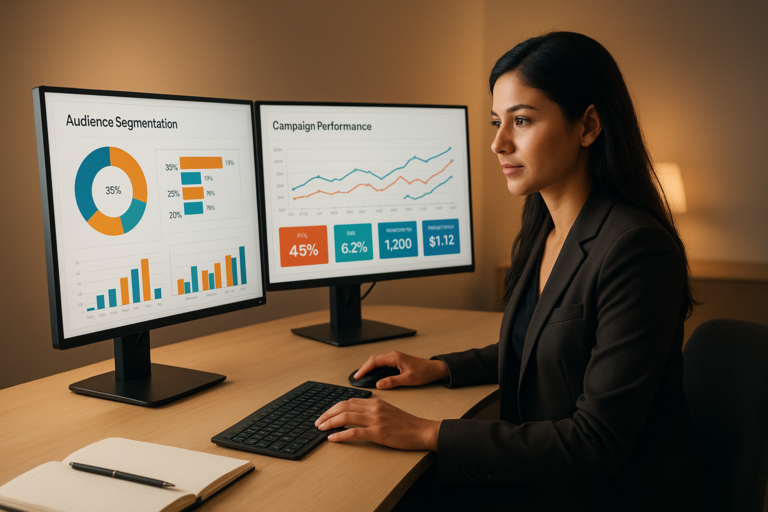
AI insights for marketers are data-driven recommendations and predictions generated by artificial intelligence that help teams understand audiences, optimize campaigns, and make smarter budget decisions faster than ever before. As competition intensifies across every digital channel, marketers who harness these insights gain a measurable edge over those still relying on intuition alone. Therefore, understanding how to apply AI effectively has become one of the most important skills in modern marketing.
This guide breaks down exactly what AI insights mean in a marketing context, which use cases deliver the greatest return, and how to build a practical strategy around them — whether you lead a solo operation or a full marketing department.
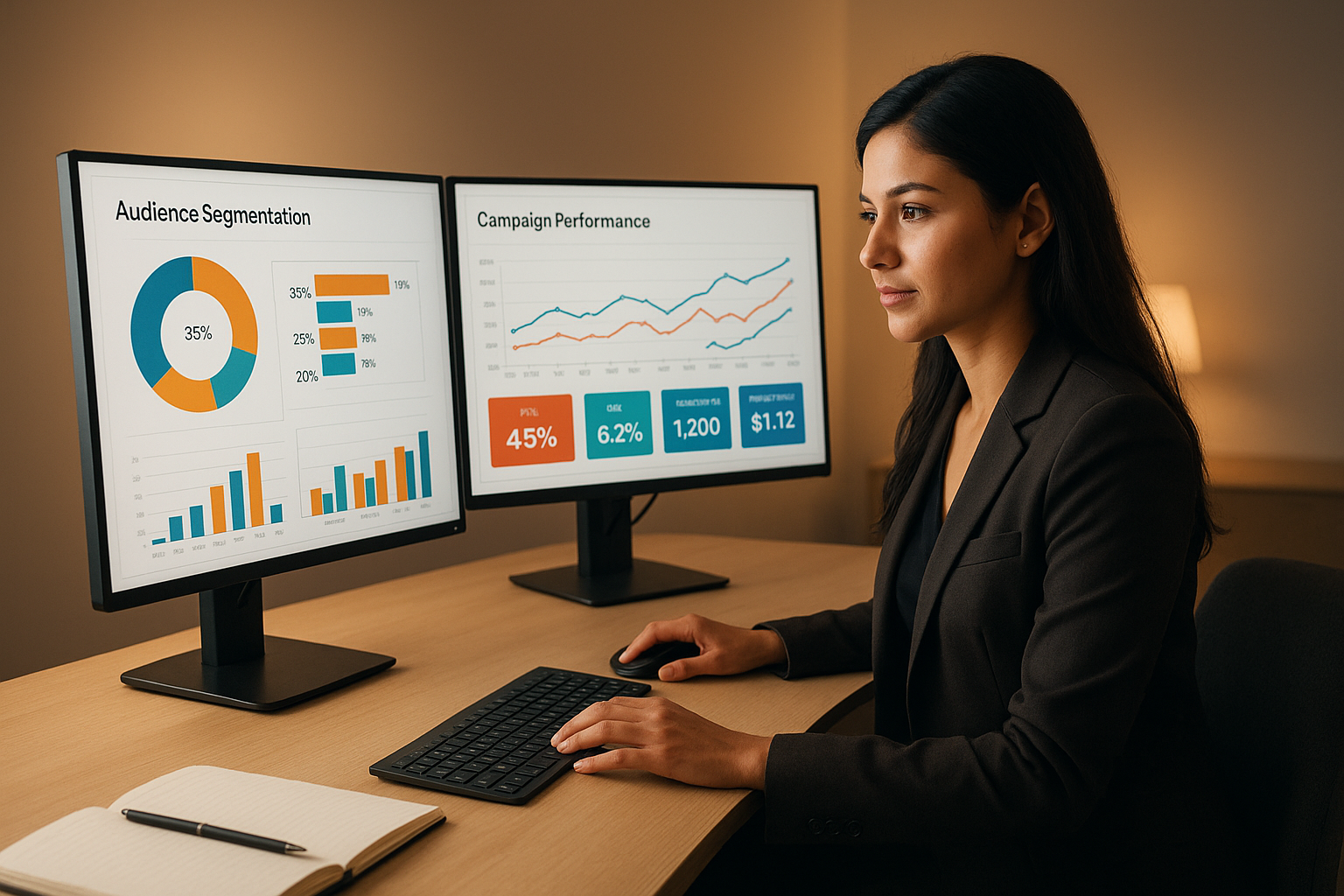
AI-powered dashboards give marketers a real-time view of audience behavior and campaign performance.
What Are AI Insights for Marketers?
AI insights for marketers is the practice of using machine learning, natural language processing, and predictive analytics to surface patterns in marketing data that humans would struggle to find manually. These insights range from identifying which audience segment is most likely to convert this week, to predicting when a loyal customer is about to churn.
In practice, AI processes enormous datasets — website behavior, email engagement, ad performance, social signals — and translates them into clear, actionable recommendations. As a result, marketing teams spend less time digging through spreadsheets and more time executing strategies that are already validated by data.
According to Wikipedia’s overview of AI in marketing, the field has evolved rapidly from basic automation into sophisticated predictive modeling that influences everything from ad creative to pricing strategy.
The Core Benefits Driving Adoption
Speed is the most immediate benefit. Traditional analytics workflows require analysts to pull data, build reports, and present findings — a cycle that can take days. AI compresses that cycle into minutes, allowing teams to react to campaign performance in near real time.
Additionally, AI removes a significant layer of human bias. When decisions are grounded in statistical patterns rather than gut feeling, budget allocation improves and underperforming channels get cut earlier. For example, an AI model might flag that your Tuesday email sends consistently underperform Thursday sends — a pattern easy to miss in a busy week.
Finally, scalability becomes achievable. A team of three can personalize messaging for 50,000 contacts because AI handles the segmentation and content variation logic automatically.
Quick Answer
AI insights for marketers combine machine learning and predictive analytics to surface audience patterns, forecast campaign outcomes, and automate optimization decisions. Teams that act on these insights consistently outperform those relying on manual analysis alone.
High-Impact Use Cases in 2025
Not every AI application delivers equal value. However, the following five areas consistently produce measurable ROI for marketing teams across industries.
1. Predictive Audience Segmentation
Rather than grouping contacts by static demographics, AI builds dynamic segments based on behavioral signals — pages visited, products viewed, time since last purchase. Because these segments update continuously, your targeting stays accurate even as audience behavior shifts.
2. Content Performance Forecasting
AI tools analyze historical engagement data to predict which content formats, headlines, and topics will resonate with specific audience segments before you publish. This means fewer wasted content investments and a higher baseline for organic reach.
3. Paid Ad Optimization
Platforms like Google Ads already use machine learning for smart bidding, but marketers who layer additional AI analysis on top can identify creative fatigue, audience overlap, and budget inefficiencies that platform-native tools miss. As a result, cost-per-acquisition often drops significantly within the first few optimization cycles.
4. Email Personalization at Scale
AI determines the optimal send time, subject line variant, and content block for each individual subscriber. Tools integrated with platforms like HubSpot can automate this personalization without manual setup for every contact, making one-to-one email marketing genuinely achievable at scale.
5. Churn Prediction and Retention
AI models trained on historical customer data can flag accounts showing early churn signals — reduced login frequency, declining purchase value, or increased support tickets. Marketers can then trigger targeted retention campaigns before the customer disengages completely.

Predictive segmentation uses behavioral data flows to build smarter, more responsive audience groups.
Building Your AI-Driven Marketing Strategy
Starting with AI does not require replacing your entire marketing stack. Instead, identify one high-friction area in your current workflow — perhaps lead scoring or email segmentation — and introduce an AI tool to address that specific pain point first.
Next, ensure your data foundation is clean. AI models are only as reliable as the data they train on. Therefore, auditing your CRM for duplicate records, inconsistent tagging, and missing fields before onboarding any AI tool will dramatically improve output quality.
Once your first AI application is running, measure its impact against a defined baseline. For example, compare conversion rates from AI-scored leads against leads that were not scored. This evidence builds internal confidence and justifies expanding AI use to additional channels.
Resources like Rank Authority provide practical guidance on integrating AI into SEO and content workflows, which complements the audience and campaign intelligence covered here.
Common Mistakes Marketers Make with AI
One of the most frequent errors is treating AI recommendations as final decisions rather than starting points. Although AI surfaces patterns efficiently, it cannot account for brand tone, cultural nuance, or emerging news events that might make a campaign inappropriate. Human review remains essential.
Another common mistake is deploying AI without a clear objective. Teams that adopt tools broadly, hoping AI will reveal something useful, often end up overwhelmed by data without a clear action path. In contrast, teams that define a specific question — “Which leads are most likely to convert this quarter?” — extract far more value.
Finally, ignoring privacy compliance is a serious risk. AI tools that process customer data must align with regulations such as GDPR and CCPA. Marketers should confirm data handling practices with vendors before connecting any customer database to a third-party AI platform.
Measuring the ROI of AI in Your Campaigns
Measuring ROI starts with establishing a pre-AI baseline for your key performance indicators — cost per lead, email open rate, conversion rate, and customer lifetime value. After implementing AI-driven optimizations, track the same metrics over a 60 to 90 day window to identify statistically meaningful changes.
Because AI improvements often compound over time — the model learns as more data flows through — early results may understate long-term gains. Additionally, qualitative benefits like reduced analyst workload and faster campaign iteration cycles carry real value even when they are harder to quantify in a spreadsheet.
For a deeper look at how AI is reshaping search and content ROI, Rank Authority covers the intersection of AI and organic visibility in practical detail. For a deeper walkthrough, see our AI Optimization Tools: The Complete 2026 Guide.
Key Takeaway: The marketers seeing the greatest gains from AI are not the ones with the biggest budgets — they are the ones who define clear objectives, maintain clean data, and treat AI as a continuous optimization engine rather than a one-time setup.
Putting AI Insights to Work: A Practical Conclusion
AI insights for marketers represent a fundamental shift in how campaigns are planned, executed, and refined. The technology is no longer experimental — it is embedded in the tools most marketing teams already use, from email platforms to paid search consoles.
The most effective path forward is incremental: start with one use case, measure rigorously, and expand based on proven results. Teams that build this habit now will compound their advantage as AI capabilities continue to advance throughout 2025 and beyond.
Frequently Asked Questions
What are AI insights for marketers?
AI insights for marketers are data-driven recommendations and predictions generated by artificial intelligence tools that help marketing teams understand audience behavior, optimize campaigns, and improve ROI. These insights are produced by analyzing large datasets far faster than any human team could manage manually.
How does AI improve audience targeting in marketing?
AI improves audience targeting by analyzing behavioral signals, purchase history, and engagement patterns to build precise audience segments. This allows marketers to deliver personalized messages to the right people at the right time, reducing wasted ad spend.
Which marketing tasks benefit most from AI?
Content personalization, email campaign optimization, paid ad bidding, SEO keyword research, and customer churn prediction benefit most from AI. These tasks involve large volumes of data that AI can process and act on in real time.
Is AI marketing only for large enterprises?
No, AI marketing tools are available at all budget levels. Many platforms like HubSpot and Google Analytics offer AI-powered features accessible to small and mid-sized businesses, making data-driven marketing achievable without a large team.
What is predictive analytics in marketing?
Predictive analytics uses historical data and machine learning models to forecast future customer behaviors, such as likelihood to purchase or churn. Marketers use these forecasts to allocate budget more effectively and prioritize high-value leads.
How can AI help with content strategy?
AI analyzes search trends, competitor content, and audience engagement to recommend topics, formats, and publishing schedules most likely to perform well. It can also assist with drafting, editing, and personalizing content at scale.
What are the risks of relying on AI for marketing decisions?
Key risks include data bias, over-automation that removes the human touch, and privacy compliance issues if customer data is not handled properly. Marketers should treat AI as a decision-support tool rather than a full replacement for human judgment.
How do AI tools integrate with existing marketing platforms?
Most modern AI marketing tools integrate via APIs or native connectors with platforms like CRMs, email service providers, and ad networks. This allows insights to flow directly into campaign workflows without requiring manual data transfers.
How quickly can marketers see results from AI-driven campaigns?
Many marketers see measurable improvements in click-through rates and conversion within the first 30 to 90 days of implementing AI-driven optimizations. The timeline depends on data volume, tool quality, and how quickly teams act on AI recommendations.
What skills do marketers need to use AI tools effectively?
Marketers need a foundational understanding of data interpretation, basic analytics, and prompt engineering for generative AI tools. Deep coding skills are rarely required, as most AI marketing platforms are designed for non-technical users.
Can AI replace human creativity in marketing?
AI can assist with creative tasks like generating copy variations and design suggestions, but it cannot fully replace human creativity, brand intuition, or emotional storytelling. The strongest marketing strategies combine AI efficiency with human creative direction.
How does AI support SEO for marketers?
AI supports SEO by identifying high-opportunity keywords, analyzing competitor rankings, and suggesting content improvements that align with search intent. Tools powered by AI can also monitor ranking changes and recommend adjustments in near real time.

