The Definitive Guide
“Ranking on Google used to be enough. In 2025, you also need to exist inside the AI answer.”
An AI visibility checker is a tool that measures how frequently and prominently your brand, website, or content appears within responses generated by AI-powered search engines and answer engines — platforms like ChatGPT, Google Gemini, Perplexity, and Microsoft Copilot. As AI-driven search reshapes how people find information online, understanding and improving your AI search visibility has become as critical as traditional SEO. This guide explains exactly what an AI visibility checker does, why it matters, and how to use one to strengthen your digital presence in 2025.
Quick Answer
An AI visibility checker analyzes AI-generated search responses to determine whether your brand or content is being surfaced, cited, or recommended. It gives marketers a measurable score and actionable recommendations for improving their presence in the rapidly growing AI search ecosystem.
What Is an AI Visibility Checker?
Traditional SEO tools measure your position in search engine results pages (SERPs). An AI visibility checker operates differently — it submits carefully chosen prompts to AI language model-based platforms and then parses the responses to evaluate whether your brand appears, how positively it is framed, and how often it is cited compared to competitors.
Think of it as a rank tracker, but for the AI layer of the internet. Just as you would monitor your position for a keyword on Google, an AI visibility checker monitors your “position” inside AI-generated answers. This discipline is increasingly referred to as Generative Engine Optimization (GEO) — the practice of optimizing content so that it is selected, cited, and surfaced by large language models (LLMs) when users ask relevant questions.
According to research published by Wikipedia on generative artificial intelligence, LLMs synthesize information from vast training datasets to generate contextually relevant responses — making it essential for brands to be well-represented in the data and citations these models rely on.

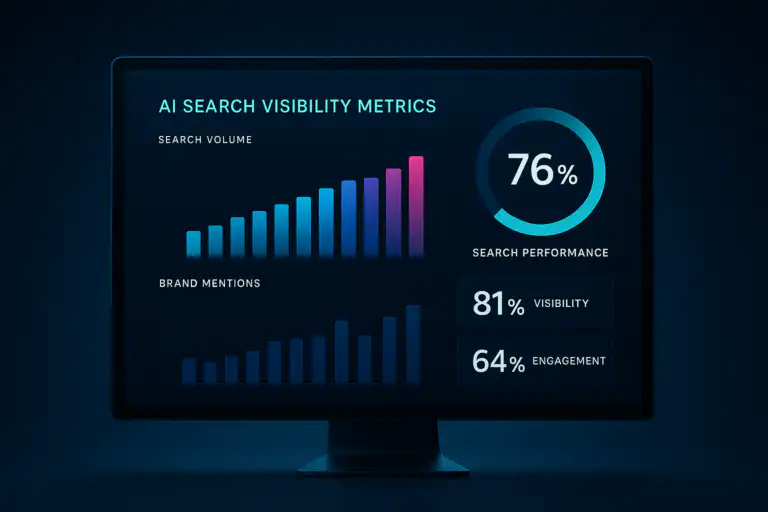
A modern AI visibility checker dashboard surfaces brand mention frequency and sentiment across multiple AI search platforms.
Why AI Search Visibility Matters Right Now
The SEO landscape has shifted dramatically. A growing percentage of internet users now turn to AI assistants to answer questions directly, bypassing traditional search results entirely. When someone asks an AI assistant “What is the best project management software for small teams?” — your brand either appears in that answer or it doesn’t. There is no page two.
This zero-sum dynamic makes AI visibility measurement urgent. Brands that fail to track and optimize for AI-generated responses risk becoming invisible to an entire generation of searchers — even if they hold strong positions in conventional SERPs. The stakes are high: AI-generated answers influence purchase decisions, brand perception, and click-through behavior in ways that are still being quantified but are already undeniable.
3x
Faster growth in AI search usage vs. traditional search in 2024
60%
Of users report trusting AI-recommended brands more than paid ads
1 in 4
Search queries in 2025 are now handled primarily by AI answer engines
How Does an AI Visibility Checker Work?
The mechanics of a good AI visibility checker follow a consistent workflow:
- Prompt Generation: The tool creates a library of relevant queries and prompts that real users might ask AI engines in your niche or industry.
- AI Query Execution: Those prompts are submitted to one or more AI platforms — ChatGPT, Perplexity, Gemini, Copilot — and the responses are captured.
- Brand Mention Analysis: The tool scans each response for mentions of your brand, your competitors, and your key URLs or content pieces.
- Sentiment and Position Scoring: Beyond mere mentions, the tool evaluates whether your brand is cited positively, neutrally, or negatively, and in what position within the response.
- Reporting and Recommendations: Results are compiled into a visibility score with competitive benchmarking and content gap analysis.

Brand mention scanning is at the core of how an AI visibility checker evaluates your presence in AI-generated answers.
Key Factors That Influence Your AI Visibility Score
Understanding what drives your score is the first step toward improving it. AI language models don’t rank pages the way Google does — they synthesize information from sources they deem authoritative, relevant, and well-structured. The following factors carry the most weight:
📄 Content Depth and Comprehensiveness
LLMs favor sources that provide complete, well-organized answers. Thin content rarely makes it into AI responses. Research on how content length impacts SEO rankings shows that longer, more comprehensive pieces consistently outperform thin content — a principle that applies equally in the AI search era.
🔄 Content Freshness
AI models increasingly weight recency. Stale content that hasn’t been touched in years is less likely to surface. A disciplined practice of updating content for SEO directly supports your AI visibility score by signaling that your information is current and reliable.
🏛️ E-E-A-T Signals
Experience, Expertise, Authoritativeness, and Trustworthiness remain foundational. AI systems are trained to prefer sources that demonstrate genuine expertise and are cited by other credible sources.
🗂️ Structured Data and Schema Markup
Properly implemented schema markup (FAQ, HowTo, Article) makes it easier for AI systems to parse and extract your content accurately, increasing the likelihood of citation.
🔗 Third-Party Citations and Brand Mentions
When reputable external sites reference your brand or content, it reinforces your authority in AI training data. Digital PR and link-building remain powerful levers for AI visibility.
Frequently Asked Questions
Why does AI search visibility matter for SEO in 2025?
AI-powered search engines are handling an increasing share of search queries, often delivering direct answers without sending users to a website. If your brand is not visible in these AI-generated responses, you risk losing significant organic traffic and brand awareness — even if you rank well in traditional search results.
How can I improve my AI visibility score?
Focus on publishing comprehensive, well-structured content that directly answers common questions in your niche. Earn citations from authoritative sources, implement schema markup, keep your content regularly updated, and ensure your site demonstrates strong E-E-A-T signals. Consistently monitoring your score with an AI visibility checker allows you to measure progress and adjust your strategy.
Is AI visibility the same as traditional SEO ranking?
No — they are related but distinct. Traditional SEO focuses on ranking in SERPs for specific keywords. AI visibility measures your presence within AI-generated conversational responses, which operate on different algorithmic logic. A strong traditional SEO foundation supports AI visibility, but dedicated GEO strategies are also needed.

Traditional SEO and AI visibility tracking serve different but complementary purposes in a modern search strategy.
How to Get Started With AI Visibility Tracking
Getting started does not require a complete overhaul of your SEO strategy. Begin with these practical steps:
- Audit your current AI presence manually — Ask ChatGPT, Perplexity, and Gemini five to ten questions relevant to your niche and note whether your brand appears.
- Choose an AI visibility checker tool — Dedicated platforms now exist to automate this process at scale, tracking dozens or hundreds of prompts across multiple AI platforms simultaneously.
- Benchmark against competitors — Understand not just your own score but how it compares to others in your space.
- Identify content gaps — Discover which questions AI engines are answering from competitor sources instead of yours, and create content to fill those gaps.
- Track progress monthly — AI visibility can shift quickly as models are updated and new content enters the web. Regular monitoring is essential.
Resources like Rank Authority provide in-depth guidance on integrating AI visibility strategies into your broader SEO framework, covering everything from content architecture to technical optimization for AI-driven platforms.
Conclusion
An AI visibility checker is no longer a niche tool for early adopters — it is rapidly becoming a core component of any serious digital marketing strategy. As AI answer engines reshape how people discover brands, products, and information, the ability to measure and optimize your presence within those systems is a genuine competitive advantage. Start tracking your AI visibility today, invest in content depth and freshness, build your authority through credible citations, and use the insights from your AI visibility checker to stay ahead of a search landscape that is evolving faster than ever before.