

Authority ranking is the measure of trust and credibility that search engines assign to your website, and it is one of the most decisive factors in determining where your pages appear in search results. Without building genuine authority, even technically perfect content struggles to compete against established players in your niche.
Understanding how authority is built, measured, and leveraged gives you a strategic edge that compounds over time. In this guide, you will learn exactly what drives authority, how to diagnose where you stand, and which actions produce the fastest, most durable gains.

Authority ranking visualized as a trust hierarchy — sites with stronger link profiles and E-E-A-T signals occupy the top tiers.
What Does Authority Ranking Actually Mean?
Authority ranking is the composite score of signals that tell search engines how trustworthy, relevant, and credible a website is within its subject area. According to Wikipedia’s overview of PageRank, Google’s foundational algorithm treats links as votes of confidence — but modern authority goes far beyond simple link counting.
Today, authority is shaped by the quality of your backlink profile, the depth of your topical content, your E-E-A-T signals (Experience, Expertise, Authoritativeness, and Trustworthiness), and even technical factors like site speed and security. Therefore, improving authority requires a multi-front strategy rather than a single tactic.
Third-party tools like Moz’s Domain Authority and Ahrefs’ Domain Rating approximate these signals with a numeric score, typically on a 0–100 scale. However, these are benchmarking proxies — not direct Google metrics. In practice, what matters most is how Google’s own systems perceive your site’s trustworthiness relative to competitors.
The Core Signals That Drive Search Trust
Several distinct signal categories combine to form your overall authority profile. First, backlinks remain the single most powerful external signal. A single editorial link from a high-authority news outlet or industry publication can move the needle more than dozens of low-quality directory links.
Second, topical depth matters enormously. Sites that comprehensively cover a subject — through pillar pages, supporting cluster articles, and detailed FAQs — signal to search engines that they are genuine subject-matter experts. Additionally, content freshness and update frequency demonstrate ongoing relevance.
Third, on-page E-E-A-T signals reinforce credibility. These include named authors with verifiable credentials, citations to reputable sources, transparent contact information, and clear editorial standards. As a result, sites that invest in these trust markers consistently outperform those that treat content as anonymous filler.
Quick Answer
Authority ranking is determined by three core pillars: the quality and relevance of your backlink profile, the depth and accuracy of your topical content, and the on-page E-E-A-T signals that demonstrate real-world expertise. Improving all three simultaneously produces the fastest and most durable ranking gains.
How to Improve Your Authority Ranking Step by Step
Building authority is a process, not a single action. The following five steps provide a structured path from audit to sustained growth.
Audit Your Current Backlink Profile
Use Moz, Ahrefs, or Semrush to map your existing links, identify toxic or spammy domains, and establish a baseline authority score. Because you cannot improve what you have not measured, this step is non-negotiable.
Build Topical Content Clusters
Create a comprehensive pillar page on your core topic and surround it with detailed supporting articles. Internal links between cluster pages and the pillar distribute equity and signal subject-matter depth to crawlers.
Earn High-Quality Backlinks
Pursue editorial links through original research, expert roundups, and digital PR. Furthermore, guest posts on reputable industry publications remain a reliable method for earning contextually relevant links.
Strengthen On-Page E-E-A-T Signals
Add author bios with real credentials, cite authoritative external sources, and display trust indicators like privacy policies and contact pages. These signals directly support Google’s quality evaluation process.
Fix Technical SEO Issues
Resolve crawl errors, improve Core Web Vitals, enforce HTTPS, and ensure clean site architecture. Technical deficiencies create friction for search engine crawlers and can suppress authority signals even when your content is excellent.
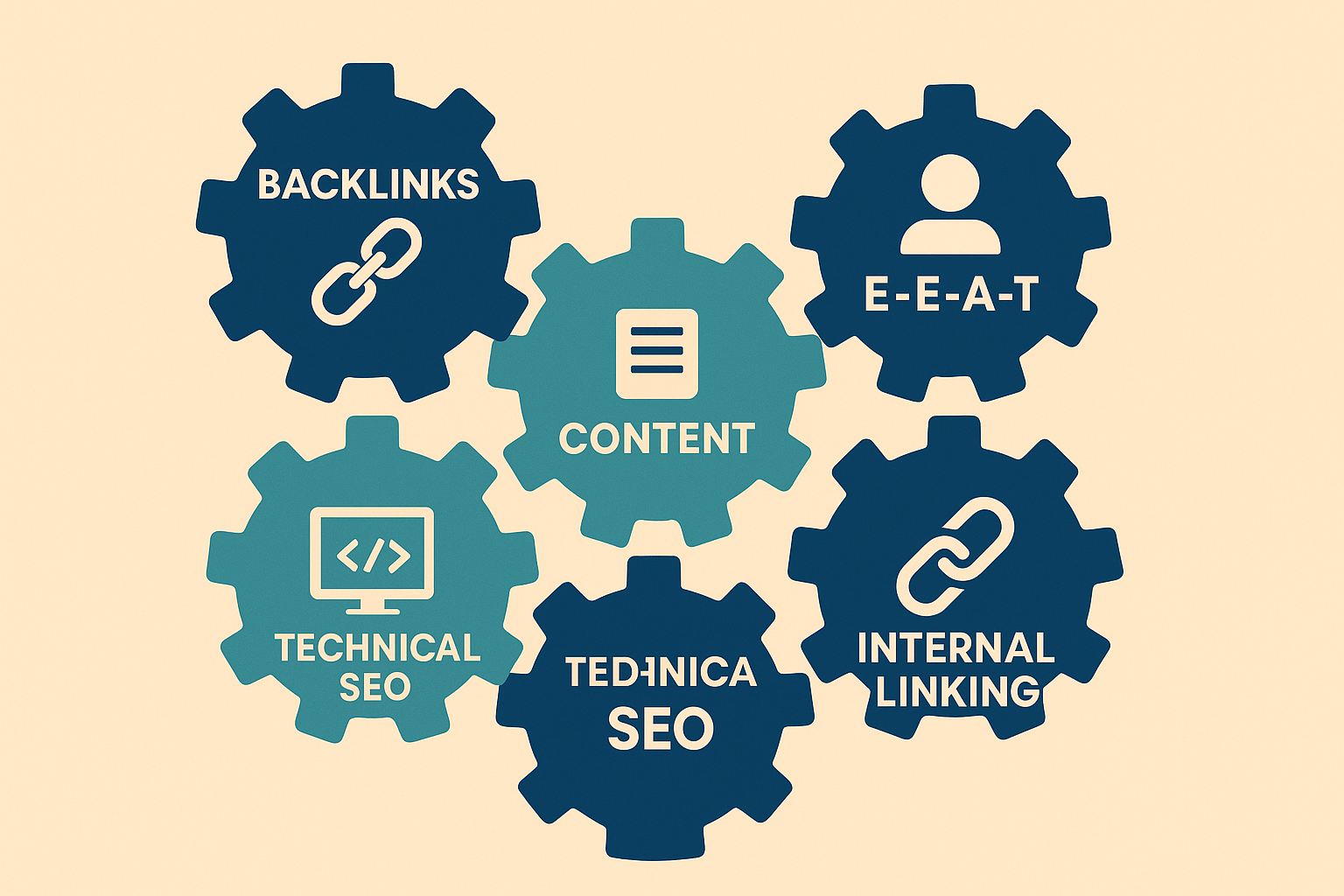
The five components of a strong SEO authority strategy work together — weakening one gear slows the entire system.
Common Mistakes That Silently Erode Your Rankings
Many sites unknowingly sabotage their own authority through avoidable errors. For example, purchasing backlinks from private blog networks or link farms can trigger manual penalties that take months to recover from. Although these tactics may produce short-term score boosts, the long-term damage far outweighs any temporary gain.
Another common mistake is publishing thin, undifferentiated content at high volume. In contrast to sites that publish fewer, deeper articles, content farms often see diminishing returns because Google’s systems deprioritize pages that add no unique value to the search ecosystem.
Finally, neglecting to update older content is a subtle but significant authority drain. Pages that contain outdated statistics, broken links, or superseded advice signal to search engines that a site is not actively maintained. Therefore, a regular content audit should be part of every authority-building strategy.
The Role of Brand Mentions and Unlinked Citations
Brand mentions — even without a hyperlink — contribute to what SEO researchers call co-citation authority. When reputable publications reference your brand name in context, search engines may interpret this as a trust signal even in the absence of a followed link. As a result, digital PR and thought leadership activities that generate press coverage can meaningfully support your authority profile.
Resources like RankAuthority provide practical frameworks for tracking and growing these brand-level signals alongside traditional link-building efforts.
Measuring Progress Without Obsessing Over Scores
Third-party authority scores are useful benchmarks, but they should never be your primary KPI. Instead, focus on the outcomes these scores are designed to predict: organic traffic growth, keyword ranking improvements, and conversion rate trends from organic channels.
Meanwhile, track the number of referring domains gained each month, the quality distribution of your backlink profile, and the share of voice your brand holds for target keywords. These metrics provide a more accurate picture of real authority growth than any single numeric score.
Additionally, monitoring your click-through rates in Google Search Console reveals whether your authority improvements are translating into user trust at the SERP level. High impressions with low CTR often indicate that your brand is not yet perceived as the most authoritative result, even when you rank well.
Conclusion: Why Authority Ranking Is a Long-Term Investment
Authority ranking is not a campaign you run once — it is a compounding asset that grows with every quality backlink earned, every expert article published, and every technical improvement made to your site. Sites that treat authority as a long-term investment consistently outperform competitors who chase short-term ranking hacks.
By following the five-step framework outlined here and avoiding the common pitfalls that erode trust, you can build a durable search presence that resists algorithm updates and generates compounding organic growth. For deeper strategic guidance, RankAuthority is a valuable ongoing resource for SEO practitioners at every level.
Frequently Asked Questions
What is authority ranking in SEO?
Authority ranking is a measure of how much trust and credibility search engines assign to a website or page based on backlinks, content quality, and E-E-A-T signals. Higher authority generally correlates with better search engine positions and more consistent organic traffic.
How is domain authority different from page authority?
Domain authority measures the overall trust and link equity of an entire website, while page authority focuses on the strength of a single URL. Both are third-party metrics useful for benchmarking, though Google uses its own internal signals rather than these scores directly.
How long does it take to improve authority ranking?
Meaningful improvements typically take three to six months of consistent effort. Link building, content publishing, and technical fixes all contribute, but results depend on your competition level and starting baseline.
What types of backlinks improve authority the most?
Backlinks from topically relevant, high-authority domains carry the most weight. Editorial links earned through original research, data studies, or expert commentary are especially powerful for raising your authority ranking.
Does publishing more content automatically raise authority?
Volume alone does not raise authority. Content must demonstrate expertise, answer real user questions, and earn engagement signals. In fact, thin or duplicate content can dilute your topical authority over time.
What is E-E-A-T and how does it relate to authority?
E-E-A-T stands for Experience, Expertise, Authoritativeness, and Trustworthiness — a framework from Google’s Search Quality Evaluator Guidelines. It directly influences how Google’s quality raters perceive your site, which feeds into authority ranking signals.
Can internal linking improve authority ranking?
Yes. Strategic internal linking distributes link equity across your site and helps search engines discover important pages. It also reinforces topical clusters, which strengthens perceived subject-matter authority across your domain.
What are the biggest mistakes that hurt authority ranking?
Common mistakes include buying low-quality backlinks, publishing thin content, neglecting technical SEO issues like slow load times, and failing to update outdated pages. These signals tell search engines your site is less trustworthy than competitors.
How do I check my current authority score?
You can check third-party authority scores using Moz’s Domain Authority checker, Ahrefs Domain Rating, or Semrush Authority Score. These metrics approximate how search engines may perceive your site’s trust level relative to competitors.
Does social media activity affect authority ranking?
Social media signals are not direct Google ranking factors, but social sharing increases content visibility and can lead to more backlinks and brand mentions. These downstream effects do contribute to improved authority over time.
Is authority ranking the same as PageRank?
No. PageRank is a specific Google algorithm measuring link-based importance of individual pages. Authority ranking is a broader concept encompassing link equity, content quality, E-E-A-T, and overall site trust signals well beyond PageRank alone.
How does topical authority differ from domain authority?
Topical authority refers to how comprehensively a site covers a specific subject area, while domain authority is a numeric score reflecting overall link strength. A site can have strong topical authority in a niche even with a moderate domain authority score.

