
Automated backlink strategies are structured workflows that use SEO software, outreach platforms, and data pipelines to acquire high-quality inbound links at scale — without requiring manual effort for every single step. For businesses competing in crowded search results, mastering these strategies is now one of the fastest paths to growing domain authority efficiently and sustainably. This guide is written by the RankAuthority editorial team; add a short author bio and a visible "last updated" date near the top to boost credibility and E‑E‑A‑T.
Building backlinks manually is slow, inconsistent, and hard to scale. However, with the right automation framework, even a lean two-person team can run outreach campaigns that rival a full-service SEO agency. The key is knowing precisely which steps to automate — and which steps still require a skilled human hand.
In this guide, you will find a complete automated backlink guide of how automated link building works, which tools power the best campaigns, how to avoid penalties, and how to measure real ROI — all drawn from proven SEO practice.
Why Automated Backlink Strategies Matter for Modern SEO
According to search engine optimization principles, backlinks remain one of Google’s top-three ranking signals. Therefore, consistently acquiring links is non-negotiable for competitive rankings. The challenge is that manual prospecting, email writing, and follow-up tracking can easily consume 20 to 40 hours per week for even a modest campaign.
Automation addresses this bottleneck directly. By delegating repetitive tasks to software, SEO professionals reclaim time for strategy, content quality, and genuine relationship-building — the elements that actually separate a high-performing campaign from an average one.
Furthermore, automation introduces consistency. Human-driven campaigns frequently stall during busy periods, creating uneven link velocity. An automated system, in contrast, sends outreach and processes responses on a predictable schedule — regardless of how busy your team becomes.
The Link Velocity Advantage
Link velocity — the rate at which new backlinks point to your domain — is a signal Google uses to assess organic growth. Specifically, a steady, consistent velocity looks natural. Sharp spikes followed by months of silence can raise algorithmic flags. Automated systems are uniquely positioned to maintain that steady cadence automatically.
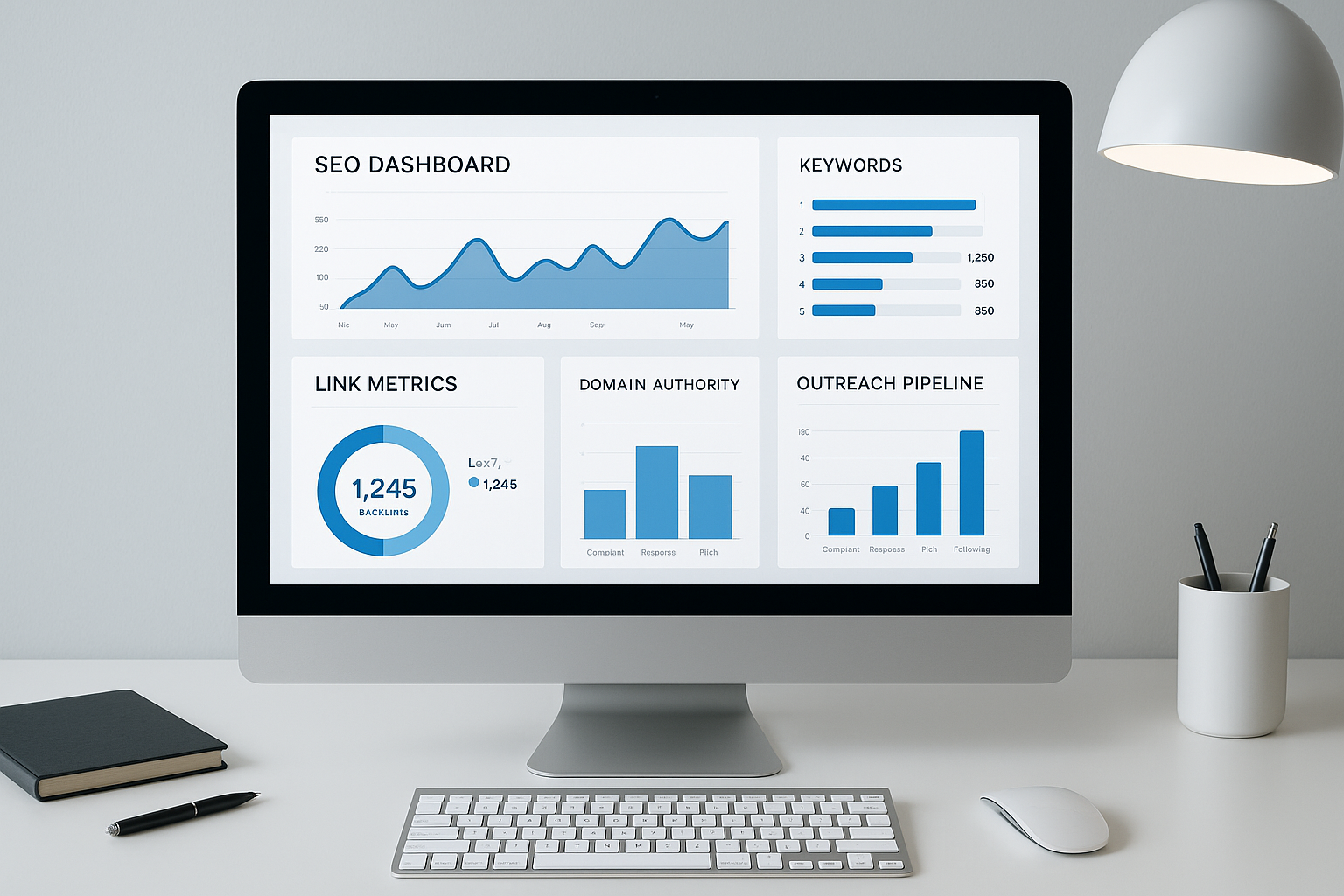
A well-configured dashboard is the command center for every automated backlink strategy.
What Are Automated Backlink Strategies? A Clear Definition
Direct Answer: Automated backlink strategies are structured workflows that use tools to discover link prospects, verify contact information, send personalized outreach sequences, and monitor link acquisition — all with minimal manual intervention at each step. They work best when human judgment defines quality standards and software handles execution volume.
This distinction is critical. Automation amplifies your strategy; it does not replace it. As a result, the quality of your targeting criteria and outreach messaging still determines whether campaigns succeed or fail at scale.
It is also important to distinguish between legitimate automated outreach (using software to send personalized, genuine requests for editorial links) and black-hat link schemes (programmatically generating spam links or purchasing bulk links). Google’s spam policies penalize the latter, not the former. Consequently, the methods in this guide focus entirely on earning real editorial links through scalable, compliant outreach.
The Best Tools for Automated Backlink Strategies in 2025
Before building your workflow, you need the right link building software guide. The best automated backlink strategies combine tools from three categories: prospecting, contact enrichment, and outreach automation. Here is a breakdown of the top options in each category.
Prospecting and Link Research Tools
- Ahrefs — Industry-leading backlink database with competitor gap analysis, broken link finder, and automated link monitoring alerts. Best for prospecting and link profile tracking.
- SEMrush — Offers a bulk backlink gap tool and link building workflow with built-in prospect management. Strong for combining keyword and link data.
- Screaming Frog SEO Spider — Crawls competitor sites at scale to surface broken outbound links — ideal for automated broken link building campaigns.
- Moz Link Explorer — Useful for Domain Authority filtering and identifying high-authority prospects in niche verticals.
Contact Enrichment and Email Verification Tools
- Hunter.io — Finds and verifies editor email addresses by domain. Integrates directly with most outreach platforms for seamless data transfer.
- Snov.io — Combines email discovery, verification, and drip outreach in one platform. Particularly effective for small teams managing full campaigns solo.
- Apollo.io — Strong B2B contact database useful for digital PR and link prospecting in business-focused niches.
Outreach Automation Platforms
- Pitchbox — Purpose-built for SEO outreach. Automates prospecting, personalization, multi-step sequences, and CRM tracking in one workflow.
- BuzzStream — Excellent for relationship-based link building. Strong CRM features help teams track conversations and maintain personalization at scale.
- Mailshake — Lightweight, affordable option for outreach automation. Works well for smaller campaigns with straightforward follow-up sequences.
- Respona — Combines link prospecting and outreach into one platform with AI-assisted personalization features, reducing manual copy work.
Pro Tip
Combine Ahrefs for prospecting, Hunter.io for contact enrichment, and Pitchbox for outreach delivery. This three-tool stack covers the entire automated backlink workflow and integrates natively — eliminating manual data transfers between steps. Visit rankauthority.com for more tool stack guidance.
Step-by-Step: Building Your Automated Link Acquisition System
Follow these steps in order. Each one builds on the last, so skipping ahead will create gaps that reduce your results significantly.
Step 1 — Define Your Link Quality Thresholds
Before launching any automated campaign, first establish the minimum standards a prospect must meet to enter your pipeline. Common quality filters include:
- Domain Rating (DR) above 30 (or Domain Authority above 25)
- Monthly organic traffic above 500 visits (verifiable via Ahrefs or SEMrush)
- Topical relevance to your niche — not just general authority
- Spam score below 5% (Moz metric)
- No more than 30% paid or low-quality outbound links on their site
- Active publishing — at least one new article in the past 90 days
Setting these parameters upfront ensures your automation surfaces only genuinely valuable opportunities. As a result, you avoid wasting outreach budget on domains that would never move the needle for your rankings.
Step 2 — Prospect at Scale with Competitor Gap Analysis
Ahrefs and SEMrush both support bulk competitor backlink gap analysis. In practice, you input three to five competitor domains and the tool automatically identifies sites linking to them but not to you. This generates hundreds of qualified prospects in minutes — work that would take days manually. See our effective backlink strategies for practical examples and follow-up tactics.
Furthermore, you can export these prospect lists directly into your outreach platform via CSV or native integration, eliminating the manual data transfer step entirely. Specifically, Pitchbox and Ahrefs share a direct integration that pushes prospects into live campaigns with one click.
Additionally, consider using advanced Google search operators to surface resource pages and guest post opportunities. Queries like "your niche" + "write for us" or "your niche" + "resources" can be automated through tools like Scrapebox or URL Profiler to pull lists at scale.
Step 3 — Enrich Prospects with Verified Contact Data
Email discovery tools such as Hunter.io and Snov.io integrate directly with outreach platforms. They automatically find and verify editor or webmaster email addresses for each prospect domain. This step is essential before sending at volume.
Specifically, unverified emails increase bounce rates. High bounce rates damage your sender reputation score — which, in turn, causes future emails to land in spam folders rather than inboxes. Therefore, always run email lists through a verification tool before any send. A bounce rate above 3% is a warning sign that requires immediate attention.
Step 4 — Build Personalized Multi-Step Outreach Sequences
Platforms like Pitchbox and BuzzStream allow you to create email sequences with dynamic merge fields that automatically pull in the prospect’s name, site name, and a relevant page reference. Consequently, each email feels individually crafted even though the system sends it automatically.
Most successful automated campaigns follow this sequence structure:
- Day 1: Initial personalized pitch referencing a specific piece of their content
- Day 5: Soft follow-up adding a new value point or data angle
- Day 10: Final follow-up with a clear, low-friction call to action
- Day 15 (optional): Break-up email — brief, direct, and often the highest-reply step
Additionally, personalize beyond just name fields. Reference a specific article headline, a recent site update, or a data point from their content. Outreach tools with AI personalization features — like Respona — can generate these custom lines automatically, further reducing manual effort.
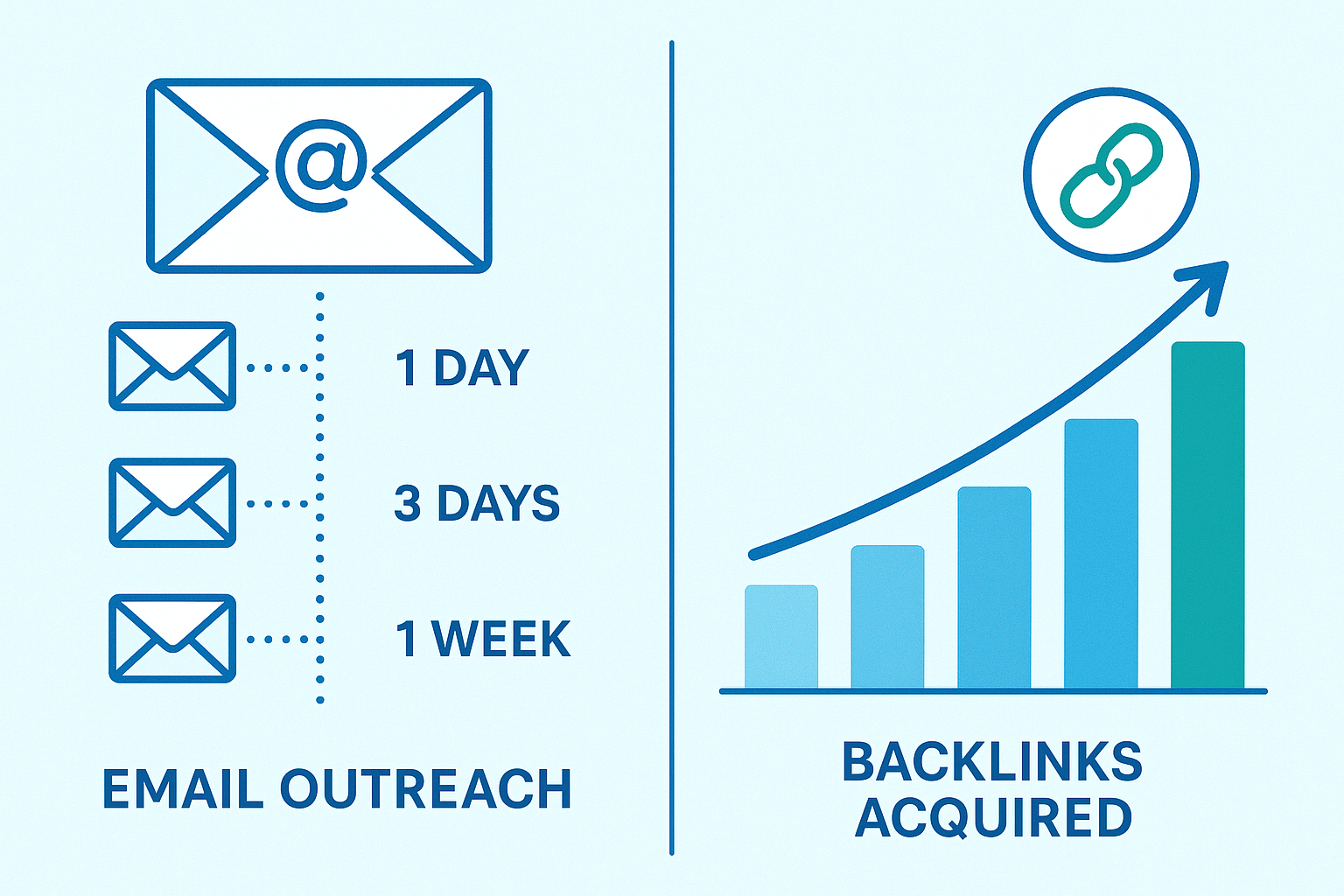
A four-step outreach sequence significantly outperforms single-email campaigns in both reply rate and link acquisition.
Step 5 — Warm Up Email Infrastructure Before Sending at Volume
New sending domains and email addresses must be warmed up before launching high-volume outreach. Specifically, start with 10 to 20 emails per day for the first week, then ramp to 30 to 50 in week two, and finally to your target volume of 50 to 100 per inbox in week three. Tools like Lemwarm or Mailwarm automate this process by simulating real email engagement.
Furthermore, use a dedicated sending domain (e.g., outreach.yourdomain.com) separate from your primary business domain. This way, deliverability issues affect only your outreach domain and not your core email reputation.
Step 6 — Monitor, Protect, and Expand Your Link Portfolio
Acquiring links is only half the battle. Therefore, set up automated alerts in Ahrefs or Google Search Console to notify you when new links go live or when existing links are removed. This monitoring ensures you maintain the link velocity gains your campaigns generate.
In addition, run a monthly link audit to identify toxic or spammy links that may have pointed to your domain organically. Use the Google Search Console disavow tool to neutralize any links that fall below your quality threshold. Specifically, this protects your domain from algorithmic penalties tied to unnatural link patterns.
Seven Tactics That Pair Perfectly with Automated Backlink Strategies
Certain link building tactics are especially well-suited to automation because they involve structured, repeatable processes. Consider incorporating these into your system:
1. Broken Link Building
Crawlers like Screaming Frog automatically identify broken outbound links on competitor pages and resource sites. You then configure automated outreach to notify the site owner and suggest your relevant content as a replacement. This approach converts a site owner’s problem into your link opportunity — making it one of the highest-converting automated tactics available.
2. Resource Page Outreach
Automated searches using Google operators surface resource and link roundup pages in your niche. Specifically, these pages are curated lists that actively welcome additions of genuinely useful resources — making your pitch highly relevant from the outset. Consequently, resource page campaigns often deliver reply rates 2 to 3 times higher than cold guest post pitches.
3. Unlinked Brand Mention Reclamation
Tools like Ahrefs Content Explorer, Google Alerts, and Mention.com automatically detect when your brand is referenced online without a hyperlink. Once detected, your outreach platform sends a polite, templated request asking the author to convert the mention into a link. Because the author already knows your brand, conversion rates are exceptionally high for this tactic.
4. Guest Post Prospecting
Automated searches identify sites accepting guest contributions. Email tools then handle the initial pitch sequence, including follow-up reminders. However, always write the actual guest post content manually — this is where quality determines whether the acquired link carries authority or gets rejected.
5. Digital PR and Data-Driven Content
Publishing original research, surveys, or industry statistics generates passive backlinks at scale. While this is not strictly “automated,” you can automate the distribution step by using PR outreach tools like Prowly or Muck Rack to pitch your data to relevant journalists and bloggers automatically. A single strong data piece can earn dozens of editorial links.
6. HARO and Journalist Query Monitoring
HARO (Help a Reporter Out) connects journalists seeking expert sources with brands that can provide them. While crafting your response requires human expertise, tools can filter and alert you to relevant queries in real time — dramatically accelerating your response workflow. Specifically, being among the first three responses to a query significantly increases your chance of being quoted and linked. Learn how SEO automation speeds this process for busy teams.
7. Skyscraper Technique at Scale
The Skyscraper Technique — finding top-ranked content, creating a superior version, and then pitching all sites that link to the original — pairs naturally with automation. Tools identify the link sources automatically. Outreach platforms then deliver your pitch to every qualifying domain in the list. For comprehensive resources on building authority through structured SEO systems, RankAuthority covers this tactic in depth.
Anchor Text Strategy Within Automated Campaigns
Anchor text — the visible, clickable words in a hyperlink — is a significant ranking signal. However, over-optimized anchor text patterns are one of Google’s clearest signals of manipulative link building. Therefore, your automated campaigns must deliberately diversify anchor text across four categories:
- Branded anchors — Your company or site name (e.g., “RankAuthority”) — target 30 to 40% of your profile
- Exact-match anchors — Precise target keyword (e.g., “automated backlink strategies”) — keep below 10%
- Partial-match anchors — Semantic variations (e.g., “link building automation tips”) — target 20 to 30%
- Generic anchors — “click here,” “read more,” “this article” — make up the remainder naturally
Advanced outreach platforms like Pitchbox allow you to rotate anchor text suggestions within email templates, ensuring natural distribution is baked directly into your automated campaigns. Consequently, this prevents the over-optimization patterns that trigger algorithmic scrutiny.
Avoiding the Pitfalls of Over-Automation
Although automation dramatically increases efficiency, it introduces specific risks when applied without proper oversight. Recognizing these pitfalls early prevents costly penalties and wasted outreach budget.
Generic Outreach Templates
The most common mistake is sending generic outreach templates with no genuine personalization. Recipients immediately recognize templated emails. As a result, response rates collapse. Specifically, research suggests that personalized emails generate 6 times the transaction rate of generic ones. Always include at least one custom sentence per prospect.
Sending Volume Too High Too Fast
Sending too many emails too quickly triggers spam filters at major email providers. In practice, limit daily sends to 50 to 100 emails per inbox. Additionally, warm up new email addresses over two to three weeks before reaching full volume. This approach protects deliverability and ensures your messages reach inboxes rather than spam folders.
Targeting Low-Quality or Irrelevant Domains
Never automate link acquisition from low-quality or irrelevant domains. Even if the volume looks impressive on paper, a backlink profile filled with spammy sites can trigger algorithmic or manual penalties from Google. According to Google’s Search Essentials, links should be earned editorially. Therefore, quality thresholds must be enforced at the prospecting stage — not corrected after the fact with a disavow file.
Neglecting Acquired Link Monitoring
Links disappear. Site owners redesign pages, remove content, or change policies — and your carefully acquired link vanishes with no warning. As a result, automated monitoring through Ahrefs alerts or Google Search Console is essential. Specifically, set up weekly link status checks so you can follow up immediately when a valuable link goes dark.

Strict quality filters protect your domain reputation and prevent automated campaigns from creating penalty risk.
Measuring Success: KPIs for Automated Link Building Campaigns
Effective automation is never set-and-forget. Instead, review campaign performance weekly using the metrics below. Tracking the right KPIs allows you to iterate quickly and compound results over time.
Core Outreach Metrics
- Email open rate: Target 40 to 60%. Below 30% signals subject line or sender reputation issues.
- Positive reply rate: Target 5 to 15%. Below 3% indicates personalization or value proposition problems.
- Bounce rate: Keep below 3%. Above 5% requires immediate list cleaning and domain warm-up review.
- Unsubscribe rate: Keep below 0.5% per sequence. Higher rates suggest targeting or tone mismatches.
Link Acquisition and SEO Impact Metrics
- Links acquired per month: With a well-configured system, most teams acquire 20 to 150 links monthly.
- Average DR of acquired links: Track this monthly to ensure quality doesn’t drift downward as volume increases.
- Domain Rating (DR) improvement: Expect measurable movement within 60 to 90 days of consistent link acquisition.
- Organic traffic growth: The ultimate downstream metric. Use Google Search Console to track keyword ranking improvements tied to link gains.
- Link retention rate: The percentage of acquired links still live after 90 days. Target above 80%.
When metrics fall below benchmarks, test one variable at a time — subject line, value proposition, or call-to-action. Because automation runs at scale, even a 2% improvement in reply rate translates into dozens more acquired links each month.
How Long Does It Take to See Results from Automated Link Building?
Most sites see measurable ranking improvements within 60 to 90 days of consistent link acquisition. However, competitive niches — finance, legal, health, and SaaS — may require 4 to 6 months of sustained effort before significant organic traffic gains appear in Search Console data.
In addition, the age and existing authority of your domain matters. A brand-new domain building links through automation will see slower initial gains than a 3-year-old domain with an established authority baseline. Specifically, for new sites, focus on earning links from highly topically relevant domains first, even if their DR is modest.
Furthermore, the compounding effect of link building means that results accelerate over time. Consequently, the teams that start building their automated systems earliest gain the greatest long-term advantage over competitors who are still building links manually.
Automated Backlink Strategies for Small Businesses and Solo SEOs
Automation is not reserved for enterprise SEO teams with large budgets. In fact, small businesses and individual SEO practitioners benefit most from automated workflows because they have the least time to dedicate to manual outreach.
A lean but effective setup for budget-conscious teams might look like this:
- Ahrefs Lite ($99/month) — For prospect research and competitor gap analysis
- Hunter.io Starter ($49/month) — For contact email discovery and verification
- Mailshake ($58/month) — For automated outreach sequences and follow-ups
- Google Alerts (free) — For unlinked brand mention monitoring
- Screaming Frog free tier — For broken link discovery on competitor sites
This stack costs approximately $206 per month and covers every core automated workflow — prospecting, enrichment, outreach, and monitoring. For context, a single hour of agency link building time often costs more than this full monthly stack.
Frequently Asked Questions About Automated Backlink Strategies
Conclusion: Scale Smarter with Automated Backlink Strategies
Automated backlink strategies represent the most efficient path to sustainable SEO growth for businesses that cannot staff a full link building team. By combining intelligent prospecting tools, verified contact data, personalized multi-step sequences, email infrastructure warm-up, and continuous link monitoring, you can build a link acquisition engine that runs consistently in the background — while you focus on content, strategy, and business growth. For a deeper walkthrough, see the complete 2025 guide on automated backlink building.
The most important principle remains unchanged: automation scales your effort, but quality determines your results. Therefore, invest time upfront in defining your targeting criteria, crafting compelling outreach copy, and reviewing campaign data weekly. In doing so, you will build a backlink profile that drives compounding organic growth for years to come.
For more on building authority through structured SEO systems and scaling your automated backlink strategies further, visit rankauthority.com.

