
Your complete reference for understanding
Domain Authority & Ahrefs DR — Everything That Actually Matters
Domain authority Ahrefs — specifically called Domain Rating (DR) — is a proprietary metric developed by Ahrefs that scores the overall strength of a website’s backlink profile on a logarithmic scale from 0 to 100. Understanding this score is one of the most practical skills any SEO professional, content strategist, or website owner can develop, because it directly informs link-building decisions, competitive analysis, and long-term organic growth strategy.
Quick Answer
Domain authority in Ahrefs is measured as Domain Rating (DR), a score from 0–100 reflecting the strength and quality of a site’s backlink profile. It is calculated using the number of unique referring domains, their own DR scores, and how many outbound links each domain sends. A higher DR generally correlates with stronger ranking potential, though it is not a direct Google ranking factor.
What Is Domain Authority in Ahrefs?
Domain authority Ahrefs is the platform’s answer to a long-standing SEO question: how do you quickly gauge how “powerful” a website is in terms of its link profile? Ahrefs chose to call this metric Domain Rating (DR) to distinguish it from Moz’s trademarked “Domain Authority” (DA) score — though in everyday conversation, SEOs often use both terms interchangeably when discussing Ahrefs data.
For a deeper walkthrough, see our Domain Moz Rank: What It Is and How to Improve It.
According to backlink theory as described on Wikipedia, the value of a hyperlink from one site to another is influenced by the authority of the linking page and domain. Ahrefs operationalizes this concept by building DR from the real-world backlink graph it crawls continuously across billions of pages.
It is important to note that DR is not a Google metric. Google does not publish a domain-level authority score. DR is Ahrefs’ internal approximation, and while it often correlates with ranking performance, it is a third-party indicator — not a direct ranking signal. For a deeper conceptual breakdown, Rank Authority’s guide to understanding domain authority is an excellent companion resource.
For a deeper walkthrough, see our How Do I Enhance My Website’s Authority Quickly?.

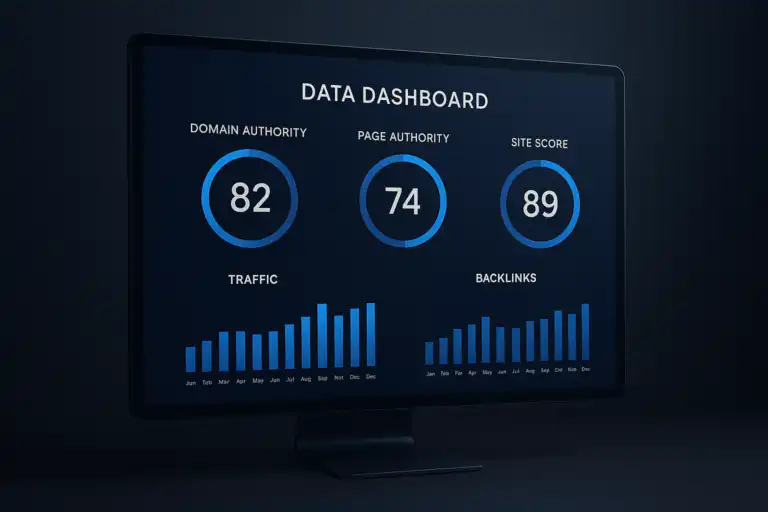
A visual representation of how domain authority Ahrefs metrics appear in a typical SEO analytics dashboard, highlighting DR scores and backlink data. For a deeper walkthrough, see our Domain Comparison Ahrefs: The Complete 2024 Guide.
How Is Ahrefs Domain Rating Calculated?
Ahrefs has published a transparent explanation of its DR formula. The calculation works in three core steps:
- Count unique referring domains. Ahrefs identifies every unique domain that sends at least one followed backlink to your site. Duplicate links from the same domain count only once.
- Apply link equity weighting. Each referring domain passes a portion of its own DR to your site. However, if that domain links to many other sites, the equity it passes to each one is diluted proportionally.
- Apply logarithmic scaling. The final score is mapped to a 0–100 logarithmic scale, meaning each incremental point at the top of the scale requires exponentially more link equity than at the bottom.
Key Insight
Because DR uses a logarithmic scale, moving from DR 20 to DR 30 is far easier than moving from DR 70 to DR 80. This is why even large link-building campaigns can produce only marginal DR gains for high-authority sites.
Domain Rating vs. Domain Authority: Understanding the Difference
The terms are often conflated, but they represent different products from different companies. Here is a side-by-side breakdown:
Because the underlying data sets and algorithms differ, a site with DR 55 in Ahrefs may have DA 40 in Moz — or vice versa. Never use scores from one tool to benchmark against scores from another. For a detailed head-to-head analysis of how Ahrefs compares to other authority measurement tools, see Rank Authority’s Ahrefs comparison guide.
For a deeper walkthrough, see our Domain Rank Moz: How to Understand and Improve It.

Comparing domain authority scores across different SEO tools like Ahrefs illustrates why metrics from separate platforms should never be used interchangeably.
What Is a Good Ahrefs DR Score?
There is no universal “good” DR score — context is everything. The most useful benchmark is always your direct competitors in the same niche and for the same target keywords. That said, here are general reference ranges:
0–20
New or low-authority sites. Normal for brand-new domains.
21–49
Developing authority. Competitive for local and niche markets.
50–69
Solid authority. Competitive across most industries.
70+
High authority. Typical of major publishers and enterprise brands.
How to Improve Your Domain Authority in Ahrefs
Improving your domain authority Ahrefs score is fundamentally about improving your backlink profile. Here are the highest-impact strategies, ranked by long-term ROI:
For a deeper walkthrough, see our Domain Authority Checker – Rank Authority.
1. Earn Links from High-DR, Relevant Domains
A single link from a DR 75 site in your niche is worth more than dozens of links from DR 10 directories. Prioritize quality over quantity. Guest posting, digital PR, and original research are reliable methods for earning these links.
2. Create Link-Worthy Content Assets
Original data studies, comprehensive guides, free tools, and infographics attract natural backlinks over time. Content that solves a real problem and is the best resource on its topic earns links passively.
3. Reclaim Lost Backlinks
Use Ahrefs’ Lost Backlinks report to identify links you previously had that have disappeared. Reach out to webmasters to restore them, or use 301 redirects if the linked page has moved.
4. Disavow Toxic Links
Spammy backlinks from irrelevant or penalized domains can suppress your DR. Use Ahrefs’ Referring Domains report to identify suspicious links and submit a disavow file through Google Search Console.
5. Build Strategic Partnerships
Co-author research with industry publications, participate in expert roundups, and build genuine relationships with journalists and bloggers in your space. These relationships compound over time into consistent link acquisition.

Building a consistent link acquisition strategy is the most reliable path to improving your domain authority Ahrefs score over time. For a deeper walkthrough, see our DA Checker Free: Check Domain Authority Instantly.
Common Mistakes When Interpreting Ahrefs DR
Even experienced SEOs misuse DR data. Watch out for these common pitfalls:
- Treating DR as a Google ranking factor. Google does not use Ahrefs DR. Optimizing for DR is only useful insofar as it reflects real improvements in your backlink profile, which do influence Google’s own internal link analysis.
- Comparing DR across different tools. A DR 60 in Ahrefs is not equivalent to a DA 60 in Moz. Each tool has its own data and algorithm.
- Chasing DR as a vanity metric. A site with DR 30 and highly targeted, niche-relevant backlinks can outrank a DR 60 site in specific keyword battles. Relevance and content quality still matter enormously.
- Ignoring URL Rating (UR). Ahrefs also provides a URL Rating (UR) at the page level. For keyword-level competition, UR of individual pages is often more predictive than domain-level DR.
Frequently Asked Questions
Is Ahrefs Domain Rating the same as Moz Domain Authority?
No. Ahrefs Domain Rating (DR) and Moz Domain Authority (DA) are separate proprietary metrics from different companies. Both aim to predict ranking potential based on backlinks, but they use different algorithms, data sets, and scales, so scores are not directly comparable. For a deeper walkthrough, see our Domain Ranking Moz: How to Understand and Improve It.
How often does Ahrefs update Domain Rating?
Ahrefs updates DR scores on a rolling basis as its crawler discovers new or lost backlinks. Significant changes to your backlink profile can reflect in your DR within days to a few weeks, though major shifts typically take longer to stabilize.
Can my DR drop even if I haven’t lost backlinks?
Yes. Because DR is a relative score benchmarked against all sites in the Ahrefs database, your score can drop if other sites gain backlinks faster than you do, even if your own profile remains unchanged. This is a common source of confusion for site owners monitoring their scores.
Does a high DR guarantee first-page Google rankings?
No. DR is a useful competitive signal, but Google’s algorithm evaluates hundreds of factors including content quality, on-page optimization, user experience, and topical relevance. A high DR gives you a stronger foundation, but it does not guarantee rankings on its own.
Conclusion: Using Domain Authority Ahrefs Intelligently
Understanding domain authority Ahrefs — specifically the Domain Rating metric — is an essential part of any modern SEO toolkit. DR gives you a fast, reliable way to assess the competitive strength of any website’s backlink profile, prioritize link-building targets, and track your own site’s authority growth over time. The key is to use it as a directional indicator rather than an absolute truth: always compare DR within your niche, combine it with page-level URL Rating data, and remember that genuine, relevant backlinks from authoritative sources are what move the needle — both in DR and in actual Google rankings. Build your strategy around real link equity, and your domain authority will reflect that growth naturally.

