AI Search Visibility
The search landscape is shifting. AI engines now answer questions directly — and only the brands they trust get cited. Here is everything you need to know about getting there.
Generative engine optimization services is the practice of strategically structuring, formatting, and positioning digital content so that large language model (LLM) powered search engines — such as Google’s AI Overviews, Perplexity, ChatGPT Search, and Bing Copilot — select, cite, and surface that content in their AI-generated answers. In short, it is SEO rebuilt from the ground up for the age of generative AI.
Direct Answer
Generative engine optimization services help brands appear inside AI-generated search responses by optimizing content for how LLMs read, evaluate, and cite sources. They combine structured content, authoritative signals, and schema markup to make a brand the answer AI engines deliver.
What Are Generative Engine Optimization Services?
Traditional SEO earns a ranked link on a results page. Generative engine optimization earns a citation inside a synthesized answer. That distinction changes almost everything about how content must be written, structured, and validated.
When a user asks ChatGPT or Perplexity a question, the engine does not return a list of links — it constructs a response. It draws from content it has indexed, crawled, or retrieved in real time, and it attributes that content to sources it deems credible. Generative engine optimization services train brands to become those credible sources.
According to research published by Wikipedia on generative artificial intelligence, generative AI systems learn statistical patterns from enormous datasets to produce human-like outputs. Search engines built on these systems evaluate content quality differently than keyword-matching algorithms — they prioritize clarity, factual density, and structural coherence.

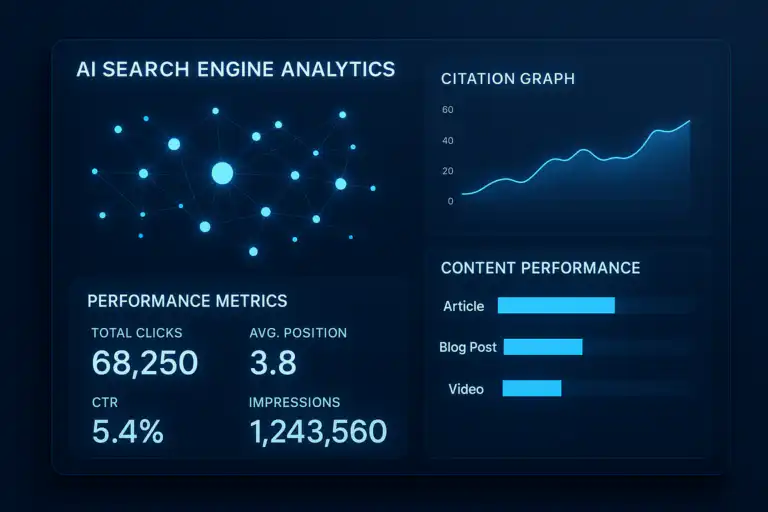
A conceptual view of how generative engine optimization services track AI citation performance across multiple LLM platforms.
How GEO Differs From Traditional SEO
The core difference is the destination. Traditional SEO targets a ranked position on a results page. GEO targets inclusion inside a generated paragraph. That shift demands a completely different optimization philosophy.
Traditional SEO
- Targets blue-link rankings
- Optimizes for crawlers and keyword density
- Measures clicks and impressions
- Focuses on backlink volume
- Competes for page position
Generative Engine Optimization
- Targets AI-generated citations
- Optimizes for LLM comprehension
- Measures citation frequency and brand mentions
- Focuses on topical authority and trust signals
- Competes to become the cited answer
For a deeper technical breakdown of how AEO and GEO intersect, the team at Rank Authority has published a comprehensive guide on understanding AEO, GEO, and AI search that maps out the full ecosystem clearly.
The Five Pillars of Effective GEO Services
Professional generative engine optimization services are built on five interconnected pillars. Each one addresses a specific way that LLMs evaluate and select content for inclusion in generated responses.
Direct-Answer Content Architecture
LLMs favor content that answers questions immediately and unambiguously. Every key page should open with a clear, concise definition or answer before elaborating. This mirrors how AI engines want to present information to users.
Topical Authority and Entity Coverage
AI engines assess how comprehensively a domain covers a topic. Building interconnected content clusters that address every facet of a subject signals deep expertise, making a site a trusted reference for LLM retrieval.
Structured Data and Schema Markup
FAQPage, HowTo, Article, and Speakable schema types give AI engines machine-readable signals about content meaning and structure. Proper schema implementation significantly increases the probability of citation in AI-generated answers.
Trust Signal Amplification
Citations from reputable third-party sources, author credentials, editorial standards, and consistent brand mentions across the web collectively raise an entity’s trustworthiness score in LLM evaluation. This is the GEO equivalent of link authority.
Continuous Testing and Iteration
GEO is not a one-time setup. AI engine behavior evolves as models are updated and retrained. Effective GEO services include ongoing monitoring of AI citation patterns, prompt testing, and content refinement to maintain and grow visibility.

Building a structured content architecture is central to any effective generative engine optimization services engagement.
Why Businesses Cannot Afford to Ignore GEO in 2025
AI-powered search is not a future trend — it is the current reality. Google’s AI Overviews now appear on a significant percentage of informational queries. Perplexity processes tens of millions of searches per month. ChatGPT Search is growing rapidly. Users are increasingly receiving answers without ever clicking a traditional result.
For brands that have invested years in traditional SEO, this shift represents both a threat and an opportunity. The threat: organic click-through rates on traditional results are declining as AI answers intercept queries. The opportunity: brands that invest in GEO now can establish themselves as the cited authority before their competitors even recognize the landscape has changed.
Key Insight
Brands that appear in AI-generated answers gain a qualitatively different form of visibility than a ranked link. Being cited by an AI engine carries implicit endorsement — the engine is telling the user this source is trustworthy. That trust transfer is enormously valuable for brand authority.
Why Do Businesses Need Generative Engine Optimization Services in 2025?
Businesses need generative engine optimization services because AI-powered search is now the primary discovery channel for a rapidly growing segment of users. Without deliberate GEO investment, brands become invisible to those users — not because their content is poor, but because it was not built to be read and cited by AI engines.
The industries most immediately affected include healthcare, finance, legal services, e-commerce, SaaS, and professional services — any sector where users ask complex informational questions before making a decision. In these verticals, appearing in the AI answer is often more impactful than ranking in position one.
Frequently Asked Questions About GEO Services
How is GEO different from traditional SEO?
Traditional SEO targets ranked blue-link results on search engine results pages, while GEO targets the synthesized answers produced by generative AI engines. GEO prioritizes authoritative, well-structured, and factually verifiable content that LLMs can confidently cite and include in their responses. The two disciplines overlap but require distinct strategies.
What content formats work best for GEO?
Direct-answer paragraphs, FAQ sections, structured data markup, authoritative citations, and clearly defined definitions perform best. LLMs prefer content that is concise, factual, and well-organized so it can be lifted and cited accurately in generated responses. Conversational, question-based headings also improve LLM comprehension significantly.
How long does it take to see results from GEO services?
GEO results typically begin to appear within four to twelve weeks, depending on domain authority, content quality, and how frequently AI engines re-index or re-crawl source material. Consistent content publishing and structured data implementation accelerate visibility gains. Established domains with existing authority often see faster initial results.
Can GEO and SEO be run simultaneously?
Absolutely — and they should be. The best-performing digital strategies in 2025 run GEO and traditional SEO in parallel. Many GEO optimizations, such as improving content clarity, adding structured data, and building topical authority, directly benefit traditional search rankings as well. The two disciplines are complementary, not competing.

Visualizing how topical content clusters connect to AI citation pathways — the foundation of modern generative engine optimization.
How to Choose the Right GEO Service Provider
Not every agency offering digital marketing services has genuine expertise in GEO. Because the discipline is relatively new, the market contains a wide range of providers — from those who have deeply studied LLM behavior to those who have simply rebranded existing SEO packages with new terminology.
When evaluating providers, look for demonstrated understanding of how specific AI engines index and retrieve content, evidence-based testing methodologies, and transparent reporting on citation metrics rather than just traditional ranking data. The right provider should be able to show you where and how your brand is being mentioned — or not mentioned — across the major AI platforms.
It is also worth exploring fresh testing approaches. Rank Authority’s guide on fresh SEO ideas for testing strategies outlines practical experimentation frameworks that translate well into GEO testing — particularly for identifying which content formats earn the most AI citations for a given topic area.
Provider Checklist
- Can they demonstrate knowledge of specific LLM retrieval behaviors?
- Do they track AI citation frequency as a core KPI?
- Do they implement and validate structured data markup?
- Can they show evidence of improved AI visibility for past clients?
- Do they integrate GEO with broader content and SEO strategy?
- Do they stay current with AI engine algorithm updates?
Getting Started With Generative Engine Optimization
The most practical starting point for any brand entering GEO is a content audit framed around AI readability. Review your highest-traffic pages and ask: does each page open with a direct, citable answer? Does it use structured headings that mirror natural questions? Does it include schema markup? Does it cite authoritative sources?
From there, identify the ten to twenty questions your target audience most commonly asks AI engines about your industry. Build or retrofit content to answer each of those questions with the clarity and authority that LLMs reward. Then implement FAQPage and Article schema to give AI engines a structured signal about what your content contains.
Finally, monitor. Use tools that track brand mentions and citations across AI platforms, not just traditional rank trackers. GEO success looks different from SEO success — it shows up as increased brand mentions in AI responses, growing topical authority signals, and ultimately, more users arriving already familiar with your brand because an AI engine recommended it.
Conclusion
Generative engine optimization services represent the most significant evolution in digital visibility since the rise of mobile search. As AI engines become the primary interface between users and information, brands that invest in GEO now will compound their authority advantage over competitors who wait.
The fundamentals are clear: build content that answers questions directly, structure it for machine comprehension, validate it with schema markup, and earn the trust signals that LLMs use to select their sources. Do those things consistently, and generative engine optimization services will make your brand the answer that AI delivers — not just a link that users might click.