

Keyword Research: The Complete Guide to Finding Keywords That Drive Real Traffic
Last updated: June 2025 | 18-minute read
Keyword research is the practice of discovering, analyzing, and prioritizing the exact words and phrases your target audience types into search engines — and then using that data to build content that ranks, attracts visitors, and converts them into customers. It is not a preliminary box to tick; it is the strategic core that determines whether every piece of content you publish sinks or soars.
Whether you are launching a brand-new website or auditing an established domain, effective keyword research answers three questions that nothing else can: What are people searching for? How many people search for it? What do they expect to find? Every content decision flows from those answers.
Quick Answer
Keyword research means finding search terms your audience uses, evaluating them for volume, difficulty, and intent, then mapping each term to a specific page. The process starts with seed keywords, expands using research tools, filters by realistic ranking potential, and ends with a prioritized content plan tied directly to business goals.

Effective keyword research is grounded in real search data — not assumptions about what your audience wants.
What Is Keyword Research — and Why Does It Matter?
At its core, keyword research is a window into your audience’s mind. Every search query is an expressed need — a question, a problem, a desire. The brands that understand those needs most clearly are the ones that earn the traffic, trust, and revenue that others miss entirely.
Practically speaking, keyword research serves five critical functions in an SEO strategy:
- Content direction: It tells you exactly what to write, so you stop guessing and start publishing content with proven demand.
- Audience insight: The language people use in searches reveals how they think about a topic — invaluable for copywriting, product naming, and positioning.
- Competitive intelligence: Researching keywords exposes what your competitors rank for, where their gaps are, and where you can outmaneuver them.
- Traffic forecasting: Search volume data lets you estimate how much organic traffic a page could realistically generate before you write a single word.
- Priority setting: Difficulty scores help you allocate effort intelligently — spending time on keywords where you have a realistic shot at ranking.
According to Wikipedia’s overview of SEO, aligning content with the exact terms users search for is a foundational requirement of organic search visibility. Keyword research is how that alignment is achieved.
Understanding the Core Metrics Behind Every Keyword
Before executing keyword research, you need to understand what the data actually means. Every major tool reports a core set of metrics — and misreading any one of them leads to poor targeting decisions.
Search Volume
Search volume is the estimated number of times a keyword is searched per month, typically averaged over the past 12 months. High volume sounds appealing, but it comes with important caveats. Volume is usually distributed unevenly across devices, locations, and user types. A keyword with 10,000 monthly searches may generate far fewer actual clicks if the SERP is dominated by ads, featured snippets, or People Also Ask boxes that absorb attention before users even reach organic listings.
Keyword Difficulty (KD)
Keyword difficulty is a score — usually from 0 to 100 — that estimates how hard it is to rank on page one for a given term. The score is calculated differently across tools, but it generally reflects the authority and number of backlinks held by the pages currently ranking. A KD of 0–30 is generally achievable for most sites; 31–60 requires domain authority and strong content; 61+ is competitive territory typically reserved for established domains with thousands of backlinks.
Click-Through Rate (CTR) and Traffic Potential
Not all searches result in clicks. Some queries — especially those answered directly in a featured snippet — have very low organic CTRs. Traffic potential is a more useful metric than raw volume because it estimates the total traffic a top-ranking page could realistically receive, including traffic from related long-tail variations, not just the exact-match term. Always evaluate traffic potential alongside volume.
Cost Per Click (CPC)
CPC is the average price advertisers pay per click for a keyword in Google Ads. While primarily a paid search metric, high CPC signals strong commercial value — meaning these keywords attract searchers with genuine buying intent. A keyword with a $15 CPC and 500 monthly searches can be far more valuable than one with a $0.20 CPC and 50,000 searches.
Return Rate
Return rate measures how often the same user searches a keyword multiple times within a given period. High return rate suggests ongoing interest and research behavior — a signal that the topic has staying power and recurring audience demand worth targeting.
Search Intent: The Most Important Dimension in Keyword Research
Search intent — sometimes called user intent or query intent — is the underlying goal a person has when they type a query into a search engine. Google’s algorithm has become extraordinarily good at detecting intent and rewarding pages that satisfy it. If your page does not match the dominant intent of a keyword, it will not rank — regardless of optimization, backlinks, or content quality.
There are four recognized intent types:
📖 Informational
The user wants to learn something. Best served by blog posts, guides, tutorials, and how-to articles. Example: “how does keyword research work”
🧭 Navigational
The user is looking for a specific website or page. Optimizing for these rarely makes sense unless you own the brand. Example: “Ahrefs keyword explorer login”
🔍 Commercial Investigation
The user is comparing options before buying. Best served by reviews, comparisons, and “best of” lists. Example: “best keyword research tools 2025”
🛒 Transactional
The user is ready to take action or make a purchase. Best served by landing pages and product pages. Example: “buy Semrush subscription”
To identify the dominant intent for any keyword, examine the top five organic results. Are they blog posts or product pages? Listicles or tutorials? The current SERP layout is Google’s clearest signal of what it believes searchers want. Match that format, and you dramatically improve your chance of ranking.
It is also worth noting that a single page can satisfy multiple intent types simultaneously. A comprehensive keyword research guide — like this one — serves informational intent while also addressing commercial intent for readers evaluating which tools to use.
Types of Keywords You Need to Know
Not all keywords are the same, and a strong keyword strategy requires you to understand the different categories and how each fits into your overall plan.
Head Terms (Short-Tail Keywords)
Head terms are one- to two-word queries with very high search volume and extremely high competition. Examples: “SEO,” “keyword research,” “shoes.” These terms are dominated by established brands and major publishers. Ranking for them requires years of authority-building. They are worth including as ultimate targets, but rarely as near-term priorities for most sites.
Middle-Tail Keywords
Middle-tail keywords are two to three words with moderate volume and competition. Examples: “keyword research tools,” “SEO strategy 2025.” These represent a strong balance between traffic potential and ranking achievability, making them ideal targets for growing sites with some existing authority.
Long-Tail Keywords
Long-tail keywords are phrases of four or more words with lower individual volume but significantly lower competition. Examples: “how to do keyword research for a new blog,” “best free keyword research tools for beginners.” While each long-tail term attracts fewer searches individually, they collectively account for the majority of all search queries online. They also tend to attract highly specific, action-ready audiences — meaning higher conversion rates.
LSI and Semantic Keywords
Latent Semantic Indexing (LSI) keywords are terms and phrases conceptually related to your target keyword. While Google has moved beyond simple LSI matching, using semantically related terms strengthens your content’s topical relevance. If your target keyword is “keyword research,” semantic terms include “search intent,” “search volume,” “SERP analysis,” “topic clusters,” and “organic traffic.” Including these naturally signals comprehensive topical coverage to search engines.
Branded vs. Non-Branded Keywords
Branded keywords include your company or product name. Non-branded keywords are generic search terms that don’t reference any specific brand. For most keyword research strategies, non-branded terms represent the biggest growth opportunity because they attract people who don’t yet know your brand exists.
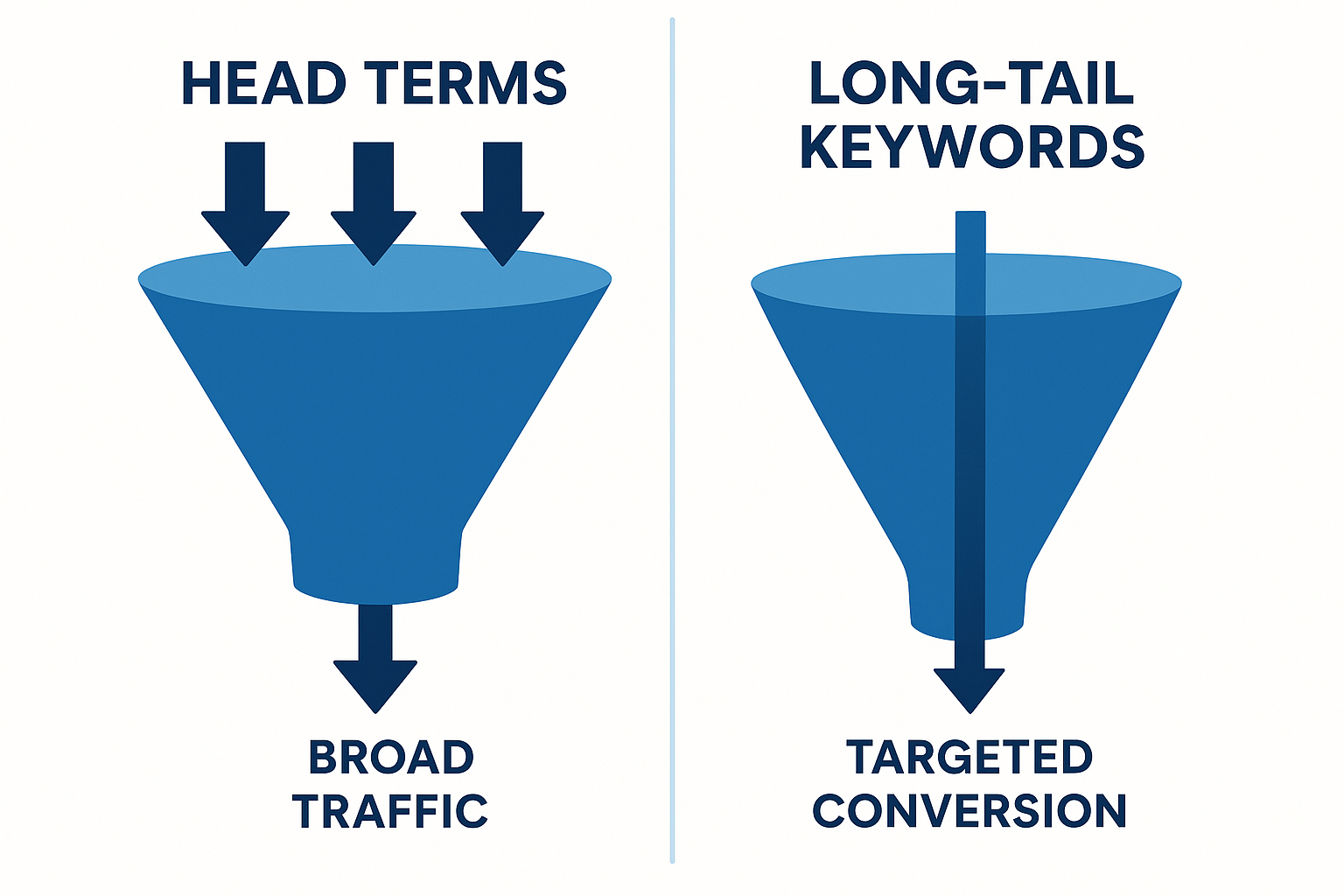
A balanced keyword strategy uses both head terms and long-tail keywords — each serving a different role in your growth plan.
How to Do Keyword Research: A Complete Step-by-Step Process
Following a structured, repeatable process ensures you capture high-value opportunities, avoid wasted effort, and build a keyword list aligned with real business outcomes. Here is the full framework — eight steps from blank slate to actionable content plan.
-
Define Your Goals and Audience First
Before you open any keyword tool, define who you are trying to reach and what you want them to do. A SaaS company targeting marketing managers has entirely different keyword priorities than an e-commerce store selling outdoor gear. Your business goals — whether that is lead generation, product sales, newsletter signups, or ad revenue — determine which keywords are actually worth ranking for. High-volume keywords that attract the wrong audience are worthless.
-
Generate Seed Keywords
Seed keywords are broad, short terms that represent the core topics of your business or content. Write down five to ten seeds based on your products, services, or content categories. For an SEO tool company, seeds might include “keyword research,” “backlink analysis,” “site audit,” and “rank tracking.” These seeds are not your final targets — they are the raw material you feed into tools to expand and refine your list. Good seed sources include your site’s existing pages, competitor homepages, industry glossaries, and your own sales conversations.
-
Expand Using Keyword Research Tools
Enter your seed keywords into dedicated keyword research tools to generate hundreds of related keyword ideas. Each tool provides different angles: Google Keyword Planner shows grouped volume data useful for PPC planning; Ahrefs Keywords Explorer surfaces traffic potential and parent topic data; Semrush Keyword Magic Tool provides intent classification and competitive density scores. Pull ideas from multiple sources and collect them in a spreadsheet, recording volume, difficulty, CPC, and intent for each term. Cast a wide net at this stage — pruning comes later.
-
Analyze Competitor Keywords
One of the fastest ways to build a strong keyword list is to analyze what your competitors already rank for. In tools like Ahrefs or Semrush, enter a competitor’s domain into the “organic keywords” report to see every keyword they rank for, their position, and the estimated traffic each term drives. Filter for keywords where they rank in positions 2–10 — these are terms where you can realistically compete with strong content. Also look for competitor keyword gaps: terms other competitors rank for that your closest rival does not. These represent uncontested opportunities.
-
Analyze Search Intent for Each Candidate Keyword
For every keyword you are seriously considering, open a private browser window and Google the term. Examine the top five organic results: Are they blog posts, product pages, video embeds, or local listings? Note the format (how-to guide, listicle, comparison, definition), the depth, and who is ranking. This tells you exactly what Google believes people want when they search that term. If all five results are product pages and you plan to write an informational blog post, you are misaligned with intent and will struggle to rank regardless of other factors.
-
Filter by Difficulty, Volume, and Business Value
Now narrow your list using a combination of metrics. Keyword difficulty tells you how hard it is to rank; search volume tells you how much traffic is available; business value tells you whether ranking would actually benefit your bottom line. A practical filter for newer sites: KD under 30, volume over 100, and a clear connection to a product or service you offer. For established sites: KD up to 50, volume over 500. Importantly, do not filter by volume alone — a keyword with 200 monthly searches and a $40 CPC can be far more valuable than one with 20,000 searches and zero commercial intent.
-
Group Keywords Into Topic Clusters
Rather than treating each keyword as a standalone target, group related keywords into topic clusters. Each cluster has a central pillar page targeting a broad, high-authority keyword, supported by cluster pages targeting more specific long-tail variations. For example, a pillar page on “keyword research” might be supported by cluster articles on “how to find long-tail keywords,” “keyword difficulty explained,” and “keyword research for e-commerce.” This structure builds topical authority — a signal that search engines use to determine whether your site deserves to rank across an entire subject domain — while also creating a natural internal linking architecture.
-
Map Keywords to Pages and Build Your Content Plan
Assign each prioritized keyword to one specific page on your site. This is called keyword mapping, and it prevents keyword cannibalization — the problem that occurs when multiple pages compete for the same term and undermine each other’s rankings. Each page gets one primary keyword and two to five closely related secondary keywords. Translate this mapping into a prioritized content calendar, scheduling quick-win long-tail topics first to build momentum, then layering in more competitive targets as your domain authority grows.
How to Find Low-Competition Keywords Worth Targeting
For most sites — especially newer ones without significant domain authority — the fastest path to organic traffic runs through low-competition keywords. These terms offer a realistic ranking opportunity without requiring an extensive backlink-building campaign. Here is how to find them systematically.
Use “Questions” Filters in Keyword Tools
Most keyword tools let you filter results to show only question-based queries — searches beginning with “how,” “what,” “why,” “when,” “where,” or “can.” These question keywords almost always have lower competition because they require more specific, structured answers that many sites don’t invest in producing. They also align perfectly with FAQ schema and featured snippet optimization.
Mine Google’s “People Also Ask” and Autocomplete
Google’s People Also Ask (PAA) boxes and autocomplete suggestions are real-time data on related searches. Every PAA question is a low-competition long-tail keyword with confirmed demand — Google only surfaces questions that enough people actually ask. Autocomplete fills are similarly useful, especially when you type a seed keyword followed by a letter (e.g., “keyword research a…”, “keyword research b…”) to uncover alphabetically organized variations.
Target “Parent Topic” Gaps
In Ahrefs, the “parent topic” for a keyword is the broader term that a top-ranking page tends to also rank for. If a page ranking for “keyword research for beginners” actually derives most of its traffic from “keyword research,” that signals the parent topic is highly valuable and its sub-variations are underserved. Find these sub-variations and create dedicated, thorough pages for each.
Look for Pages Ranking in Positions 5–20
Using Google Search Console, identify keywords where you currently rank between positions 5 and 20. These are pages that Google already considers relevant — they just need a content improvement push to break into the top four results where the majority of clicks happen. These “almost there” keywords are often your highest-ROI optimization targets.
Keyword Research Tools: A Comprehensive Comparison
Choosing the right tool significantly affects the depth and accuracy of your keyword research. Here is a detailed look at the most widely used platforms, including their strengths, weaknesses, and best use cases.
For most professionals doing serious keyword research, using at least two tools simultaneously — one paid platform like Ahrefs or Semrush combined with Google Search Console and Google Keyword Planner — provides a more complete and accurate picture than relying on any single tool alone.
For a complete guide to building an SEO strategy around your keyword data, RankAuthority provides in-depth guidance on connecting keyword research to content planning, on-page optimization, and technical SEO.
Keyword Research for Specific Use Cases
Keyword research is not one-size-fits-all. Different website types and business models require adapted approaches to find keywords that align with their specific audience and conversion goals.
Keyword Research for E-Commerce Sites
E-commerce keyword research prioritizes transactional and commercial-investigation intent. Product category pages target middle-tail keywords (“men’s running shoes”), product detail pages target highly specific long-tail terms (“Nike Air Zoom Pegasus 41 wide fit”), and blog content targets informational keywords that build early-funnel awareness. For e-commerce, CPC data is especially valuable because high-CPC keywords indicate categories where buyers are actively spending money. Also look for “product + review,” “product + comparison,” and “best + category” constructions.
Keyword Research for Local SEO
Local keyword research adds a geographic modifier to your targeting — “plumber in Austin,” “best Italian restaurant near downtown Seattle,” “emergency dentist Chicago.” Use Google Keyword Planner’s geographic filtering to find locally relevant search volumes. Prioritize keywords that trigger Google’s local pack (the map results block) in addition to standard organic results, since appearing in both dramatically increases your SERP real estate. Also research hyper-local queries like neighborhood names and landmark references.
Keyword Research for SaaS and B2B
B2B and SaaS keyword research often targets lower-volume, higher-intent keywords that map directly to the buyer’s journey stages: awareness (informational guides on problems the product solves), consideration (comparison and “alternative to” keywords), and decision (demo requests, pricing pages, free trial signups). Don’t be discouraged by modest volume — a keyword with 150 monthly searches that drives a $5,000 SaaS subscription has extraordinary business value. Also target competitor brand names with “alternative to” or “vs.” modifiers to capture high-intent searchers already in the market.
Keyword Research for Blog Content and Publishing
For content-first sites, the primary goal is informational keyword volume at scale. Use topic cluster architecture to build subject-matter authority across dozens or hundreds of interlinked posts. Prioritize keywords where your content can genuinely be the definitive answer — long-tail questions, emerging trends captured via Google Trends, and topics where current top-ranking content is thin, outdated, or poorly structured.
Building a Topic Cluster Strategy from Keyword Research
Topic clusters represent the modern evolution of keyword-driven content strategy. Instead of treating each keyword as a siloed target, a cluster organizes related keywords into a hierarchical content structure that maximizes topical authority across an entire subject domain.
A topic cluster consists of three components:
- Pillar Page: A comprehensive, long-form page targeting a broad head or middle-tail keyword. It covers the topic thoroughly at a high level and links out to all cluster pages. Example: a pillar page on “keyword research” covering all major subtopics.
- Cluster Pages: Individual posts or pages each targeting a specific long-tail variation. They cover their subtopic in depth and link back to the pillar. Examples: “how to find long-tail keywords,” “keyword difficulty explained,” “keyword mapping guide.”
- Internal Links: Strategic links between the pillar and all cluster pages, and between cluster pages themselves where relevant. This structure distributes link equity, helps search engines understand the relationship between pages, and guides users to deeper content.
When you build multiple clusters across all the key topics in your niche, you signal to search engines that your site is a genuine authority on those subjects — not just a page with keywords on it. This topical authority is increasingly important as Google’s algorithms move toward understanding entities and expertise rather than simply matching keywords.

Organizing keywords into topic clusters turns raw research data into a structured, compounding content strategy.
Common Keyword Research Mistakes to Avoid
Even experienced SEOs make costly errors in keyword research. Recognizing these mistakes before they happen saves months of wasted effort and misallocated content spend.
- Ignoring search intent: Targeting a keyword with informational intent on a product page — or commercial intent on a blog post — creates a fundamental mismatch. Google’s algorithm recognizes intent-content misalignment and penalizes it with lower rankings, regardless of all other optimization factors. Always confirm intent before assigning a keyword to a page type.
- Chasing volume without considering business value: A keyword with 50,000 monthly searches that attracts curious browsers contributes less to revenue than a keyword with 400 searches from buyers with credit cards in hand. Evaluate every keyword against its potential to drive actual business outcomes — not just traffic numbers.
- Skipping competitor analysis: Failing to analyze what your top-ranking competitors target means leaving obvious opportunities on the table. Competitor keyword research reveals quick wins (terms they rank for weakly), content gaps (topics they haven’t covered), and emerging opportunities (trending terms nobody has claimed yet).
- Keyword cannibalization: When multiple pages on your site target the same primary keyword, they compete against each other, splitting link equity and click signals in a way that prevents either page from ranking strongly. Keyword mapping directly prevents this — assign each keyword to exactly one page.
- Treating keyword research as a one-time task: Search trends, competitive landscapes, and user language evolve constantly. A keyword with KD 20 today may have KD 55 in a year after competitors flood the space. Schedule keyword audits quarterly to identify shifting opportunities, update declining pages, and capture newly trending terms.
- Using only one keyword tool: No single tool has perfect data. Volume estimates, difficulty scores, and related keyword suggestions differ meaningfully across tools. Cross-referencing two or three tools produces a more accurate and comprehensive view than relying on any one source.
- Over-targeting too many keywords per page: Trying to rank one page for ten different primary keywords dilutes topical relevance and sends confusing signals to search engines. One primary keyword per page — supported by a small cluster of semantically related secondaries — is the correct approach.
How to Prioritize Your Keyword List for Maximum Impact
After generating a large keyword list, the challenge becomes deciding where to invest your content effort first. Prioritization prevents the paralysis that comes from having 500 keywords and no clear starting point.
Use this scoring framework to rank each keyword candidate:
Keyword Priority Score Formula
Assign each keyword a score from 1–5 on four dimensions:
- Business Relevance — How closely does this keyword relate to your product or service?
- Search Volume — Higher volume = higher potential reach.
- Ranking Feasibility — Based on KD vs. your current domain authority, can you realistically rank? For a deeper walkthrough, see our Is There a Risk-Free Trial for SEO Services?.
- Business Value — If you rank and visitors convert, how much is each visitor worth?
Add the four scores together. Keywords scoring 16–20 are your highest priorities. Schedule these first.
In practice, most successful keyword strategies layer effort across three time horizons: quick wins (low-KD, moderate-volume long-tail terms you can rank for within weeks), medium-term targets (middle-tail terms requiring a few months and solid content), and long-term goals (high-competition head terms you build toward over 12–24 months through compounding authority). Resources like RankAuthority can help you structure this layered approach into a content strategy that produces consistent, compounding organic growth.
Keyword Research in the Age of AI and Semantic Search
Google’s AI-powered algorithm — built on natural language processing systems like BERT and MUM — has fundamentally changed what it means to target a keyword. The era of exact-match keyword stuffing is long gone. Today, Google understands synonyms, related concepts, and the contextual meaning of entire documents, not just individual keyword instances on a page.
What this means practically for keyword research:
- A single page can rank for hundreds of semantically related terms if it comprehensively covers a topic. The target keyword remains important as a primary focus signal, but ranking breadth comes from semantic depth.
- Intent and context matter more than keyword frequency. A page that answers the user’s full question will outrank a page that repeats the target keyword more often but answers less.
- Entity-based optimization is increasingly important. Google maps content to real-world entities (people, places, brands, concepts). Building content that establishes clear entity relationships strengthens rankings across a topic domain.
- AI-generated content makes quality the differentiator. As AI tools make content creation faster and easier, the pages that rank will be those that demonstrate genuine expertise, original insight, and superior user experience — not just keyword coverage.
The implication: keyword research should inform a topic, not constrain it. Use your target keyword as the anchor and your semantic research as the map — then write the most genuinely useful, thorough, and well-structured content on the subject that exists anywhere on the web.
Conclusion: Make Keyword Research a Continuous Competitive Advantage
Keyword research is not a task you complete once and archive. It is an ongoing intelligence practice that keeps your content strategy aligned with how real people actually search — and how that behavior evolves over time. The brands that treat it as a living process, revisiting and refining their keyword maps quarterly, consistently outpace those that treat it as a setup step.
Start with seed keywords that represent your core business. Expand into hundreds of candidates using research tools. Filter ruthlessly by intent, difficulty, and business value. Map what remains to specific pages. Build topic clusters that compound authority across entire subject domains. Then return every quarter to find the new opportunities that your competitors haven’t spotted yet.
Done consistently, keyword research is the single highest-leverage activity in your SEO toolbox — the foundation beneath every ranking, every visitor, and every conversion your organic channel delivers.
Frequently Asked Questions About Keyword Research
What is keyword research in SEO?
Keyword research is the process of identifying and analyzing the words and phrases people type into search engines. In SEO, it is used to guide content creation, optimize existing pages, and ensure your site targets terms that real people are actively searching for with sufficient volume and manageable competition.
Why is keyword research important for SEO?
Keyword research is important because it tells you what your audience is looking for and whether the content you create will attract organic search traffic. Without it, you risk publishing content that no one searches for, missing high-value opportunities, and wasting resources on topics that cannot drive meaningful results.
How do I start keyword research from scratch?
Start by defining your audience and business goals, then brainstorm three to ten seed keywords representing your core topics. Enter those seeds into a keyword tool like Google Keyword Planner, Ahrefs, or Semrush to expand your list. Analyze each keyword for search volume, difficulty, and intent, then filter down to a prioritized list of the most valuable and achievable targets.
What tools are best for keyword research?
The most widely used keyword research tools are Ahrefs, Semrush, Google Keyword Planner, Google Search Console, Moz Keyword Explorer, Ubersuggest, and AnswerThePublic. For the most complete picture, use at least two tools — one paid platform plus Google’s free tools — to cross-reference data and reduce the impact of any single tool’s limitations.
What is keyword difficulty and how should I use it?
Keyword difficulty (KD) is a score estimating how hard it is to rank on page one for a given term, based primarily on the authority of currently ranking pages. Use it as a filter — not an absolute rule. A keyword with KD 45 may be achievable if existing results are thin, outdated, or poor quality, while a KD 25 keyword might still be hard if major brands dominate the SERP. Always look at the actual results, not just the score.
What are long-tail keywords and why do they matter?
Long-tail keywords are specific, multi-word phrases — typically four or more words — with lower individual search volume but significantly lower competition and higher conversion rates. They matter because they collectively account for the majority of all online searches, are far easier to rank for than head terms, and attract highly qualified visitors closer to making a decision. Example: “best keyword research tools for small business” versus “keyword research.”
How do I analyze search intent for a keyword?
To analyze search intent, search the keyword in a private browser and study the top five organic results. Note whether they are blog posts, product pages, videos, or local listings, and observe the content format (how-to guide, listicle, review, definition). The dominant format and content type in those top results is Google’s signal of what intent it believes the keyword represents. Match your page type and format to that pattern.
What is keyword cannibalization?
Keyword cannibalization occurs when two or more pages on the same website target the same primary keyword. This splits ranking signals and link equity between competing pages, preventing either from ranking as strongly as a single, consolidated page would. Fix it by merging competing pages, redirecting weaker versions to the strongest, or differentiating the content so each page targets a clearly distinct keyword.
How many keywords should I target per page?
Target one primary keyword per page, supported by two to five closely related secondary keywords that reflect semantic variations of the same topic. Over-targeting dilutes relevance and confuses search engines. A well-written page that comprehensively covers a topic will naturally rank for dozens or hundreds of semantically related terms without being explicitly optimized for each one.
Can I do effective keyword research for free?
Yes, meaningful keyword research is possible using only free tools — Google Keyword Planner for volume estimates, Google Search Console for existing ranking data, Google Trends for seasonal and trending insights, and AnswerThePublic (limited free searches) for question-based keywords. The limitation is depth: free tools provide less precise volume data, fewer keyword suggestions, and no competitive difficulty scoring. For professional-grade research, a paid tool is worth the investment.
What is a topic cluster in keyword research?
A topic cluster is a group of related content pages organized around a central pillar page. The pillar page targets a broad keyword and links to multiple cluster pages, each targeting a specific long-tail variation. This structure builds topical authority — signaling to search engines that your site covers a subject comprehensively — and creates a natural internal linking architecture that distributes ranking power across the cluster.
How often should I update my keyword research?
Revisit your keyword research at least every three months. Search trends shift, new keywords emerge, competitor landscapes change, and some previously low-competition terms become saturated quickly. Quarterly audits let you update declining pages, capture emerging opportunities, and realign your content calendar with current demand before competitors do.
What is the difference between search volume and traffic potential?
Search volume is the number of times a specific keyword is searched per month. Traffic potential is a broader estimate of the total traffic a top-ranking page could receive, including traffic from all related long-tail variations that the page would also rank for. Traffic potential is generally a more useful metric because a page rarely ranks only for its exact target keyword — it will attract traffic from dozens of semantically related searches as well.

