

In this Keyword SEO guide, a keyword is any word or phrase a person types into a search engine to find information, products, or services online. In SEO, keywords are the foundation of every strategy — they connect your content to the people who need it most.
Understanding how to choose, use, and optimize keywords can mean the difference between a page that ranks on page one and a page that no one ever finds. In this guide, you will learn exactly what keywords are, why they matter, and how to build a smart strategy around them.
Keyword SEO Guide: What Is a Keyword? A Clear Definition
A keyword is the specific term or phrase that signals to a search engine what a web page is about. For example, when someone types “best running shoes for flat feet” into Google, that entire phrase is a keyword. Search engines analyze this input and return the most relevant results from across the web. See our keyword research guide for deeper methods.
Keywords are not just single words. They range from broad, one-word terms like “shoes” to highly specific phrases called long-tail keywords — for instance, “waterproof trail running shoes under $100.” According to Wikipedia’s overview of keyword research, long-tail keywords account for the majority of all search queries, making them an essential part of any content plan.
Furthermore, keywords carry search intent — the underlying reason behind the query. Recognizing intent helps you create content that truly satisfies what the searcher wants, which in turn earns higher rankings and better engagement.

Effective keyword research combines data tools with strategic thinking to uncover the terms your audience actually uses.
Types of Keywords You Need to Know
Not all search terms are equal. Therefore, understanding the main categories helps you build a balanced strategy that captures traffic at every stage of the buyer journey.
Short-Tail vs. Long-Tail Keywords
Short-tail keywords are broad terms of one or two words. They attract enormous search volume but face fierce competition. For example, “SEO” receives millions of monthly searches, yet ranking for it requires extraordinary domain authority.
Long-tail keywords, in contrast, are three or more words long and much more specific. They typically convert better because the searcher already has a clear goal. Research from Ahrefs shows that approximately 92% of all keywords receive fewer than 10 monthly searches, highlighting just how fragmented — and opportunity-rich — the long-tail space really is.
Local Intent Keywords
Local intent keywords include geographic signals such as city names, neighborhoods, or phrases like “near me.” These terms are especially valuable for businesses serving specific regions. Incorporating local intent keywords into your headings and body text is a proven tactic for capturing nearby customers. Learn more in our detailed guide on using local intent keywords in headings.
Semantic and LSI Keywords
Semantic keywords are conceptually related terms that help search engines understand the broader topic of your content. For instance, an article about “keyword research” might naturally include terms like “search volume,” “SERP,” and “query intent.” Using these variants prevents over-repetition and signals topical depth to algorithms.
How to Research the Right Search Terms: Step-by-Step
Solid keyword research is the engine that drives every successful SEO campaign. Specifically, follow this process to identify terms worth targeting: Also see our improve keyword research with AI guide for tool-driven techniques.
- Define your core topics. List the main themes your website covers. These become seed categories for generating specific ideas.
- Use keyword research tools. Enter seed topics into tools like Google Keyword Planner or Ahrefs to discover related terms, monthly volumes, and competition scores. You can also try our free keyword checker tool for a quick starting point. Find recommended options in our best SEO tools guide.
- Analyze search intent. Review the top-ranking pages for each candidate term. Determine whether the intent is informational, commercial, navigational, or transactional before committing to a target.
- Evaluate keyword difficulty and opportunity. Compare difficulty scores against your site’s current authority. Prioritize terms where ranking is realistically achievable in a reasonable timeframe.
- Place keywords strategically on the page. Include your primary term in the title, first paragraph, at least one heading, the meta description, and naturally throughout the body text.
For a deeper dive into this process, see our comprehensive guide on AI-Powered Keyword Research for your content strategy.
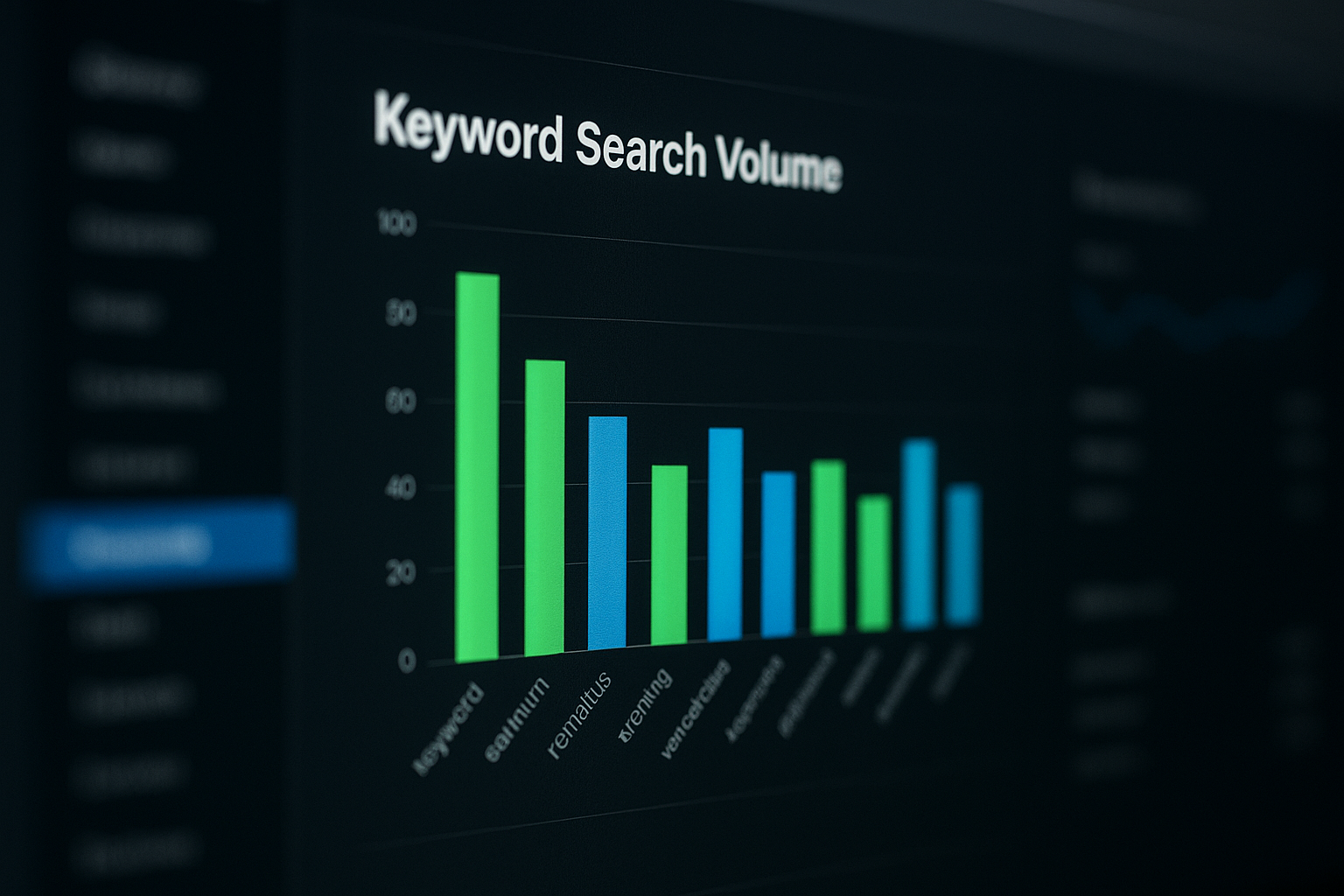
Analyzing keyword search volume data helps prioritize which terms offer the best balance of traffic potential and ranking difficulty.
Keyword Prominence and Placement Best Practices
Where you place a keyword matters as much as how often you use it. Keyword prominence refers to how early and how visibly a term appears on a page. Search engines give extra weight to terms found in the title tag, the first paragraph, subheadings, and image alt text.
However, avoid stuffing your content with repeated exact matches. Google’s algorithms are sophisticated enough to detect unnatural usage, and over-optimization can trigger ranking penalties. Instead, aim for a keyword density of roughly 0.5% to 2% and supplement with semantic variants. Our guide on keyword prominence and SEO covers the optimal placement tactics in detail.
On-Page Placement Checklist
- Include the primary term in the SEO title tag.
- Use it in the meta description naturally.
- Place it within the first 100 words of body content.
- Include it in at least one H2 or H3 heading.
- Add it to image alt text where relevant.
- Use semantic variants throughout the remaining body text.
Keyword Gap Analysis: Finding Hidden Opportunities
A keyword gap analysis compares your site’s current rankings against those of your top competitors. As a result, you can identify valuable search terms your rivals rank for that your content does not yet target. This approach is one of the fastest ways to grow organic traffic without starting from scratch.
For example, if a competitor ranks for “keyword strategy for YouTube” and your site does not, that gap represents a direct content opportunity. Our detailed resource on keyword gap analysis for YouTube and blogs walks through the full process with actionable examples.
Keywords in AI-Powered Search: What’s Changing
Traditional search engines matched pages to queries primarily through exact keyword signals. AI-powered search, however, goes much further. Systems like Google’s Search Generative Experience and other answer engines analyze semantic meaning, entity relationships, and topical authority to determine which content best answers a query. Learn how to improve search performance using AI.
Consequently, modern keyword strategy must extend beyond simple term placement. You need to build content that comprehensively covers a topic, answers follow-up questions, and demonstrates genuine expertise (AI insights for SEO). According to Google’s own SEO Starter Guide, creating helpful, people-first content remains the most reliable path to sustained visibility.
Platforms like AI insights for SEO are built specifically for this new landscape. Their automated GEO and AEO tools help businesses optimize for both traditional keyword signals and the emerging AI search environment — without requiring deep technical expertise. The platform’s 1-Click AI AutoPilot technology handles the heavy lifting, continuously adjusting content signals to keep your pages competitive as search algorithms evolve.
Quick Stat: Research from Ahrefs found that the top-ranking page for a given keyword also ranks in the top 10 for nearly 1,000 other related keywords on average — demonstrating why topical depth matters far more than targeting a single term in isolation.

AI search engines analyze semantic keyword relationships rather than relying on exact-match terms alone.
Common Keyword Mistakes to Avoid
Even experienced marketers make avoidable errors. In particular, watch out for these common pitfalls:
- Keyword cannibalization: Targeting the same primary term on multiple pages causes your own content to compete against itself. Assign unique primary keywords to each page.
- Ignoring search intent: Targeting a high-volume term without matching the searcher’s actual goal results in high bounce rates and poor rankings.
- Keyword stuffing: Overusing a term unnaturally signals spam to search engines. Keep density below 2% and write for humans first.
- Skipping long-tail opportunities: Focusing only on high-volume short-tail terms ignores the large portion of searches that are specific and highly convertible.
- Never updating your strategy: Search trends shift constantly. Review your keyword targets at least quarterly to stay aligned with what your audience is currently searching for.
Frequently Asked Questions About Keyword SEO
What is a keyword in SEO?
A keyword in SEO is a word or phrase that users type into a search engine to find information. Search engines use these terms to match relevant web pages to user queries. Every piece of optimized content targets at least one primary keyword alongside several secondary terms.
Why is keyword research important?
Keyword research helps you understand exactly what your audience is searching for. By targeting the right terms, you attract qualified traffic and improve your chances of ranking higher. Without research, you risk creating content that no one is actually looking for.
What is the difference between short-tail and long-tail keywords?
Short-tail keywords are broad, one- to two-word phrases with high search volume but intense competition. Long-tail keywords are more specific phrases of three or more words that typically have lower volume but higher conversion rates because the searcher has a clearer intent.
How do I find the right keywords for my website?
Start by brainstorming topics relevant to your business, then use tools like Google Keyword Planner or Ahrefs to find related terms. Analyze search volume, competition, and search intent before finalizing your list. Prioritize terms where your site has a realistic chance of ranking.
What is keyword density and how much is ideal?
Keyword density is the percentage of times a target term appears relative to total word count. Most SEO experts recommend keeping density between 0.5% and 2% to avoid keyword stuffing penalties. Supplement with semantic variants to maintain natural language flow.
What is search intent in keyword strategy?
Search intent refers to the underlying goal a user has when typing a query. The four main types are informational, navigational, commercial, and transactional intent. Matching your content format and depth to the correct intent type significantly improves rankings and user satisfaction.
How does keyword prominence affect rankings?
Keyword prominence refers to how early and how visibly a term appears on a page. Placing your target keyword in the title, first paragraph, and headings signals strong relevance to search engines. Higher prominence generally correlates with stronger ranking signals for that term.
What is a keyword gap analysis?
A keyword gap analysis identifies search terms your competitors rank for that your site does not. This reveals untapped opportunities to capture additional organic traffic. It is one of the fastest ways to expand your content strategy with high-confidence targets.
How often should I update my keyword strategy?
You should review your keyword strategy at least every quarter. Search trends, algorithm updates, and competitive shifts can change which terms are most valuable for your site. Regular audits ensure your content stays aligned with current demand.
Can I use the same keyword on multiple pages?
Using the same primary keyword on multiple pages can cause keyword cannibalization, where your pages compete against each other in search results. It is better to assign unique primary keywords to each page and use related terms as secondary targets to avoid splitting ranking signals.
What are local intent keywords?
Local intent keywords include geographic modifiers such as city names or phrases like “near me.” These terms signal that a user is looking for a business or service in a specific location. They are especially valuable for brick-and-mortar businesses and service-area companies.
How do AI search engines use keywords differently?
AI-powered search engines analyze semantic meaning and context rather than relying solely on exact keyword matches. Optimizing for topics, entities, and natural language patterns is increasingly important alongside traditional keyword targeting. Content that comprehensively covers a subject tends to perform better in AI-driven search environments. See AI insights for SEO for practical tactics.
Conclusion: Building a Smarter Keyword Strategy - Keyword SEO Guide
Mastering the keyword is still the cornerstone of effective SEO — but the rules have evolved. Today, success requires matching terms to search intent, building topical depth, and adapting to AI-powered ranking systems that prioritize genuine relevance over simple repetition (use AI to improve SEO). By following the research process outlined in this guide, avoiding common mistakes, and continuously refining your targets, you position your content for lasting visibility in both traditional and next-generation search environments. Start with a solid keyword foundation, and everything else in your SEO strategy becomes measurably more effective.

