

Moz rank domain authority is a proprietary SEO metric developed by Moz that predicts how well an entire website is likely to rank on search engine results pages, scored on a logarithmic scale from 1 to 100. Understanding this metric helps SEO professionals benchmark their sites, evaluate competitors, and prioritize link-building efforts more effectively.
Because the scale is logarithmic, moving from a score of 20 to 30 is considerably easier than moving from 70 to 80. Therefore, context and competition matter enormously when interpreting your score.
Quick Answer: Moz rank domain authority is a score from 1 to 100 that estimates a domain’s overall ranking strength based on its backlink profile. A higher score signals greater authority and better ranking potential. It is a comparative tool, not a direct Google ranking factor.
What Is Moz Rank Domain Authority and How Is It Calculated?
Moz calculates Domain Authority using a machine learning model trained on data from its web index. The model primarily evaluates the number of unique linking root domains and the overall quality of those links. Additionally, it weighs the relevance and trustworthiness of each linking site.
Because Moz periodically updates the algorithm, scores can fluctuate even when you have not changed your link profile. In practice, this means a drop in DA does not always signal a problem — it may simply reflect a recalibration across all sites in the index.
According to Wikipedia’s overview of domain authority, the metric was designed to correlate with actual search engine rankings, making it a useful proxy for competitive analysis even though Google does not use it internally.
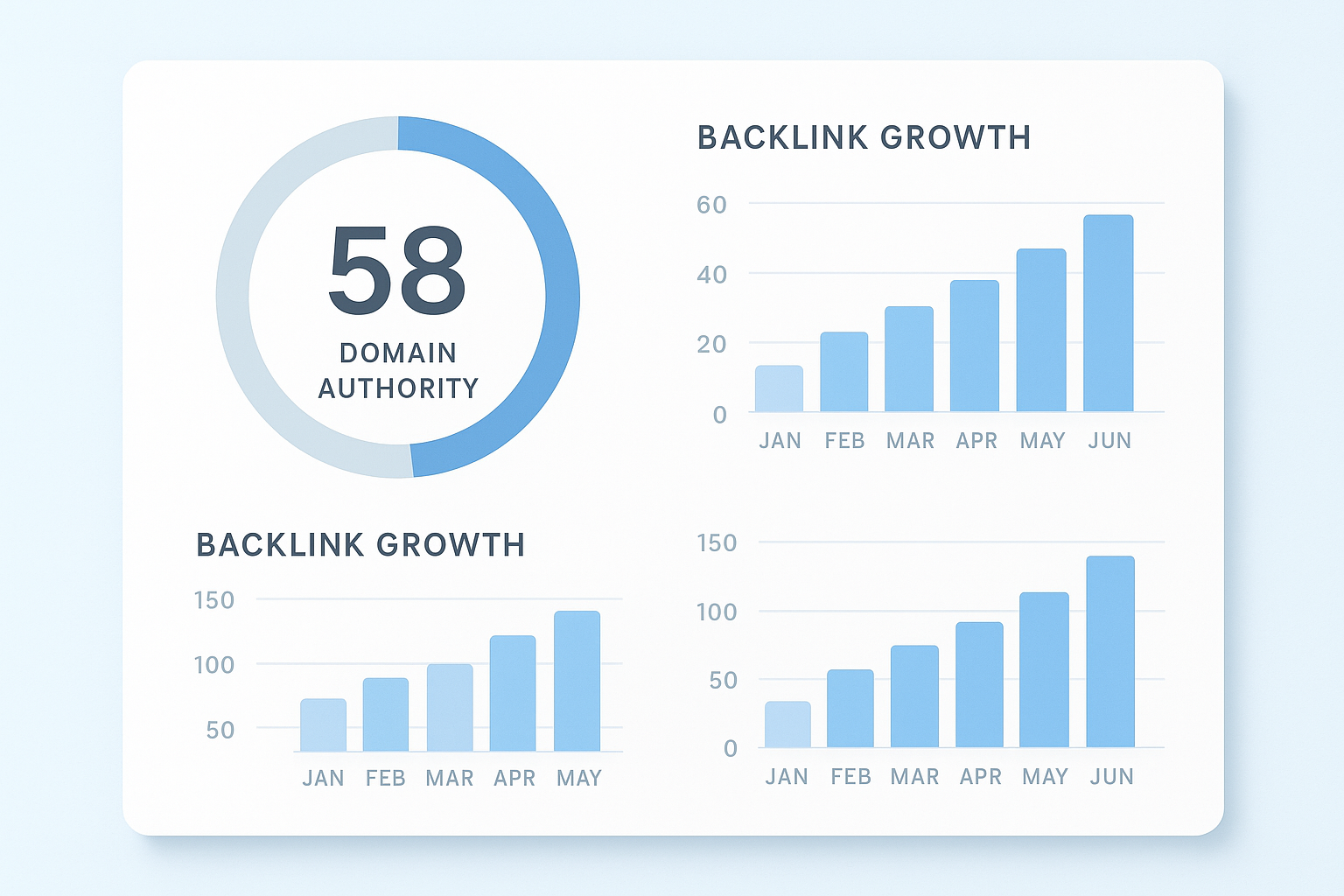
A Domain Authority dashboard showing a score of 58, reflecting a strong and growing backlink profile over six months.
MozRank vs. Domain Authority: Understanding the Difference
MozRank is an older, page-level metric that measures the strength of a single page’s link profile on a scale of 0 to 10 — conceptually similar to Google’s original PageRank. Domain Authority, however, evaluates the entire domain and uses a more sophisticated model with far more input signals.
In contrast, Page Authority (PA) sits between these two concepts: it uses the same 1-to-100 scale as DA but focuses on the ranking potential of a single URL rather than the whole domain. As a result, a site can have a high DA while individual pages carry lower PA scores if they lack direct inbound links.
What Score Range Should You Aim For?
Score benchmarks vary by industry, but general guidelines apply across most niches. First, new websites typically start near 1 and grow slowly. Meanwhile, established blogs and business sites often land between 30 and 50.
Domain Authority Score Benchmarks
| Score Range | Assessment | Typical Profile |
|---|---|---|
| 1 – 20 | Low | New or thin-content sites |
| 21 – 40 | Below Average | Growing sites with limited links |
| 41 – 60 | Average to Good | Established blogs and SMBs |
| 61 – 80 | Strong | Authority sites and media outlets |
| 81 – 100 | Exceptional | Major brands and news publishers |
However, absolute scores matter less than relative scores within your competitive landscape. For example, if your top competitors have DA scores between 35 and 45, then reaching 50 puts you in a strong competitive position regardless of the broader scale.
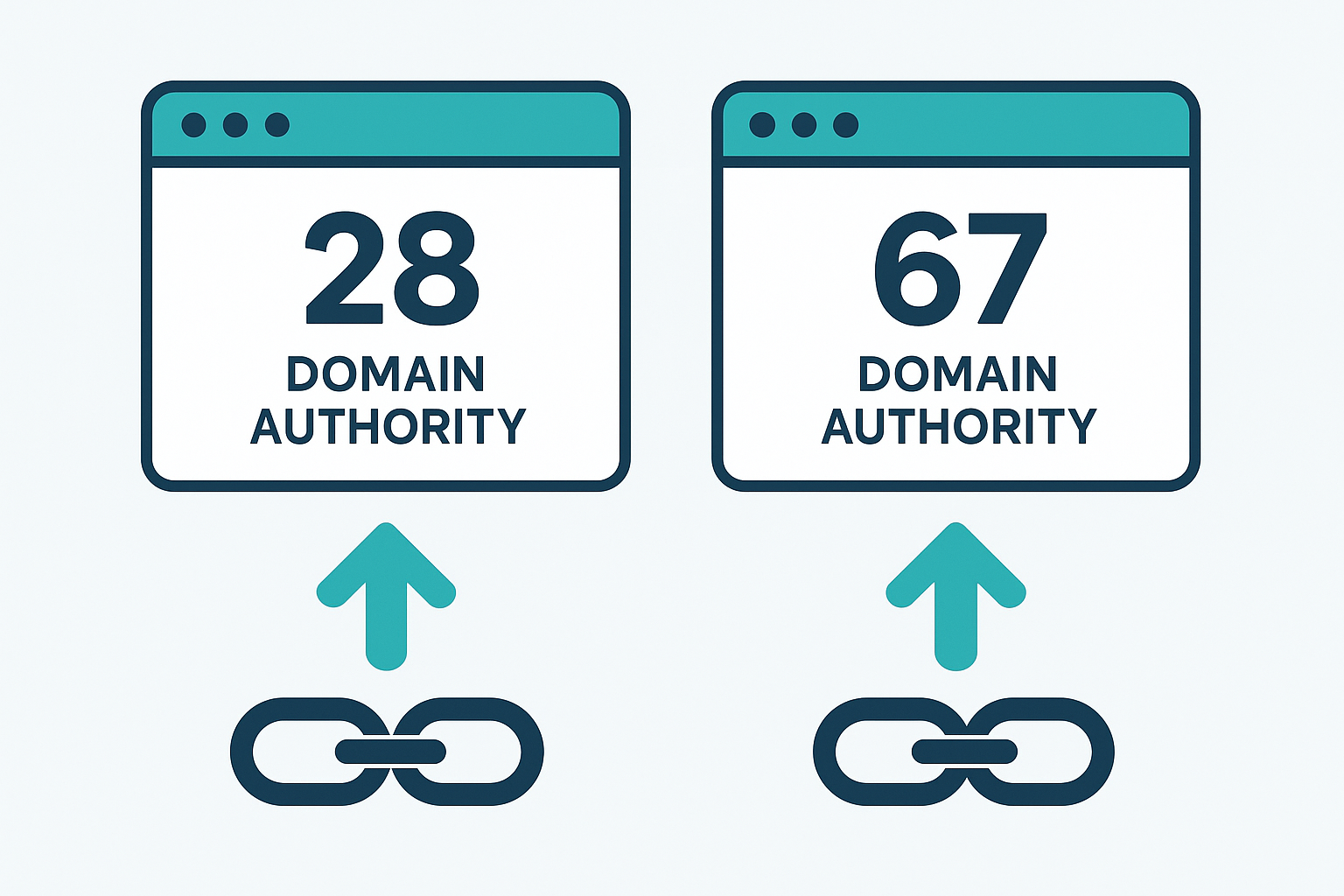
Comparing two sites with different authority scores illustrates how backlink quality drives meaningful gaps in ranking potential.
Five Proven Ways to Improve Your Score
Improving your Domain Authority requires consistent, strategic effort. Because the metric is heavily backlink-driven, most tactics revolve around earning high-quality links. The following approaches deliver the strongest results over time.
- Earn editorial backlinks through content assets. Create original research, data studies, or comprehensive guides that journalists and bloggers naturally want to cite. These links tend to come from high-authority domains and carry significant weight.
- Pursue strategic guest posting. Writing for reputable publications in your niche builds both authority and relevance signals. However, focus on genuine editorial value rather than link-only placements, which offer diminishing returns.
- Fix and reclaim lost links. Use tools like Moz’s Link Explorer to identify broken backlinks pointing to your site. Then, reach out to the linking domains and request an update to the correct URL.
- Audit and disavow toxic links. Spammy or irrelevant backlinks can dilute your link profile. Therefore, regularly audit your backlinks and use Google’s Disavow Tool to remove harmful ones.
- Build internal linking structures. While internal links do not directly increase DA, they distribute page authority across your site more efficiently. As a result, more pages gain the authority needed to compete for competitive keywords.
Common Mistakes That Hurt Your Authority Score
Many site owners inadvertently damage their scores through avoidable errors. First, purchasing bulk backlinks from low-quality networks is one of the most damaging tactics. Although these links may inflate your count temporarily, they signal spam and can trigger manual penalties.
Additionally, neglecting to remove or disavow toxic links allows a poor-quality backlink profile to accumulate over time. Another common mistake is focusing exclusively on DA while ignoring content quality — because without strong content, earning legitimate high-authority links becomes nearly impossible.
Finally, comparing your DA against sites in entirely different industries leads to misguided conclusions. Instead, always benchmark against direct competitors in your niche for accurate interpretation. Resources like Rank Authority offer practical guidance on interpreting these metrics within the right competitive context.
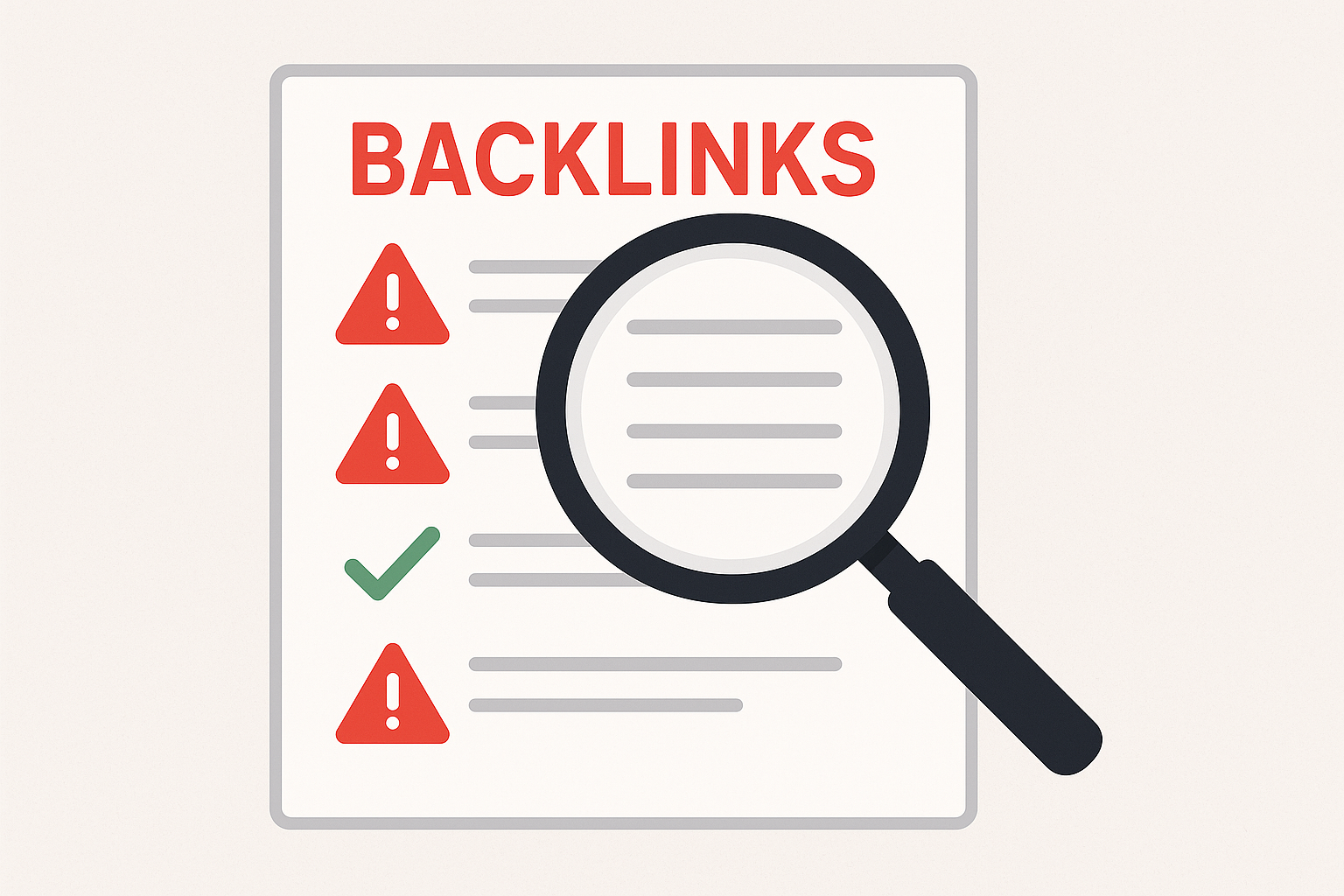
A backlink audit separates high-value links from toxic ones — a critical step in protecting and growing your domain authority.
How DA Fits Into a Broader SEO Strategy
Domain Authority is most useful as a benchmarking and competitive analysis tool, not as a primary success metric. Because Google’s algorithm uses hundreds of signals, DA captures only one dimension of ranking potential. Nevertheless, it remains one of the most widely used proxies for link-based authority in the SEO industry.
In practice, use DA alongside keyword difficulty scores, organic traffic data, and on-page quality signals for a complete picture. For example, a site with DA 45 and excellent on-page SEO can outrank a DA 60 site with thin, poorly structured content. Therefore, treat DA as one input in a multi-signal strategy rather than the sole measure of success.
For deeper analysis and ongoing monitoring, Rank Authority provides additional SEO resources to help you track authority metrics alongside broader ranking performance indicators.
Conclusion: Using Moz Rank Domain Authority Wisely
Moz rank domain authority is a powerful benchmarking tool that gives SEO professionals a reliable way to measure link-based strength and competitive positioning. However, it works best when combined with content quality, technical SEO, and keyword strategy rather than treated as a standalone goal. By earning high-quality backlinks, auditing your link profile regularly, and interpreting your score within the right competitive context, you can use Domain Authority to drive meaningful, measurable SEO growth.
Frequently Asked Questions
What is moz rank domain authority?
Moz rank domain authority is a proprietary SEO score developed by Moz that predicts how likely a website is to rank on search engine results pages, measured on a scale of 1 to 100. Higher scores indicate greater ranking potential based on the site’s backlink profile and link quality.
What is a good Domain Authority score?
A score between 40 and 50 is considered average, 50 to 60 is good, and anything above 60 is excellent. New websites typically start near 1 and build their score over time through quality backlinks.
How is Domain Authority calculated?
Domain Authority is calculated using a machine learning model that factors in the number of linking root domains, the quality and relevance of those links, and overall link profile data. Moz updates this algorithm periodically, which can cause score fluctuations.
Does Domain Authority directly affect Google rankings?
No, Domain Authority is a third-party metric created by Moz and is not used directly by Google in its ranking algorithm. However, it correlates strongly with ranking performance because it reflects the strength of a site’s backlink profile, which Google does consider.
How long does it take to improve Domain Authority?
Improving Domain Authority typically takes three to six months of consistent link-building efforts. The timeline depends on how aggressively you earn high-quality backlinks and how competitive your niche is.
What is the difference between Domain Authority and Page Authority?
Domain Authority measures the ranking strength of an entire domain, while Page Authority measures the ranking strength of a single page. Both use the same 1-to-100 logarithmic scale developed by Moz.
What is MozRank and how does it differ from Domain Authority?
MozRank is an older Moz metric that measures the strength of a page’s link profile on a 0-to-10 scale, similar in concept to Google’s original PageRank. Domain Authority is a broader, more modern metric that evaluates the entire domain’s likelihood to rank.
Can Domain Authority decrease?
Yes, Domain Authority can decrease if you lose backlinks, if competitors gain stronger link profiles, or when Moz updates its scoring algorithm. Regular monitoring helps you detect and respond to drops quickly.
What tools can I use to check Domain Authority?
You can check Domain Authority using Moz’s free Link Explorer tool, the MozBar browser extension, or third-party platforms that integrate Moz data. Tools like Rank Authority also provide SEO analysis resources to help interpret your scores.
How many backlinks do I need to raise my Domain Authority?
There is no fixed number, because quality matters more than quantity. A single backlink from a high-authority domain can have more impact than dozens of links from low-quality sites.
Is Domain Authority the same as Domain Rating?
No, Domain Authority is Moz’s metric while Domain Rating is Ahrefs’ equivalent metric. Both measure link-based authority but use different data sets and algorithms, so scores can differ significantly for the same domain.
What is the fastest way to increase Domain Authority?
The fastest approach is to earn backlinks from high-authority, relevant websites through tactics like guest posting, digital PR, and creating link-worthy content assets. Removing toxic backlinks also helps protect your score.
Should I focus on Domain Authority or individual keyword rankings?
Both matter, but keyword rankings reflect actual traffic while Domain Authority is a predictive indicator. Use Domain Authority as a benchmarking tool and directional guide, not as your primary success metric.

