

Moz site ranking is a system of proprietary SEO metrics developed by Moz to estimate how well a website is positioned to rank in search engine results. Understanding these metrics helps you benchmark your site, identify weaknesses, and prioritize improvements that genuinely move the needle.
Whether you are running a small blog or managing an enterprise website, Moz’s scoring system provides a consistent framework for comparing your authority against competitors. In practice, most SEO professionals check their Moz scores as a routine part of their monthly reporting.
What Is Moz Site Ranking and How Does It Work?
Moz site ranking is built around two core metrics: Domain Authority (DA) and Page Authority (PA). Both scores range from 1 to 100 on a logarithmic scale, meaning it becomes progressively harder to move from 70 to 80 than from 20 to 30. Moz calculates these scores using a machine learning model trained on thousands of real Google search results.
Domain Authority evaluates the entire root domain, while Page Authority focuses on a single URL. Additionally, Moz includes a Spam Score — a percentage indicating how many characteristics your site shares with domains that have been penalized or banned by Google. Together, these three signals give a well-rounded picture of your site’s health.
According to Wikipedia’s overview of Domain Authority, the metric was introduced to fill the gap left when Google stopped publicly updating its PageRank toolbar scores. Since then, DA has become an industry-standard benchmark used by SEOs worldwide.
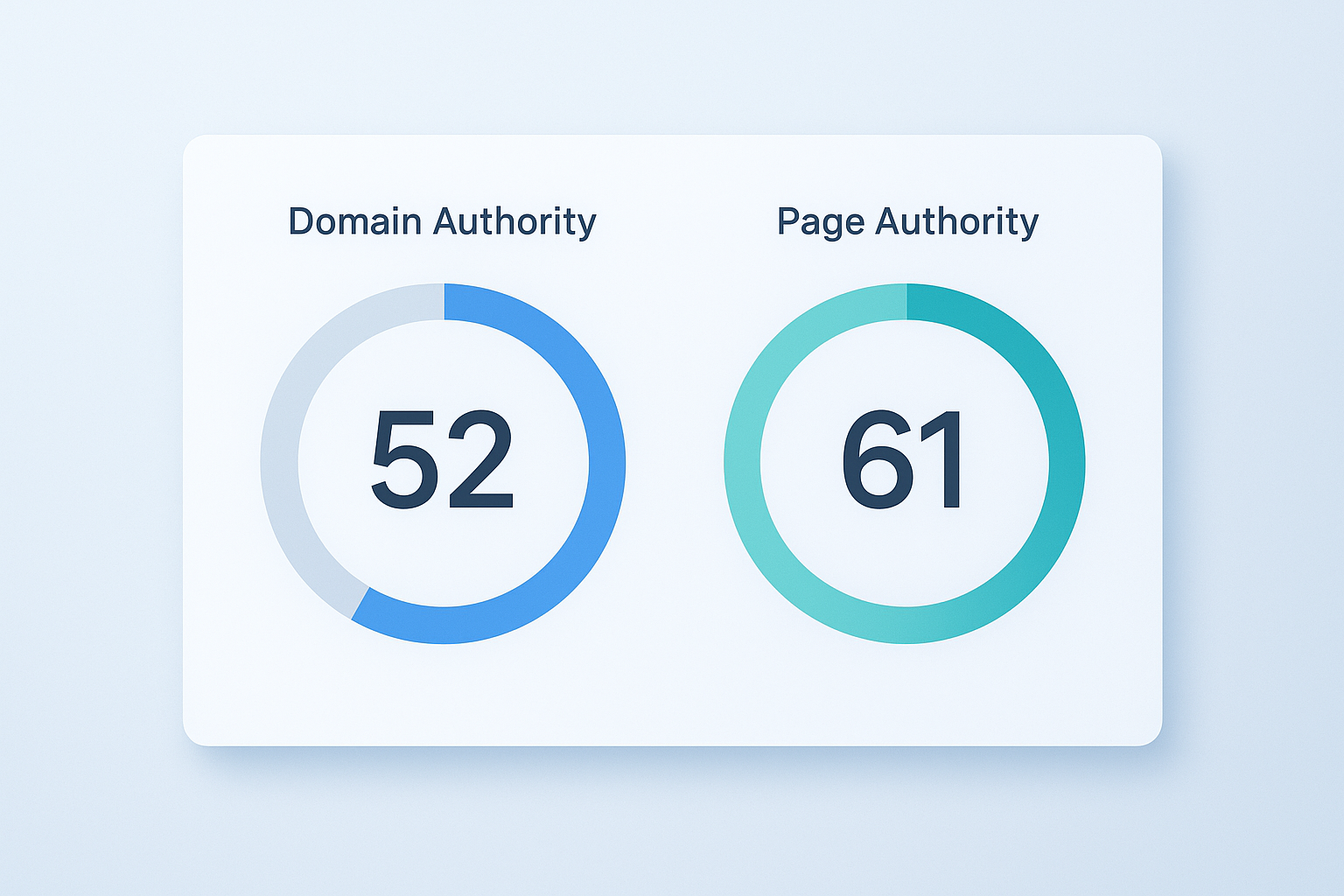
A typical moz site ranking overview showing Domain Authority and Page Authority gauge scores side by side.
The Key Metrics Inside Moz Link Explorer
Moz’s primary research tool is Link Explorer, available at moz.com. It allows you to enter any domain or URL and immediately retrieve a full breakdown of authority metrics, backlink counts, and linking root domains. Even on the free tier, you receive a meaningful snapshot of your site’s profile.
The most important data points to review inside Link Explorer include:
- Domain Authority (DA): Overall domain-level strength on a 1–100 scale.
- Page Authority (PA): Strength of a specific page, useful for evaluating landing pages.
- Linking Root Domains: The number of unique domains pointing to your site — quality matters more than quantity here.
- Total Backlinks: The raw count of all inbound links, including duplicates from the same domain.
- Spam Score: A percentage-based risk indicator for manipulative link patterns.
For a deeper competitive analysis, tools like RankAuthority can complement your Moz data by layering additional SEO insights on top of your authority benchmarks. For a deeper walkthrough, see our What Is Moz Rank? A Complete SEO Guide (2024).
How to Check Your Score in 5 Steps
Checking your score is straightforward, and you do not need a paid subscription to get started. Follow these steps to get your first reading:
- Visit Moz Link Explorer at moz.com/link-explorer and create a free account if you do not already have one.
- Audit your backlink profile by reviewing the linking root domains list and noting any suspicious or low-quality sources.
- Disavow toxic links using Google Search Console’s disavow file tool to remove harmful backlink influence.
- Build high-quality backlinks through content marketing, digital PR campaigns, and targeted guest posting on authoritative sites.
- Track your progress monthly by re-checking your DA and comparing it against three to five direct competitors.

Regularly auditing backlinks is a key part of maintaining a healthy moz site ranking over time.
What Counts as a Good Score?
Because DA uses a logarithmic scale, context is everything. Therefore, rather than chasing an arbitrary number, compare your score directly to competitors targeting the same keywords. A DA of 35 can be highly competitive in a low-authority niche, while a DA of 60 may still lag behind in finance or health sectors.
As a general reference framework:
Common Mistakes That Hurt Your Authority Score
Many site owners inadvertently damage their Moz scores through avoidable errors. First, acquiring backlinks from low-quality directories or link farms raises your Spam Score without meaningfully improving DA. As a result, Google may also treat your site with greater suspicion.
Second, neglecting to monitor lost backlinks is a common oversight. When high-authority sites remove links to your pages, your DA can decline even if you are doing everything else correctly. Additionally, over-optimized anchor text patterns — where the same exact-match keyword appears across too many backlinks — can trigger algorithmic scrutiny.
Finally, focusing exclusively on DA while ignoring Page Authority means missing opportunities to strengthen specific high-value pages that drive conversions or organic traffic.
Practical Strategies to Build Authority Over Time
Improving your score requires a sustained, multi-channel approach. However, the most reliable method remains earning editorial backlinks from genuinely authoritative websites. Content marketing — particularly original research, data studies, and comprehensive guides — naturally attracts these links because other sites want to reference credible sources.
Digital PR is another high-leverage tactic. By pitching journalists and bloggers with newsworthy angles or unique data, you can earn placements on high-DA news sites that significantly lift your own score. Meanwhile, fixing broken links on external sites and offering your content as a replacement is a lower-effort strategy that consistently delivers results.
For ongoing tracking and competitive benchmarking, resources like RankAuthority provide structured frameworks that pair well with Moz’s native data to give you a fuller picture of where you stand.

A strong backlink network is the foundation of any meaningful improvement in domain authority and site ranking.
Conclusion: Using Moz Metrics as a Competitive Compass
Understanding moz site ranking is not about obsessing over a single number — it is about using a consistent, data-driven benchmark to guide your SEO strategy. Because DA is a relative metric, the most productive use of it is ongoing competitor comparison rather than chasing an absolute target score.
By regularly auditing your backlinks, pursuing high-quality editorial links, and monitoring your Spam Score, you create the conditions for steady, compounding authority growth. In practice, sites that treat Moz metrics as a directional compass — rather than a final destination — consistently outperform those that ignore them entirely.
Quick Takeaway: Moz site ranking metrics — especially Domain Authority and Spam Score — are most valuable when tracked over time and compared against competitors in your specific niche, not evaluated in isolation.
Frequently Asked Questions
What is moz site ranking?
Moz site ranking refers to the set of proprietary metrics Moz uses to evaluate a website’s authority and likelihood of ranking in search engines, most notably Domain Authority and Page Authority. These scores range from 1 to 100 and are calculated using a machine learning model trained on Google ranking data.
What is a good Domain Authority score?
A DA score above 40 is generally considered good for most niches, while scores above 60 are strong and above 80 are exceptional. However, DA is best used as a relative metric compared to direct competitors rather than as an absolute benchmark.
How often does Moz update Domain Authority scores?
Moz updates Domain Authority scores roughly every few weeks as its web crawler processes new link data. Significant changes in your backlink profile may therefore take several weeks to reflect in your DA score.
Is Domain Authority the same as Google PageRank?
No, Domain Authority is a Moz proprietary metric and is not affiliated with Google. PageRank is Google’s internal link-based algorithm. DA is designed to correlate with Google rankings but remains a third-party estimate, not an official Google signal.
How can I check my score for free?
You can check your DA score for free using Moz’s Link Explorer tool or the MozBar browser extension. Both tools provide your Domain Authority, Page Authority, and Spam Score without requiring a paid subscription for basic lookups.
Why did my Domain Authority drop suddenly?
A sudden DA drop is usually caused by Moz recalibrating its scoring algorithm, competitors gaining more high-quality backlinks, or your site losing existing backlinks. Importantly, it does not necessarily mean your Google rankings will drop in parallel.
What is Moz Spam Score and why does it matter?
Moz Spam Score flags how many spam signals a site shares with penalized websites, expressed as a percentage from 0 to 100. A high spam score suggests your backlink profile may contain low-quality or manipulative links that could harm your SEO performance.
How long does it take to improve Domain Authority?
Improving DA is a gradual process that typically takes 3 to 12 months of consistent link building and content creation. The timeline depends on your current score, your niche’s competitiveness, and the quality of links you acquire.
Does internal linking affect Moz metrics?
Internal linking primarily influences Page Authority by distributing link equity across your site’s pages. However, it has minimal direct effect on Domain Authority, which is more influenced by the quantity and quality of external backlinks.
What is the difference between Domain Authority and Page Authority?
Domain Authority measures the overall ranking strength of an entire domain, while Page Authority measures the ranking strength of a single specific page. Both use a 1 to 100 logarithmic scale and are calculated using similar link-based factors.
Can buying backlinks improve my DA score?
Buying backlinks may temporarily inflate your DA score, but it violates Google’s Webmaster Guidelines and risks manual penalties. Additionally, Moz’s spam detection can flag paid link patterns, potentially raising your Spam Score and undermining your authority over time.
How does Moz Link Explorer work?
Moz Link Explorer crawls the web to index backlinks pointing to any domain or URL, then uses that data to calculate DA, PA, and Spam Score. Users can enter any URL to see its full backlink profile, anchor text distribution, and linking domains at a glance.

