
Geotargeted AI Visibility: The Complete 2026 Playbook for Local AI Dominance
Geotargeted AI visibility is the discipline of earning top placement in AI-driven answers — ChatGPT, Google AI Overviews, Perplexity, and voice assistants — for users in specific geographic locations. When someone nearby asks for the “best physical therapist near me,” your brand is the confident, context-aware answer that surfaces first. Author: Rank Authority SEO Team. Last updated: 2026-07-30. This guide was prepared by the Rank Authority local search team to provide actionable, auditable steps.
Why This Matters Right Now
- AI Overviews now appear in over 50% of local searches — before any organic blue links
- Location signals, structured data, and review trust now determine which brands AI recommends
- Businesses with clean NAP data and location-specific pages earn 3× more AI answer placements
- First-mover brands securing local AI visibility today are compounding an unassailable lead
In this guide: You’ll get the complete, step-by-step framework to build, optimize, measure, and scale geotargeted AI visibility across every region you serve — with deeper tactical depth than anything else available on this topic. See our AI SEO for multi-location guide for implementation details.

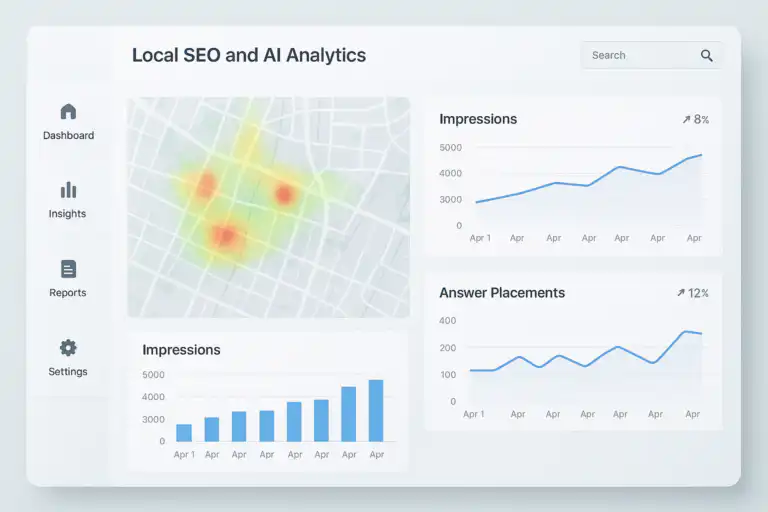
A real-time dashboard helps teams monitor geotargeted AI visibility metrics by city, neighborhood, and search platform — see the Local Search AI Visibility guide for measurement templates.
What Is Geotargeted AI Visibility?
Geotargeted AI visibility means your brand’s content, listings, and entity data are selected as the best local answer by AI systems — including Google’s AI Overviews, ChatGPT with browsing, Perplexity, Bing Copilot, and voice assistants — when a search query carries clear geographic intent.
Direct definition:
Geotargeted AI visibility is the ability for your brand to appear as the preferred, trusted local answer for location-specific queries across AI answer boxes, conversational chat results, map packs, and voice responses — measured by city, neighborhood, or service area.
Unlike traditional local SEO, which focused on ranking a blue link in position one, geotargeted AI visibility requires your brand to become a trusted entity — a coherent, verifiable, location-associated identity that AI systems can confidently cite and recommend.
How AI Systems Evaluate Local Entities
AI assistants apply a multi-factor scoring model when deciding which local business to recommend. The three primary dimensions — borrowed from Google’s original local ranking framework but now amplified by large language model (LLM) reasoning — are:
- Proximity: How physically close the entity is to the user’s detected or declared location. AI systems now use implicit signals (device GPS, IP, prior search behavior) as well as explicit location mentions.
- Relevance: How precisely your entity’s categories, services, and content match the expressed need. A page titled “emergency plumber in Austin, TX” beats a generic “plumber” listing for that specific query.
- Prominence: How authoritatively your entity is recognized across citations, reviews, backlinks, structured data, and brand mentions in AI training data and live indexes.
Beyond these three, modern AI systems additionally parse structured data, real-time hours, menus, inventory availability, review sentiment, and entity co-citations to confirm quality before recommending your business.
For background on how location-based delivery works at the infrastructure level, review the comprehensive overview of geotargeting on Wikipedia.
Why Geotargeted AI Visibility Has Become a Business-Critical Discipline
The shift isn’t gradual — it’s structural. AI answer layers are now inserted between the user’s question and the search results page, and local queries are disproportionately affected. Here’s what the data tells us:
50%+
of local queries now trigger an AI Overview before organic results appear
3–5×
higher call and direction intent from AI-recommended local results vs. position #3 organic
76%
of people who search for something nearby on their phone visit a business within one day
28%
of local searches result in a purchase — the highest conversion rate of any search category
The Collapse of the Middle Tier
Traditional local SEO created a relatively level playing field — positions 1 through 10 all received meaningful traffic. The AI answer era eliminates this middle tier almost entirely. When an AI assistant returns a single confident recommendation, positions 2 through 10 effectively vanish from the user’s experience.
This winner-take-most dynamic is why geotargeted AI visibility isn’t merely an optimization task — it’s a competitive positioning decision. Brands that invest in it now build a compounding advantage; brands that delay inherit a structural deficit that worsens month over month.
The Shift from Keywords to Entities
Traditional SEO optimized pages for keyword strings. Geotargeted AI visibility optimizes entities — the real-world things (businesses, people, places) that AI systems understand and recommend. Your business must exist as a coherent, cross-verified entity in the knowledge graph, not merely as a page that contains certain keywords.
This means the investment is in entity authority by location — a durable asset that compounds over time and is far harder for competitors to replicate than a keyword-stuffed landing page.
“Optimize for how people ask locally, structure for how machines decide, and publish where assistants can trust you — then measure everything by city, not by keyword rank.”
For deeper context on how AEO, GEO, and AI search intersect, review the essential primer at Rank Authority’s AEO + GEO + AI search guide. Pair this with their real-time SEO issue alerts to detect location data drift before it erodes visibility.
How Geotargeted AI Visibility Fits the Broader GEO + AEO Framework
Marketing leaders navigating the AI search transition encounter three overlapping disciplines. Understanding how they relate is essential before you build your strategy:
| Discipline | Primary Focus | What It Optimizes | Role in Local AI |
|---|---|---|---|
| SEO | Search engine ranking | Pages, keywords, backlinks | Foundation — still necessary |
| GEO | Generative Engine Optimization | AI answer inclusion, citations | Gets your brand cited by AI |
| AEO | Answer Engine Optimization | Featured snippets, structured answers | Makes your answers machine-readable |
| Geotargeted AI Visibility | Local AI answer dominance | Entity trust + proximity signals | The intersection of all three |
How Marketing Leaders Are Adapting Their Strategy
The most sophisticated marketing organizations are restructuring their visibility strategy around three layers:
- Entity Layer: Establishing clean, consistent, cross-verified brand and location data across all platforms — the prerequisite for AI trust.
- Content Layer: Publishing location-specific content that answers the precise questions AI systems retrieve when a nearby user asks — structured as FAQs, how-tos, and service pages.
- Signal Layer: Continuously feeding fresh, location-corroborated signals — reviews, photos, hours updates, citations — to confirm that the entity is active, trusted, and relevant right now.
The AEO + GEO + AI search guide from Rank Authority is the most practical available resource explaining how these three layers interact — required reading before you build your first location page template. For a deeper walkthrough, see our Local Search AI Visibility guide.
The 7 Core Building Blocks of Geotargeted AI Visibility
Winning locally in the AI era requires more than a Google Business Profile. It demands seven interlocking pillars that work together to make your entity unmistakably local, reliably accurate, and structurally trustworthy to AI systems. See our AI SEO for Multi-Location Businesses playbook for scalable templates.

Demand heatmaps reveal where local search intent clusters so teams can prioritize content, citations, and schema by neighborhood.
Pillar 1: Canonical Entity and NAP Data
Your legal business name, address, phone number, and primary category must be byte-for-byte identical across your website, Google Business Profile, Apple Maps, Bing Places, Yelp, industry directories, and data aggregators (Foursquare, Data Axle, Neustar Localeze).
Even minor inconsistencies — “St.” vs. “Street,” a missing suite number, an old phone number on a dormant citation — create entity ambiguity that causes AI systems to either reduce confidence in your listing or exclude it entirely from local answer results.
Action: Audit NAP consistency quarterly using a tool like BrightLocal or Moz Local, and resolve discrepancies immediately. Add secondary attributes (hours, service areas, accessibility features, parking, payment types) with the same consistency standard.
Pillar 2: Location Pages Built for AI Retrieval
Each city, district, neighborhood, or store location you serve needs a dedicated page that passes three tests: (1) it is genuinely unique and locally substantive, (2) it answers the questions AI systems most commonly retrieve for that location type, and (3) it confirms proximity through geographic context signals. See our GEO Content Optimization guide for location page templates and content examples.
A fully optimized location page includes: See our recommendations in GEO content optimization for templates and local-language examples.
- Unique service descriptions with neighborhood context (landmarks, cross streets, local points of reference)
- An embedded map and explicit driving / transit directions from major local landmarks
- A city-specific FAQ section with at least 5–8 questions answering what AI assistants commonly retrieve
- Localized social proof (reviews mentioning the specific location, photos from the actual address)
- Clear CTAs (call, book, get directions) visible above the fold on mobile
- Internal links to related service pages and the parent brand page
What to avoid: Template-cloned pages where only the city name changes. AI systems detect thin, duplicate-intent content and discount it — or worse, consolidate it into a lower-quality representation of your entity.
Pillar 3: Schema Markup That Speaks the AI’s Language
Schema markup is the direct communication channel between your content and the machines that decide which entities to recommend. For local businesses, a layered schema strategy dramatically increases AI confidence in your entity. For developer-ready JSON-LD examples, see Local Business AI Search optimization guide.
Essential schema types for geotargeted AI visibility:
- LocalBusiness (or its specific subtype: MedicalClinic, Restaurant, AutoRepair, etc.) — carries address, hours, geo-coordinates, telephone, priceRange, and payment methods
- Service — describes each service offered at that location with area served
- FAQPage — structures common local questions and answers for AI retrieval
- Review / AggregateRating — surfaces review count and average rating directly in AI answers
- GeoCoordinates — explicit latitude/longitude eliminates address ambiguity for AI mapping
- OpeningHoursSpecification — provides day-by-day hours including holiday exceptions
Always include sameAs properties linking your schema to authoritative external profiles (Google Business, Wikidata, Yelp, LinkedIn). These cross-references dramatically strengthen entity confidence in AI knowledge graphs.
Pillar 4: Reviews as Location-Corroborated Trust Signals
Reviews are no longer just social proof for human readers — they are data points that AI systems analyze for location confirmation, service quality, recency, and semantic relevance. A review that mentions “the Austin location on Congress Avenue” provides more AI value than a generic five-star rating.
Review strategy for AI visibility:
- Request reviews with location-specific prompts: “How was your experience at our [City] location?” rather than generic “leave us a review” asks
- Respond to all reviews within 48 hours — responses add context and freshness to your profile
- Diversify review platforms (Google, Yelp, industry-specific platforms) — AI systems aggregate across multiple sources
- Aim for a consistent flow of 3–5 new reviews per location per month — recency matters as much as volume
- Address negative reviews professionally and specifically — unresolved negatives reduce AI recommendation confidence
Pillar 5: Citation Building and Data Aggregator Management
Citations — mentions of your business name, address, and phone on third-party sites — serve as distributed proof points that your entity is real, established, and consistent. AI systems cross-reference these signals when building their understanding of your local entity.
Priority citation sources by tier:
- Tier 1: Google Business Profile, Apple Business Connect, Bing Places, Facebook Business — direct AI data sources
- Tier 2: Data aggregators (Foursquare/Data Axle, Neustar Localeze, Acxiom) — these feed hundreds of downstream directories automatically
- Tier 3: Industry-specific directories (Healthgrades for medical, Avvo for legal, TripAdvisor for hospitality) — provide contextual authority signals
Update data aggregators first — they propagate to the most downstream sources and resolving inconsistencies at this tier eliminates dozens of bad citations simultaneously.
Pillar 6: Locally Calibrated Content and Intent Matching
Your location pages and blog content must directly answer the specific questions people in that geography ask about your service category. This requires understanding local search intent — which varies meaningfully between cities, demographics, and seasonal patterns.
Content formats that drive geotargeted AI visibility:
- “Near me” answer blocks: Structured paragraphs that directly answer “best [service] near me in [city]” queries — formatted for AI extraction
- Neighborhood guides: Pages that establish topical authority for a specific area, linking to your location page as the primary local service provider
- Service area pages: Separate from location pages — these explain exactly which ZIP codes, districts, and neighborhoods you serve, with explicit coverage claims
- Local event and seasonal content: Time-sensitive content that demonstrates active local presence and feeds recency signals
- Comparison pages: “[Your service] in [City] vs. [Neighboring City]” — captures cross-location intent and builds regional authority
Pillar 7: Technical Foundation and Real-Time Alerting
Technical SEO is the often-overlooked prerequisite for geotargeted AI visibility. An AI system cannot recommend a page it cannot access, parse, or trust. Location pages are especially vulnerable to technical failures because they are often generated programmatically and receive less editorial attention.
Technical priorities:
- Core Web Vitals passing on mobile — LCP under 2.5s, CLS under 0.1, INP under 200ms for every location page
- Clean crawl path — no robots.txt blocks, no noindex tags, no canonicalization errors on location pages
- HTTPS with valid SSL certificates and zero mixed-content warnings
- Structured internal linking — every location page accessible within 3 clicks from the homepage
- XML sitemap that includes all location URLs with accurate lastmod dates
Configure real-time SEO issue alerts so you know within minutes when a robots rule, 500 error, or certificate issue blocks a city page. A location page that is down for 48 hours can lose AI visibility that takes weeks to recover.
How to Implement Geotargeted AI Visibility: 10-Step Process
This implementation sequence moves you from a cold audit to compounding city-level growth in the shortest possible time. Execute each step in order — the later steps depend on the foundations built in the earlier ones.
-
Step 1
Conduct a Full Entity and Location Inventory
List every brand, store location, and service area you operate. Record current NAP data as it appears in each major directory. Identify discrepancies, duplicate listings, and missing profiles. This inventory is your single source of truth for all subsequent work.
-
Step 2
Normalize All Canonical Entity Facts
Choose a single canonical version of your business name, address format, phone number, and primary category. Update every profile, citation, and website occurrence to match exactly. Begin with Tier 1 sources and data aggregators, then cascade to Tier 3 directories.
-
Step 3
Research Local Intent by City and Service
Use Google Search Console, Google Keyword Planner, and AI query testing to identify the specific questions people in each target city ask about your service. Segment by city, service type, and intent (informational vs. transactional vs. navigational). This research directly informs your location page FAQ sections.
-
Step 4
Build a Scalable Location Page Template
Design a template that enforces the required elements — unique description, embedded map, FAQ section, service list, review highlights, CTAs, internal links — while requiring human writers or AI systems to fill in genuinely unique local content for each city. The template standardizes structure; the content must be locally differentiated.
-
Step 5
Implement Layered Schema Markup
Add LocalBusiness schema (with the appropriate subtype), Service schema, FAQPage schema, and AggregateRating schema to every location page. Include GeoCoordinates, OpeningHoursSpecification, and sameAs properties. Validate with Google’s Rich Results Test and Schema.org’s validator before publishing each new page.
- Step 6 Tune Content to Answer Local AI Queries For each location page, write direct, fact-dense answers to the top 8–10 questions your research identified for that city. Format answers in 2–4 sentence blocks that AI systems can extract and cite verbatim. Include the city name, service type, and specific local context in each answer — not just in the question. See the Local Search AI Playbook for city-specific phrasing templates.
-
Step 7
Build and Maintain Priority Citations
Submit or claim profiles on all Tier 1 and Tier 2 citation sources. Update data aggregators with your canonical facts. Complete every available field — hours, attributes, photos, descriptions, categories. Set a quarterly calendar reminder to verify and refresh citation accuracy, as some directories auto-suggest edits from user submissions.
-
Step 8
Launch a Location-Specific Review Generation Program
Implement a systematic post-transaction review request at every location, using location-specific prompts that encourage customers to mention the city, their specific service experience, and any staff or physical location details. Respond to all reviews within 48 hours. Track new review velocity per location monthly — target 3–5 new reviews per location per month as a minimum baseline.
-
Step 9
Secure Technical Performance and Real-Time Monitoring
Audit Core Web Vitals for every location page and resolve failures before launching your AI visibility campaign. Configure uptime monitoring and real-time SEO alerting so you are notified within minutes of crawl blocks, 4xx/5xx errors, or certificate issues on any location page. A down location page is invisible to AI systems — speed of recovery is a competitive differentiator.
-
Step 10
Track, Report, and Iterate by City
Establish a monthly reporting cadence with city-level metrics: AI answer placements, local pack appearances, location page impressions and CTR, click-to-call events, direction requests, and conversion rates. Identify the top three underperforming cities each month and prioritize content refresh, schema updates, or citation repairs there first.
Measuring Geotargeted AI Visibility Performance
Measurement for geotargeted AI visibility is more complex than traditional rank tracking because placements occur across AI answer layers, map packs, voice results, and organic listings simultaneously. A robust GEO content optimization framework covers all four surfaces.

Teams that align content strategy, structured data, and review operations achieve measurably better local AI answer placement rates.
Metrics to Track by City
| Metric | Source | Tracking Frequency | Why It Matters |
|---|---|---|---|
| AI answer placement rate | Manual QA + AI tracking tools | Weekly | Direct measure of geotargeted AI visibility |
| Local pack impressions by city | Google Search Console | Weekly | Visibility trend by geography |
| Location page CTR | Google Search Console | Weekly | Answer quality and intent match |
| Click-to-call and directions | Google Business Profile Insights | Weekly | Conversion from local AI results |
| Review velocity by location | Review management platform | Monthly | Freshness and prominence signals |
| Conversion by city URL | GA4 / CRM attribution | Monthly | Revenue proof per location investment |
| Schema error count | Google Search Console | Monthly | Structural trust integrity |
| Crawl coverage of location pages | Server logs / Screaming Frog | Monthly | AI system accessibility confirmation |
How to Test AI Answer Placements Manually
Automated rank tracking tools have not yet fully caught up with AI answer layer visibility. Until they do, supplement your data with manual QA testing:
- Use incognito mode with location set to each target city
- Query 10–15 of your top local intent keywords and record which entity appears in the AI Overview
- Repeat the same queries on ChatGPT and Perplexity to capture cross-platform visibility
- Log results in a spreadsheet with date, query, platform, and entity cited
- Track share-of-voice trends monthly — improvements here correlate directly with revenue outcomes
Industry-Specific Geotargeted AI Visibility Strategies
The core principles of geotargeted AI visibility apply across all local business categories, but the execution details vary significantly by industry. Here are the highest-leverage adaptations by sector:
Healthcare & Medical
- Use MedicalClinic or Physician schema subtypes
- Include insurance accepted, languages spoken, accessibility
- Prioritize Healthgrades, Zocdoc, and Yelp citations
- Patient reviews mentioning specific conditions drive AI confidence
Legal Services
- Use LegalService schema with practice area properties
- Avvo, Justia, and FindLaw citations are tier-1 for this industry
- Location FAQ pages should address city-specific legal questions
- Bar association directories provide critical authority signals
Home Services
- Explicit service area pages by ZIP code are essential
- License and insurance numbers in schema increase AI trust
- Angi, HomeAdvisor, and Houzz citations matter most
- Seasonal content (winterization, spring prep) drives local intent
Restaurants & Hospitality
- Menu schema and hasMenu property are AI-critical
- TripAdvisor, OpenTable, and Yelp citations are tier-1
- Holiday hours updates must be real-time to avoid AI errors
- Photos with location geotags strengthen visual entity confirmation
Pros, Cons, and Trade-offs of a Geotargeted AI Visibility Strategy
Understanding the full trade-off landscape helps you resource the initiative appropriately and set realistic timelines for stakeholder buy-in.
| Advantage | Trade-off / Challenge | Mitigation |
|---|---|---|
| Higher local conversion rates — AI-recommended entities receive pre-qualified intent | Ongoing NAP governance across multiple locations | BrightLocal or Moz Local automation |
| Winner-take-most AI answer placement compounds over time | Content uniqueness at scale is resource-intensive | AI-assisted content with human local review |
| Stronger multi-location brand consistency and entity authority | Schema implementation requires developer support | JSON-LD templates deployable without CMS changes |
| Better LLM trust through machine-readable structured signals | AI measurement tools still maturing | Supplement with manual QA testing protocol |
| Voice and mobile search dominance — AI answers are primary on these surfaces | Cross-team coordination required (SEO, content, ops) | Shared dashboard and weekly syncs |
Common Pitfalls That Destroy Geotargeted AI Visibility
These are the mistakes that cause businesses to invest in geotargeted AI visibility and see limited results. Each is avoidable with the right process in place.
❌ Inconsistent NAP across directories
Even a single inconsistent listing in a major directory can create entity ambiguity that causes AI systems to reduce confidence in all your local signals. The fix is a data aggregator-first cleanup strategy, not a manual directory-by-directory correction.
❌ City pages that only swap the location name
Template-generated pages where “Chicago” replaces “Denver” throughout identical content are detected by AI systems as thin, low-value pages. They reduce entity trust rather than building it. Each page must contain genuinely unique local substance.
❌ Schema markup present but invalid or incomplete
Invalid JSON-LD (missing closing brackets, extra commas, unquoted strings) causes search engines to discard the schema entirely — providing no benefit while consuming crawl budget. Always validate before publishing with Google’s Rich Results Test.
❌ Location pages blocked by robots.txt or noindex
Programmatically generated location pages are frequently blocked during development and accidentally left blocked in production. An AI system cannot recommend a page it cannot read. Audit your robots.txt and meta robots tags for every location page before launch.
❌ Review neglect — stale ratings and zero response activity
Businesses with no reviews in the last 90 days send a recency signal that AI systems interpret as “potentially inactive.” Zero response rate to reviews signals disengagement. Both reduce prominence scores and AI recommendation confidence.
❌ Ignoring voice and mobile-first query formats
Voice queries are structurally different from typed queries — they are longer, more conversational, and often posed as full questions. Location pages that only target short keyword variants miss the majority of AI assistant queries. Include natural-language FAQ sections that match how people actually speak to Siri, Alexa, and Google Assistant.
Frequently Asked Questions About Geotargeted AI Visibility
Weekly Sprint Checklist for Geotargeted AI Visibility
Use this operationalized checklist during weekly sprints to maintain and grow local AI visibility across all locations. For operational playbooks and review program templates, see Local Business AI Search Optimization.
Daily (5 minutes)
- Check real-time SEO alerts for 4xx/5xx errors or robots issues on location pages
- Respond to any new reviews posted in the last 24 hours
Weekly (30 minutes)
- Confirm NAP consistency across top 5 directories for priority locations
- Validate schema markup on any location pages updated this week
- Refresh hours, photos, or special offers on Google Business Profiles
- Manually test AI answer placements for 5 priority local queries
- Identify 3 new review request opportunities from recent transactions
Monthly (2–3 hours)
- Pull city-level performance report: impressions, CTR, calls, directions, conversions
- Identify bottom 3 performing cities and prioritize content or citation improvements
- Audit full NAP consistency across all citation sources
- Check crawl coverage of all location pages in Google Search Console
- Document wins by region and share with stakeholders
Key Takeaways
- Geotargeted AI visibility is the intersection of AEO, GEO, and local SEO — and it is now the primary driver of local discovery outcomes
- NAP consistency is the single highest-ROI action — entity ambiguity undermines every other investment you make
- Location pages must be genuinely locally substantive — not template-cloned city swaps — to earn AI recommendation trust
- Layered schema markup (LocalBusiness + FAQPage + AggregateRating + GeoCoordinates) makes your local proof machine-readable
- Reviews with location-specific language are AI trust signals, not just social proof — treat review generation as a core operational function
- Technical performance — Core Web Vitals, crawl access, real-time alerting — is the non-negotiable floor for AI visibility
- Measure by city, not by keyword rank — the metrics that matter are AI answer placement rate, CTR, calls, directions, and revenue by location
Conclusion: Geotargeted AI Visibility Is Your Durable Local Competitive Advantage
Geotargeted AI visibility is not a future strategy — it is the defining local marketing challenge of right now. AI answer layers are already the first thing millions of users see for local queries, and the brands that earn those placements are capturing the highest-intent, closest-to-purchase traffic that exists.
The playbook is clear: build entity trust through consistent NAP data, create genuinely substantive location pages that answer real local questions, implement layered schema markup that speaks directly to AI systems, generate location-specific reviews as an operational discipline, and monitor performance in real time so nothing silently erodes what you’ve built.
Use trusted resources like Rank Authority’s AEO + GEO + AI search guide to deepen your practice, and configure real-time AI search optimization guide alerts so technical failures never silently cost you hard-won placements.
Start now. The brands securing geotargeted AI visibility today are building a compounding structural advantage that will be extremely difficult — and increasingly expensive — for late movers to overcome.
Ready to build geotargeted AI visibility for your locations? Author: Rank Authority editorial team. Last updated: 2026-07-02.
Implement the 10-step process above, measure by city monthly, and refine relentlessly. The local AI answer that customers see first is the one that wins their business. Add an author byline and short bio with credentials and a visible "Last updated" date to increase trust and transparency.

