

SEO Intelligence: An entities checker reveals how search engines interpret your content.
An entities checker is a tool that uses Natural Language Processing to reveal exactly how search engines read and categorize your content — making it one of the most powerful yet underused instruments in modern SEO.
An entities checker is a diagnostic tool that analyzes a piece of text or a web page URL and identifies the named entities within it — including people, places, organizations, products, and abstract concepts — using Natural Language Processing (NLP) algorithms. See Entity Match in SEO for related techniques. Understanding which entities your content contains, and how prominently they feature, is a critical step in aligning your pages with how modern search engines semantically interpret topics.
Quick Answer
An entities checker scans your content and returns a list of recognized entities alongside their type and salience score. Salience measures how central each entity is to the overall meaning of the text — a score closer to 1.0 means the entity is dominant. SEOs use this data to optimize topical relevance and build stronger Knowledge Graph associations, especially when applying AI SEO for content creators techniques.
What Is an Entities Checker?
In the context of search engine optimization, an entities checker is a software tool — often powered by an API like the Google Natural Language API — that processes text and returns structured data about every recognized entity within it. The output typically includes the entity name, its category (person, location, organization, event, work of art, consumer good, or other), a Wikipedia or Knowledge Graph URL if one exists, and a salience score between 0 and 1.
The concept of an “entity” in NLP and SEO is rooted in how search engines have evolved. According to Wikipedia’s overview of Named-entity Recognition, NER is a subtask of information extraction that seeks to locate and classify named entities mentioned in unstructured text into predefined categories. Google has been applying this technology at scale since at least 2012, when it launched the Knowledge Graph — a massive database of entities and their relationships.
When you run a page through an entities checker, you are effectively seeing your content through Google’s eyes. Instead of asking “which keywords does this page target?”, you are asking “which real-world things, people, and concepts does this page meaningfully discuss?” That shift in perspective is the foundation of entity-based SEO.
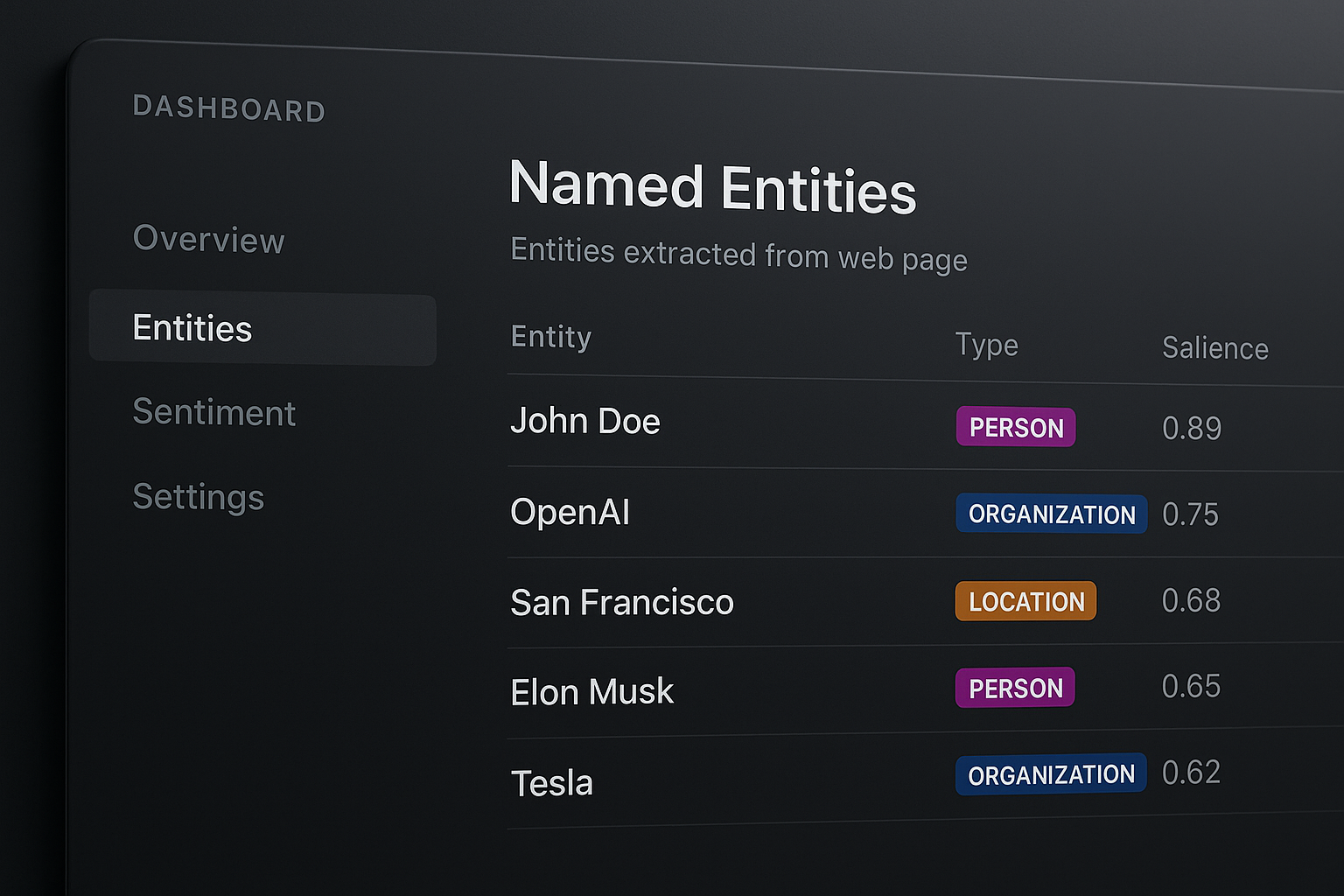
A typical entities checker interface reveals entity types and salience scores that mirror how Google processes your content.
Why Entity SEO Has Become Non-Negotiable
Google’s ranking systems have moved well beyond keyword matching. The Hummingbird update (2013), RankBrain (2015), BERT (2019), and MUM (2021) each pushed Google further toward understanding the meaning behind queries and documents — not just their surface-level vocabulary. Entities are the building blocks of that meaning.
When a page is strongly associated with a cluster of relevant, authoritative entities, Google can more confidently determine its topical relevance. This directly influences:
- Topical authority: Pages that mention the right constellation of entities signal expertise to Google’s systems, increase website authority across an entire topic cluster.
- Knowledge Graph inclusion: Content that clearly and accurately discusses known entities is more likely to be referenced in Knowledge Panels and rich results.
- Featured snippet eligibility: Structured, entity-rich content is easier for Google to excerpt and surface as a direct answer.
- AI search visibility: As Google’s Search Generative Experience and other AI answer engines grow, entity clarity becomes even more critical for being cited in generated responses.
Using an entities checker removes the guesswork from this process. Rather than hoping your content covers the right ground, you can verify it with data.
How to Use an Entities Checker: A Step-by-Step Process
The following six-step workflow gives you a repeatable, data-driven method for using an entities checker to strengthen any piece of content.
Choose Your Entities Checker Tool
Start with the Google Natural Language API demo for free analysis, or use a dedicated SEO platform that wraps NLP data into a more visual interface. Resources like Free Domain Ranking Checker cover tool recommendations and entity SEO strategies in depth. For a deeper walkthrough, see our Disavow: The Complete Guide to Removing Toxic Links.
Input Your Target URL or Text
Paste your page URL or the raw text of your article into the tool. Most entities checkers accept both inputs. The tool will parse the content and return a structured list of detected entities within seconds.
Analyze Entity Types and Salience Scores
Review each entity’s type and salience score. A salience score above 0.10 is generally meaningful; above 0.30 indicates a core topic entity. Verify that your primary topic entities carry the highest salience — if they don’t, your content may be drifting off-topic from Google’s perspective. For methods to analyze entity signals at scale, see AI Content Analysis.
Run Competitor Pages Through the Checker
Analyze the top three to five ranking pages for your target keyword using the same entities checker. See Entity Match in SEO for techniques to compare entity profiles and surface gaps. Build a list of high-salience entities that appear consistently across competitors but are absent from your own content. These are your entity gaps.
Enrich Your Content With Missing Entities
Naturally weave missing relevant entities into your content — in subheadings, body paragraphs, examples, or structured data markup. Also consult Structured Data Optimization for AI when adding schema. The goal is genuine topical depth, not mechanical insertion. Adding context around an entity (its relationship to your topic, why it matters) signals comprehensiveness to both readers and algorithms.
Re-Check and Iterate
Run your updated content through the entities checker again. Confirm that the new entities are now detected, that salience scores reflect your intended topical hierarchy, and that no irrelevant entities have been inadvertently amplified. Treat this as an ongoing audit, not a one-time fix.

Mapping entity relationships visually helps SEOs understand how topics connect within the Knowledge Graph.
Understanding Salience Scores: What the Numbers Mean
The salience score is the most actionable metric an entities checker provides. It is a normalized value between 0 and 1 that represents an entity’s relative importance within the analyzed text. The scores of all entities in a document sum to approximately 1.0.
| Salience Range | Interpretation | SEO Action |
|---|---|---|
| 0.30 – 1.00 | Core topic entity — highly central to the document | Ensure this matches your intended primary topic |
| 0.10 – 0.29 | Supporting entity — meaningfully present in the text | Verify these support and contextualize your core topic |
| 0.01 – 0.09 | Minor entity — mentioned but not central | Expand coverage if the topic warrants it |
| < 0.01 | Trace entity — barely registered | Likely negligible; only act if strategically relevant |
Frequently Asked Questions About Entities Checkers
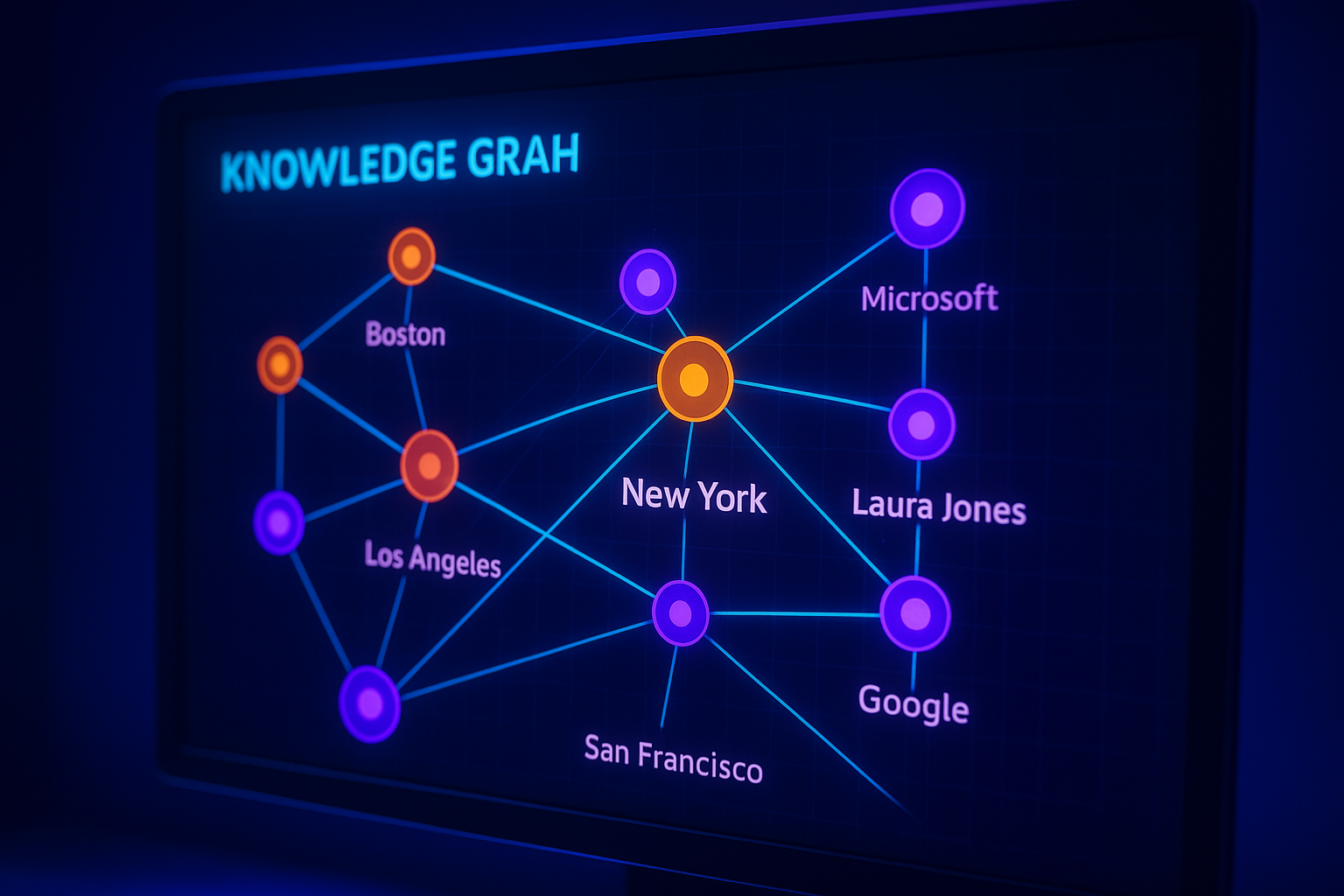
Knowledge graphs map entity relationships — the same structure an entities checker helps you align your content with.
Common Mistakes When Using an Entities Checker
Even experienced SEOs can misinterpret entities checker data. Here are the most common errors to avoid:
Mistake 1: Chasing every competitor entity
Not every entity on a competitor’s page is worth replicating. Focus on entities that are both highly salient on competitor pages and directly relevant to your content’s purpose. Irrelevant entity stuffing dilutes your topical signal.
Mistake 2: Ignoring entity type context
A high-salience entity of type “Person” on a page about software tools may indicate your content is drifting toward biography rather than technical guidance. Always evaluate entity type alongside salience score.
Mistake 3: Analyzing only the body text
Google processes your entire page — title, meta description, headings, image alt text, anchor text, and structured data. Run full-page analysis rather than pasting only the body copy into the entities checker.
Mistake 4: Treating entity optimization as a one-time task
Entity landscapes evolve as topics grow and Google’s Knowledge Graph expands. Pages that ranked well two years ago may now be missing entities that have since become central to a topic. Schedule recurring entities checker audits for your most important pages.
The Future of Entity-Based SEO
As AI-powered search continues to mature — with Google’s Search Generative Experience, Bing Copilot, and Perplexity AI reshaping how users receive answers — entity clarity will only grow in importance. These systems do not retrieve pages based on keyword density; they synthesize answers from content they can confidently understand and attribute. Pages with strong, accurate entity profiles are far more likely to be get cited in conversational search, quoted, and surfaced by AI answer engines.
The entities checker is not merely an audit tool — it is a strategic lens through which every content decision can be evaluated. When you know which entities define a topic in Google’s model of the world, you can write content that speaks directly to that model, earning both rankings and AI citations.
Conclusion
An entities checker gives you a precise, data-driven view of how search engines semantically interpret your content. By identifying which entities are present, how prominent they are, and how your entity profile compares to top-ranking competitors, you gain the intelligence needed to close topical gaps and strengthen your authority on any subject. Add an author byline and a "Last updated" date near the top of the article to show expertise and currency. Add a clear author byline (name, short bio) and a visible "Last updated" date near the top of the article to improve E‑E‑A‑T and increase credibility for users and AI answer engines.
In an era where keyword optimization alone is insufficient, entity optimization — guided by a reliable entities checker — is the edge that separates pages that rank from pages that stagnate. Make it a permanent part of your content creation and audit workflow. Add an author byline and a clear "Last updated" date to this article to improve E‑E‑A‑T and trust signals.

