Quick Answer: A page-level SEO comparison service is a specialized analysis platform that benchmarks your individual web pages against the competing pages currently outranking you — signal by signal — so you can close the exact gaps holding your rankings back. Rather than guessing what top-ranking pages are doing differently, this service gives you a precise, data-driven map of every on-page advantage your competitors hold.
If you have ever published what felt like a thorough, well-optimized page only to watch it stall on page two or three of Google, you already understand the frustration. A page-level SEO comparison service exists precisely to solve that problem. Instead of broad site-wide audits that flag generic issues, this approach zooms into the page that matters most — the one competing for a specific keyword — and measures it directly against the pages winning that race. The result is an actionable gap analysis you can act on immediately, rather than a long list of technical warnings with no clear priority.

A page-level SEO comparison service surfaces the exact signals separating your page from the current top-ranking results.
What Is a Page-Level SEO Comparison Service?
A page-level SEO comparison service is a tool or managed platform that performs a granular, side-by-side analysis of the on-page SEO signals present on your target URL versus the URLs currently ranking above it for a defined keyword. Unlike a traditional site audit — which scans your entire domain for crawl errors, broken links, and global technical issues — a page-level comparison is laser-focused on a single competitive battleground: the search engine results page (SERP) for one specific query.
According to Wikipedia’s overview of search engine optimization, on-page factors — including content relevance, heading structure, keyword usage, and internal linking — remain foundational ranking signals. A page-level comparison service quantifies exactly how your page performs on each of those factors relative to the pages already earning top positions.
Why Page-Level Analysis Beats Site-Wide Audits for Rankings
Site-wide audits are valuable for housekeeping — finding orphaned pages, fixing redirect chains, and improving crawlability. But they cannot tell you why a specific page is losing to a specific competitor for a specific keyword. That requires a different methodology entirely.
Consider this scenario: your article on “best ergonomic office chairs” ranks in position 8. A site-wide audit might tell you your page speed score is 72 or that you are missing a meta description on an unrelated blog post. Neither insight helps you climb from position 8 to position 1 for that keyword. A page-level SEO comparison, however, would reveal that the pages ranking above you average 2,400 words while yours is 900, that they each use the target keyword in exactly three heading tags while yours uses it once, and that they all include a structured FAQ schema block you have not implemented. Those are the real levers.
Key Signals Analyzed in a Page-Level SEO Comparison
- Title tag keyword placement and length
- Meta description relevance and click-through optimization
- Heading hierarchy (H2, H3 usage and keyword inclusion)
- Word count and content depth vs. competitors
- Keyword frequency and semantic term coverage
- Internal linking patterns and anchor text
- Image alt text optimization
- Schema markup types (FAQ, HowTo, Article)
- Page experience signals (Core Web Vitals)
- Readability and content structure scores
How the Comparison Process Works Step by Step
Understanding the mechanics helps you get the most from any page-level SEO comparison service. Here is how a well-structured comparison typically unfolds:
Define the Target Keyword and URL
You input the specific keyword you are targeting and the URL of your page. The service then identifies the top-ranking pages for that keyword in your target geographic market.
Crawl and Extract On-Page Signals
The platform crawls both your page and each competing page, extracting dozens of on-page signals including content length, heading structure, keyword usage, schema types, and internal link counts.
Generate a Gap Report
The service produces a prioritized gap report showing where your page underperforms relative to the average or median of top-ranking competitors, ranked by estimated ranking impact.
Implement and Monitor
You apply the recommended changes and track ranking movement. The best platforms, like Rank Authority’s real-time SEO alert system, notify you immediately when signal changes affect your page’s competitive standing.

Running a structured page-level SEO comparison turns vague ranking frustration into a clear, prioritized action plan.
Frequently Asked Questions
Choosing the Right Service: What to Look For
Not all page-level SEO comparison tools are built equally. When evaluating your options, prioritize platforms that offer competitor-averaged benchmarks rather than just showing you one competitor’s data — averages across the top five to ten results give you a far more reliable optimization target.
Also look for services that update their competitor data frequently. SERPs shift constantly, and comparing your page to a snapshot from six months ago can lead you in the wrong direction. If you are weighing your options between platforms, the comparison between SEO Juice and Rank Authority is a useful reference point for understanding how different tools approach page-level analysis and what features matter most for competitive optimization.
What Separates Good Page-Level SEO Comparison Services from Great Ones
- Benchmarks against the average of top-10 results, not just one competitor
- Refreshes competitor data in real time or near-real time
- Prioritizes gaps by estimated ranking impact, not alphabetically
- Integrates with rank tracking to measure improvement after changes
- Flags schema opportunities specific to the SERP feature landscape
- Provides semantic keyword gap analysis, not just exact-match frequency

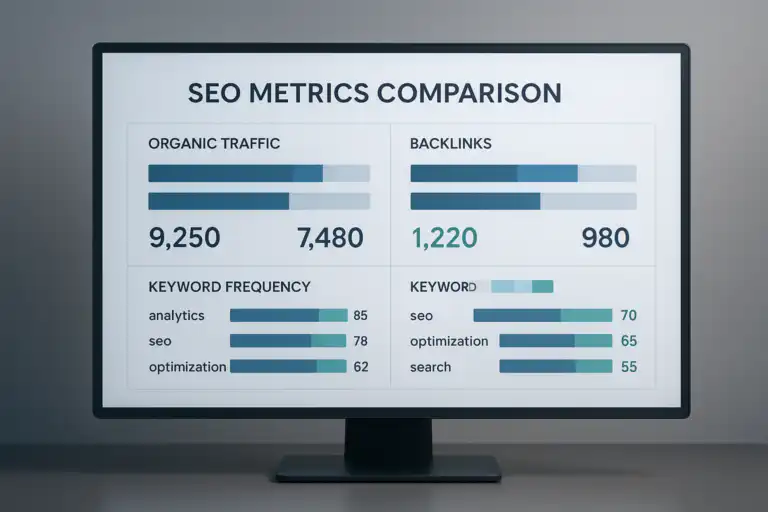
Visualizing on-page signal differences side by side makes optimization priorities immediately clear.
Common Mistakes When Using Page-Level SEO Comparisons
Even with the best data in hand, there are pitfalls that can undermine your results. The most common mistake is treating the comparison as a checklist to mechanically replicate competitors rather than a map of opportunities to outperform them. If every page ranking for a keyword has 2,000 words, writing 2,001 words is not a strategy — it is a floor. Your goal is to exceed the benchmark meaningfully, not merely match it.
A second common error is ignoring the quality dimension in favor of the quantity signals. Word count, heading count, and keyword frequency are measurable, but they are proxies for the underlying quality signals Google actually cares about: does your page genuinely answer the user’s query better than the alternatives? Use the comparison data to identify structural and technical gaps, but close those gaps with genuinely better content, not padded filler.
Finally, avoid running a comparison once and considering the job done. Competitors update their pages, Google updates its algorithms, and SERP landscapes shift. A page-level SEO comparison is most powerful as a recurring process, not a one-time exercise.
Conclusion: Make Every Page Earn Its Ranking
Ranking on the first page of Google is not a mystery — it is a measurement problem. The pages above you have specific on-page advantages that can be identified, quantified, and closed. A page-level SEO comparison service is the tool that transforms that measurement problem into a solvable one, giving you a clear, prioritized roadmap from your current position to the ranking you are targeting.
Whether you are optimizing a product page, a blog post, or a service landing page, the principle is the same: know exactly how your page stacks up against the competition, close the most impactful gaps first, and monitor the results continuously. Platforms like Rank Authority are built around this philosophy, combining page-level analysis with ongoing monitoring to make sure your improvements translate into lasting ranking gains — not just temporary lifts.
The Bottom Line
Stop guessing why your pages are not ranking. A page-level SEO comparison service gives you the exact data you need to outperform competitors on the signals that matter most — one page, one keyword, one clear action plan at a time.