

SEO Fundamentals · 12 min read
What Is a Good SEO Score? Complete Guide (2025)
Direct Answer
A good SEO score is a numeric rating — typically on a 0–100 scale — that measures how well your website is optimised for search engines. 80 or above is the industry benchmark for a good SEO score. Scores in this range signal that your site is technically healthy, well-structured, and positioned to compete for top organic rankings.
Achieving a good SEO score is one of the clearest, most measurable goals in digital marketing. However, knowing what score to aim for — and, more importantly, how to reach it — requires understanding what the number actually measures. In this guide you will find everything you need: score benchmarks, the four factors that determine your rating, a step-by-step improvement plan, tool-by-tool comparisons, industry-specific targets, and answers to every common question on the topic.

A good SEO score in the 80–100 range signals strong site health and competitive ranking potential.
What Is a Good SEO Score? Score Ranges Explained
A good SEO score is the threshold at which your website demonstrates sufficient technical integrity, content relevance, and domain authority to compete meaningfully in organic search. No universal standard exists — because different tools calculate scores differently — but the industry consensus clusters around the same clear benchmarks.
Specifically, most SEO professionals recognise three broad bands. Understanding where your site sits is therefore the essential first step toward a targeted improvement plan.
0–49
Poor
Critical issues blocking visibility
50–79
Moderate
Visible but significant gaps remain
80–100
Good to Excellent
Optimised and competitive
Why 80 Is the Widely Accepted Benchmark
The 80-point threshold is not arbitrary. It emerges from industry analysis of pages that consistently appear on the first page of Google results. In most niches, pages ranking in positions one through five share several characteristics: fewer than 5% of crawled URLs return errors, page speed scores exceed 80 on desktop, and on-page elements such as title tags, meta descriptions, and heading hierarchies are fully optimised.
Furthermore, 80+ signals to audit tools that the site has resolved the vast majority of issues that actively suppress rankings — broken internal links, duplicate content, missing canonical tags, and slow server response times. Consequently, moving from 70 to 80 often produces a more noticeable rankings lift than moving from 80 to 90, because the lower range contains errors that search engines treat as quality signals.
Good SEO Score Benchmarks by Industry
Importantly, the right target score also depends on your competitive landscape. In low-competition niches, a score of 70 may be sufficient to rank well. In highly competitive sectors — legal, finance, health, and e-commerce — competitors routinely score 85–95, so you need to match or exceed them.
What Factors Determine Your Good SEO Score?
Every reputable SEO audit tool evaluates your score across four core pillars. Mastering each one is, therefore, essential to reaching and maintaining a good SEO score. Below is a deep dive into what each pillar covers — and why it matters.
⚙️ Technical SEO
Technical SEO covers the infrastructure that allows search engines to discover, crawl, and index your pages. Specifically, it includes crawlability (whether Googlebot can access your pages), indexability (whether indexed pages are eligible to rank), HTTPS security, mobile-friendliness, site architecture, and XML sitemaps.
In addition, Core Web Vitals — Google’s framework for measuring real-world page experience — now form a confirmed technical ranking factor. The three primary metrics are LCP (Largest Contentful Paint, which measures loading speed), INP (Interaction to Next Paint, which measures responsiveness), and CLS (Cumulative Layout Shift, which measures visual stability). Technical issues are the most common reason a site scores below 60.
📝 On-Page SEO
On-page SEO is the most directly controllable part of your score. It encompasses title tags (the clickable headline in search results), meta descriptions (the summary text below), heading structure (H1 through H4), keyword usage and semantic coverage, content depth, internal linking, and image alt attributes.
Furthermore, on-page optimisation increasingly involves E-E-A-T — Experience, Expertise, Authoritativeness, and Trustworthiness — which Google uses to evaluate content quality, particularly in YMYL (Your Money or Your Life) niches such as health and finance. Missing or duplicate meta tags alone can reduce a site’s score by 10–15 points.
🔗 Off-Page Authority
Off-page signals measure how the rest of the internet perceives your site. They include backlink quality and quantity, referring domain diversity, anchor text distribution, brand mentions (both linked and unlinked), and social signals. Authority-based metrics such as Moz’s Domain Authority (DA) and Ahrefs’ Domain Rating (DR) are composite scores derived primarily from backlink data.
As a result, off-page factors take the longest to build but carry powerful influence over competitive rankings. A handful of links from high-authority, topically relevant domains consistently outperforms hundreds of low-quality links from unrelated sites.
👤 User Experience (UX) Signals
UX signals reflect how real users interact with your pages. Google’s algorithms use engagement data — including dwell time (how long visitors stay), pogo-sticking (returning to search results quickly), and page layout stability — as indirect quality signals. Additionally, mobile usability is now a ranking prerequisite, not a bonus.
Therefore, improving UX directly improves both your score and your rankings. Focus on reducing intrusive interstitials (pop-ups that block content), ensuring tap targets are large enough on mobile, and preventing unexpected layout shifts during page load.
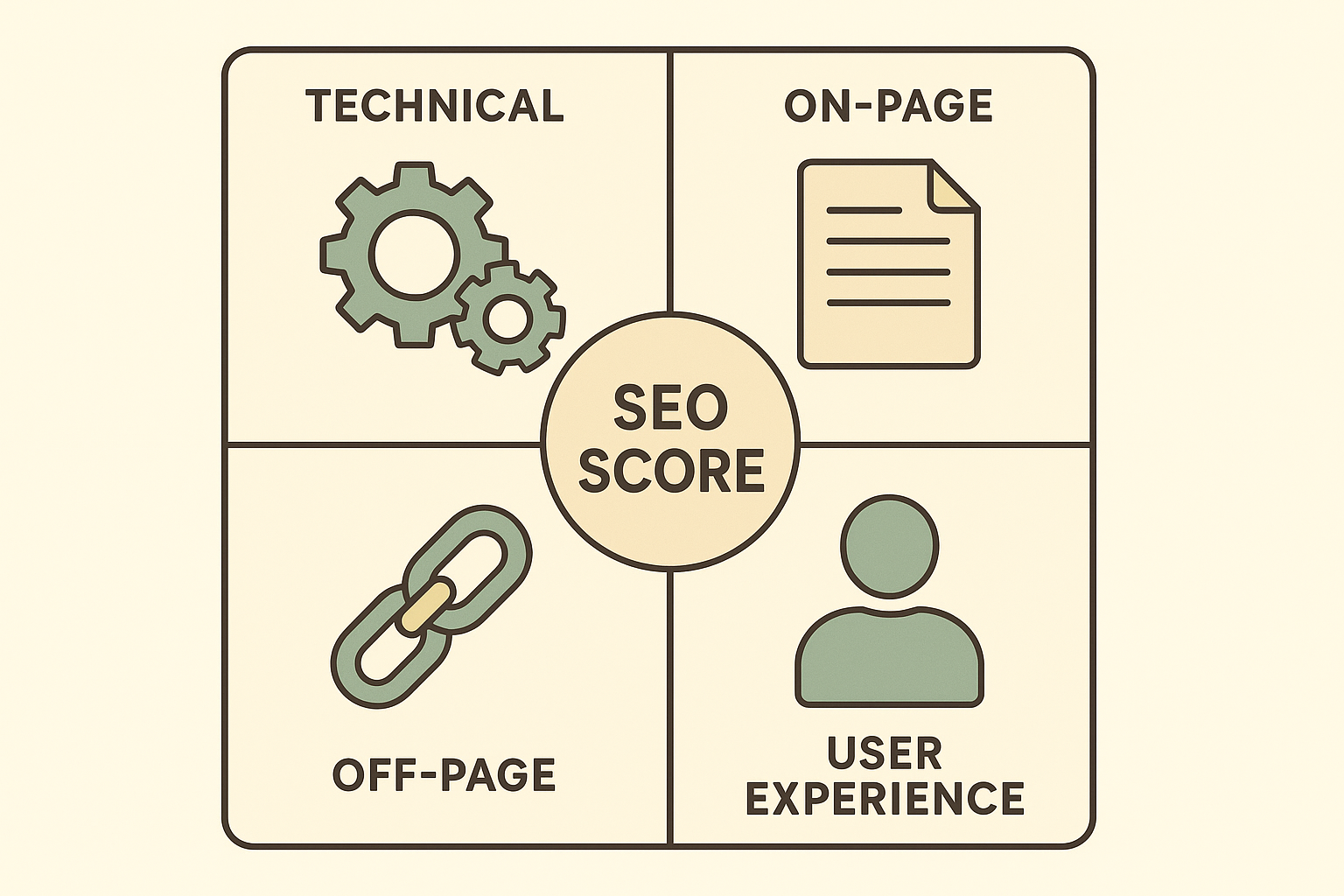
The four pillars — technical, on-page, off-page, and UX — all contribute to your overall SEO score.
Which Tools Measure a Good SEO Score — And How They Differ
No single tool owns the definitive SEO score. Each platform measures a specific slice of your site’s health, and consequently, you will get different numbers from different tools. That is normal — and expected. Here is a detailed breakdown of how the most widely used platforms approach measurement. For a deeper walkthrough, see our How to Get Keywords From a Website (Complete Guide).
How to Interpret Different Scores From Different Tools
A common point of confusion is that your Semrush score might be 84 while your Ahrefs score is 71 for the same site. This does not mean one tool is wrong. In fact, it means each tool is measuring a different dimension. Semrush’s Site Health Score focuses on the proportion of critical and warning-level errors. Ahrefs’ Health Score, however, focuses specifically on the percentage of crawled pages that return no HTTP errors.
Therefore, the most reliable approach is to track one primary tool consistently over time rather than jumping between platforms. Use Google Search Console alongside your chosen paid tool, since GSC provides ground-truth data directly from Google about how your site is being crawled and indexed.
How to Improve Your Good SEO Score: 8 Actionable Steps
Raising your score from moderate to genuinely good is a systematic process. Follow these eight steps in priority order to see the fastest, most durable gains — each one is sequenced so that earlier actions amplify the impact of later ones.
-
01
Run a Full SEO Audit
Use Semrush Site Audit, Ahrefs Site Audit, or Screaming Frog to crawl your entire site and establish a baseline score. You cannot improve what you have not measured. Document every error, warning, and notice before changing anything. Specifically, export your results to a spreadsheet and sort by severity so you can tackle high-impact issues first.
-
02
Resolve Critical Technical Errors First
Broken links, missing canonical tags (the HTML tag that tells search engines which version of a page is the preferred one), duplicate content, 4xx errors (page not found), and blocked crawl paths carry the heaviest score penalties. As a result, resolving these issues produces the fastest score improvement. Fix them before touching content-level optimisations.
-
03
Optimise Every On-Page Element
Every page needs a unique, keyword-rich title tag (50–60 characters), a compelling meta description (120–156 characters), a logical heading hierarchy (one H1, multiple H2s and H3s), and content that genuinely satisfies user intent. Furthermore, ensure every image has a descriptive alt attribute and that your internal linking structure distributes link equity to important pages. Missing or duplicate meta tags alone can reduce a site’s score by 10–15 points.
-
04
Improve Page Speed and Core Web Vitals
Run every key page through Google PageSpeed Insights. Compress and serve images in next-gen formats (WebP and AVIF use significantly less bandwidth than JPEG). Enable browser caching, defer non-critical JavaScript, and use a CDN (Content Delivery Network — a global network of servers that delivers pages faster to users worldwide). Aim for LCP under 2.5 seconds, INP under 200 milliseconds, and CLS below 0.1.
-
05
Conduct a Content Depth Audit
Thin content — pages with fewer than 300 words that offer little unique value — actively suppresses your score and your rankings. Identify your weakest pages using Google Search Console’s Performance report (filter by pages with impressions but low click-through rates). Then either expand them with genuinely useful information or consolidate them into stronger, longer pages. In particular, focus on matching search intent: informational queries need comprehensive guides, while transactional queries need clear, action-oriented content.
-
06
Strengthen Your Internal Linking Structure
Internal links pass authority between your own pages and help search engines understand your site’s topical structure. Specifically, ensure your most important pages (product pages, service pages, cornerstone content) receive links from multiple other pages on your site. Use descriptive anchor text — the clickable text of a link — that reflects the target page’s keyword focus. This signals relevance to Google and improves crawl efficiency.
-
07
Build Quality Backlinks Strategically
Authority-based scoring tools weight your link profile heavily. Focus on earning links from topically relevant, high-authority domains through original research, data-driven content, and digital PR campaigns. In contrast, avoid link schemes and paid links — Google’s algorithms detect and devalue them. A handful of genuine links from authoritative sources outperforms hundreds of low-quality directory links. Track your referring domains monthly to monitor growth.
-
08
Monitor and Iterate Every Month
SEO is not a one-time project. Schedule monthly audits to catch regressions caused by CMS updates, new content, or algorithm shifts. Tracking your score consistently over time reveals whether your efforts are compounding — which they should be if your strategy is sound. After major site changes such as redesigns or URL migrations, audit immediately to prevent silent ranking drops.

Regular audits are the foundation of maintaining and improving your website’s SEO score over time.
Good SEO Score vs. High Rankings: What’s the Real Relationship?
One of the most important distinctions in SEO is understanding that a high score does not directly cause high rankings — it signals that the conditions for high rankings are in place. Google’s algorithm evaluates over 200 factors, and many of them are not captured by any single audit score.
Consequently, a site can achieve a score of 90 and still rank poorly if its content does not satisfy search intent, its domain has no authority in its niche, or its competitors have substantially stronger backlink profiles. Conversely, a site with a score of 75 can outrank a score-90 competitor by having significantly better content and more authoritative links.
Therefore, the right way to use your SEO score is as a diagnostic tool — a measure of technical readiness — rather than a proxy for ranking performance. Think of it as a health check. Above 80, your site is healthy enough to compete. Below 80, technical barriers are likely limiting how high Google is willing to rank your pages regardless of content quality.
The Score–Rankings Relationship in Practice
Research consistently shows that pages in Google’s top three positions share high technical health scores. However, the score alone explains only part of the picture. Above all, content relevance — how well a page matches the specific intent behind a search query — and domain authority (the accumulated trust and link equity a domain has built over time) are the dominant ranking drivers once technical health is adequate.
In other words: fix your score to remove the ceiling on your rankings. Then invest in content quality and link acquisition to push through it.
Common Reasons Your SEO Score Is Stuck Below 80
Many sites plateau in the 60–75 range despite ongoing optimisation efforts. In most cases, a small number of specific issues are responsible. Here are the most common blockers — and how to address each one.
-
🔴 Excessive 3xx Redirects
Redirect chains — where URL A redirects to URL B, which redirects to URL C — dilute link equity and slow down crawl. Consolidate all redirect chains to single hops wherever possible.
-
🔴 Missing or Duplicate Title Tags and Meta Descriptions
These are the most frequently flagged on-page issues in any audit. Every page must have a unique, descriptive title and meta description. Even a single missing title tag on a high-traffic page can notably drag down your score.
-
🔴 Low Page Speed Scores
A Google PageSpeed score below 50 on mobile is one of the single biggest score suppressors. In particular, unoptimised images and render-blocking JavaScript are the primary culprits. Addressing these two issues alone frequently moves a score from poor to moderate.
-
🔴 Crawl Budget Wastage
Crawl budget refers to the number of pages Googlebot will crawl on your site within a given timeframe. Wasting it on paginated archives, faceted navigation URLs, or thin auto-generated pages prevents your valuable content from being crawled and indexed efficiently. Use robots.txt and noindex tags strategically.
-
🔴 Orphan Pages
Orphan pages — pages with no internal links pointing to them — are nearly invisible to search engines. They receive no crawl priority and no link equity. Identify them with a site crawl and add relevant internal links from existing content.
How Long Does It Take to Improve Your SEO Score?
A realistic timeline is essential for setting the right expectations with stakeholders and clients. The speed at which your score improves depends on three variables: the severity of current issues, the size of your site, and how quickly you can implement changes.
It is worth noting that score changes often lag behind the actual work by two to four weeks, because audit tools re-crawl your site on a schedule. Similarly, ranking improvements may lag behind score improvements by a further four to eight weeks as Google re-evaluates your pages. Plan accordingly — SEO is a medium-term investment, not a quick fix.

Consistent optimisation compounds over time, pushing your score steadily into the excellent range.
Frequently Asked Questions About Good SEO Scores
What is a good SEO score for a new website?
New sites typically score 40–60 initially due to thin content, limited backlinks, and unresolved technical issues. Realistically, aim to reach 70+ within your first three months by resolving technical errors and building foundational on-page optimisation. A score of 80+ becomes achievable by month six with consistent effort. However, prioritise fixing technical errors before content — a clean technical foundation multiplies the impact of every content investment you make.
What SEO score do I need to rank on page one of Google?
No score guarantees a page-one position — Google’s algorithm weighs hundreds of signals. However, sites with a good SEO score of 80 or above, combined with relevant, expert content and quality backlinks, statistically outperform lower-scoring competitors in most niches. Think of 80 as the entry ticket: it clears technical obstacles and lets your content and authority compete on equal footing.
How often should I check my SEO score?
Run a full site audit at least once per month. Additionally, after major site changes — redesigns, URL migrations, plugin updates, or large content pushes — audit immediately. Catching a technical regression within days rather than weeks can prevent significant ranking drops. Set up automated alerts in your chosen audit tool to flag critical new errors as soon as they appear.
Is a 100 SEO score possible or even necessary?
A perfect 100 is theoretically achievable on some tools but practically unnecessary. Even the highest-ranking pages on Google rarely score 100 across all dimensions. Prioritise reaching and sustaining 85–95, then direct your energy toward content quality and link acquisition rather than chasing a perfect number. Above 90, marginal score gains produce diminishing returns compared to content and authority investments.
Why do different SEO tools give me different scores?
Each tool measures different dimensions of site health using different methodologies and crawl depths. For example, Semrush weights its score toward the ratio of errors and warnings found across all crawled pages, while Ahrefs focuses specifically on the percentage of pages returning no HTTP errors. Consequently, a score of 84 from Semrush and 70 from Ahrefs for the same site is completely normal. Pick one primary tool and track consistently over time rather than comparing numbers across platforms.
Can a high SEO score hurt my rankings?
No — a genuinely high SEO score cannot directly hurt rankings. However, over-optimisation of individual on-page elements — for example, forcing keywords into every heading or writing unnaturally repetitive anchor text — can trigger algorithmic quality filters. The key is optimisation that serves users first. When your score rises because you have genuinely improved user experience, content quality, and technical health, the ranking benefits are durable and compound over time.
Conclusion: What a Good SEO Score Really Means for Your Site
Achieving a good SEO score is not the end goal — it is a reliable signal that you have built the technical and structural foundation search engines need to trust, crawl, and rank your site confidently. A score of 80 or above tells you that your infrastructure is sound, your content is properly structured, and your pages are positioned to earn the visibility they deserve.
However, the most important thing to understand is that your score is a lagging indicator. The work you do today — fixing crawl errors, refining metadata, accelerating pages, strengthening internal links, and earning quality backlinks — will first appear in your score weeks later, then in your rankings weeks after that. Consistency, therefore, beats intensity every single time in SEO.
For a deeper, hands-on analysis of your site’s current performance and a prioritised roadmap to reach and sustain a genuinely good SEO score, RankAuthority provides expert audits and strategy tailored to your competitive landscape. Whether you are starting from scratch or pushing past a plateau, having the right data and the right plan makes all the difference.
Key Takeaways
- A good SEO score is 80–100 on most audit tools
- Technical, on-page, off-page, and UX factors all contribute to your rating
- Different tools measure different dimensions — track one tool consistently
- Fix critical technical errors first — they produce the fastest score gains
- Page speed and Core Web Vitals are confirmed Google ranking factors
- Content depth and internal linking are frequently overlooked score levers
- Audit monthly — and immediately after any major site change
- Score is your foundation; content quality and backlinks drive rankings
Resources referenced:
RankAuthority ·
Google Search Console ·
Google PageSpeed Insights ·
Core Web Vitals — Wikipedia

